Supreme Court: Calling Someone **‘Motherfker’** Alone Does Not Amount to Obscenity Under IPC; Mere Abuse Is Not a Criminal Offence Under Section 294
Lexpedia News · 18 July 2026 · 10 min read
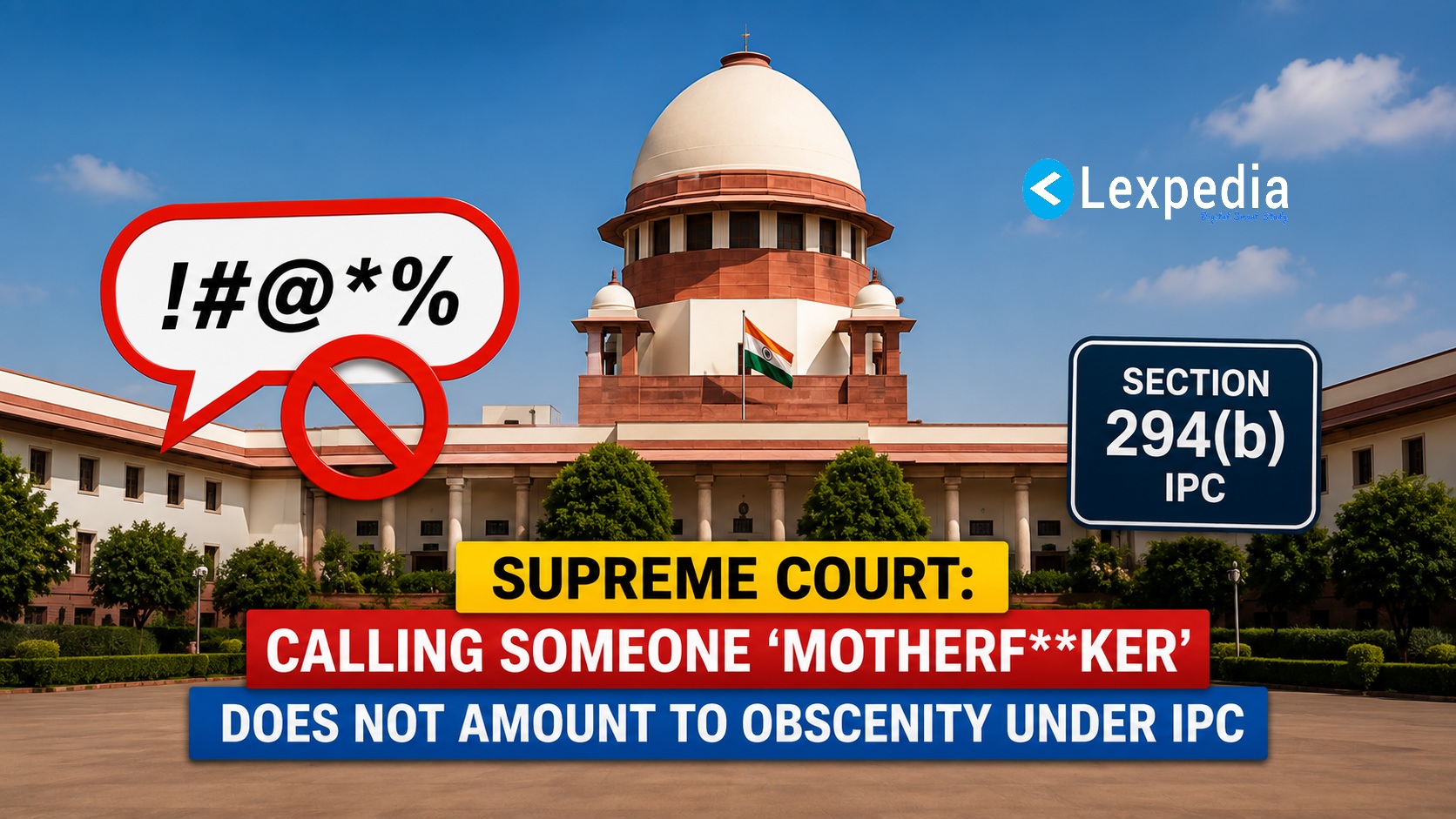
In a significant judgment clarifying the legal distinction between obscenity and abusive or vulgar language, the Supreme Court of India has ruled that merely calling someone a "motherfker," "son of a whore,"** or using similarly offensive expletives does not automatically constitute the offence of obscenity under Section 294(b) of the Indian Penal Code, 1860 (IPC).
The judgment, delivered by a Bench comprising Justice Sanjay Karol and Justice Vipul M. Pancholi in Mani @ Subramaniyam v. State represented by the Deputy Superintendent of Police, emphasizes that while such expressions are undoubtedly offensive, rude and uncivil, they cannot be treated as "obscene" in law unless they satisfy the legal tests of obscenity prescribed by judicial precedents and the statute. The decision was pronounced on July 17, 2026.
The Court partly allowed the criminal appeal, setting aside the appellant's conviction under Sections 294(b) and 506(ii) IPC, while affirming his conviction for voluntarily causing grievous hurt by dangerous weapon under Section 326 IPC. However, considering the appellant's advanced age (around 70 years), health condition and the fact that the incident arose out of a land dispute, the Court substantially modified the sentence by directing imprisonment till the rising of the Court along with payment of ₹50,000 as fine within two months.
The case arose from an incident that occurred in Tamil Nadu in August 2017. According to the prosecution, the dispute originated over agricultural land between the appellant and the complainant's family. During the altercation, the appellant allegedly abused the complainant using offensive expressions, uttered caste-based insults and later assaulted him with a billhook, causing multiple injuries including a fracture of the nasal bone. Following investigation, charges were framed under the IPC as well as the Scheduled Castes and Scheduled Tribes (Prevention of Atrocities) Act.
The Trial Court convicted the accused under the IPC and the SC/ST Act. Subsequently, the Madras High Court acquitted him of offences under the SC/ST Act but maintained his conviction under Sections 294(b), 326 and 506(ii) IPC, while reducing the sentence. Neither the State nor the complainant challenged the acquittal under the SC/ST Act before the Supreme Court.
The principal issue before the Supreme Court was whether the abusive expressions allegedly used by the appellant amounted to "obscene words" punishable under Section 294(b) IPC.
After examining decades of constitutional and criminal jurisprudence on obscenity, the Court held that the expression "obscene" has a distinct legal meaning and cannot be equated with vulgarity, profanity or abusive language.
The Bench observed that legally, obscenity is not synonymous with vulgarity or abuse. Mere swear words, however offensive or distasteful, do not automatically become obscene merely because they contain sexual references or profanities. Instead, the prosecution must establish that the impugned words are lascivious, appeal to prurient interests, and have the tendency to deprave or corrupt persons exposed to them. In addition, it must also be shown that such words caused annoyance to others in or near a public place, which is an essential ingredient of Section 294 IPC.
The Court categorically observed:
"Legally, obscenity is not synonymous with vulgarity, abuse or profanity."
Referring to the abusive expressions allegedly used in the present case—"Hey Motherf**ker! You son of a whore!..."—the Bench held that these words, though highly offensive and insulting, were at best abusive or vulgar and did not satisfy the statutory requirements of obscenity. There was nothing on record to indicate that the language had any lascivious element, appealed to sexual instincts, or had any tendency to corrupt or deprave the minds of listeners. The prosecution had also failed to establish that the alleged words caused annoyance to members of the public, another mandatory ingredient of the offence under Section 294(b). Accordingly, the conviction under that provision was set aside.
While explaining the legal principles governing obscenity, the Court relied upon several landmark judgments including Ranjit D. Udeshi v. State of Maharashtra, Samaresh Bose v. Amal Mitra, Aveek Sarkar v. State of West Bengal, S. Khushboo v. Kanniammal, N.S. Madhanagopal v. K. Lalitha and Apoorva Arora v. State (NCT of Delhi). The Court reiterated that community standards, the overall context of the expression and its tendency to arouse lustful or prurient thoughts remain the accepted legal tests for determining obscenity in India.
The Bench also set aside the appellant's conviction under Section 506(ii) IPC relating to criminal intimidation. According to the Court, the mere use of threatening words during a quarrel is insufficient to constitute criminal intimidation unless the prosecution proves that the threat was intentionally made to cause alarm or compel the victim to perform or omit a legally significant act. Since the evidence on record did not establish such intention, the conviction under Section 506(ii) could not be sustained.
However, the Supreme Court affirmed the conviction under Section 326 IPC. Medical evidence established that the complainant had suffered a fracture of the nasal bone, which squarely falls within the definition of grievous hurt under Section 320 IPC. The Court held that the injury had been inflicted using a billhook, which is unquestionably a dangerous weapon. The testimony of eyewitnesses was corroborated by medical evidence, leaving no reason to interfere with the conviction for grievous hurt.
While maintaining the conviction, the Bench substantially reduced the sentence after considering mitigating circumstances. Observing that the incident arose from a private land dispute, that there was no previous criminal history placed on record, and that the appellant was an elderly person suffering from health issues, the Court directed that he undergo imprisonment till the rising of the Court and deposit ₹50,000 as fine within two months.
The judgment is expected to serve as an important precedent in cases involving allegations of obscenity arising solely from abusive language. It reiterates that criminal law cannot be invoked merely because words are offensive or indecent, and that courts must distinguish between vulgarity, profanity, and legal obscenity by applying established constitutional and statutory standards. At the same time, the Court clarified that abusive language may still attract liability under other penal provisions if the statutory ingredients of those offences are independently established.
सुप्रीम कोर्ट का महत्वपूर्ण फैसला: केवल **'Motherfker'** कह देना अश्लीलता नहीं, गाली-गलौज मात्र से IPC की धारा 294 का अपराध नहीं बनता
सुप्रीम कोर्ट ने अश्लीलता (Obscenity) और अशिष्ट अथवा अभद्र भाषा (Vulgar or Abusive Language) के बीच स्पष्ट कानूनी अंतर स्थापित करते हुए महत्वपूर्ण निर्णय दिया है कि किसी व्यक्ति को "Motherfker", "Son of a Whore"** जैसी गालियां देना अपने-आप में भारतीय दंड संहिता, 1860 (IPC) की धारा 294(b) के तहत अश्लीलता का अपराध नहीं बनता।
न्यायमूर्ति संजय करोल और न्यायमूर्ति विपुल एम. पंचोली की पीठ ने Mani @ Subramaniyam v. State represented by the Deputy Superintendent of Police मामले में यह स्पष्ट किया कि ऐसी भाषा निस्संदेह अपमानजनक, असभ्य और अभद्र हो सकती है, किन्तु जब तक वह कानून द्वारा निर्धारित अश्लीलता की कसौटियों को पूरा नहीं करती, तब तक उसे धारा 294 IPC के तहत दंडनीय नहीं माना जा सकता। यह निर्णय 17 जुलाई 2026 को सुनाया गया।
सुप्रीम कोर्ट ने अपील को आंशिक रूप से स्वीकार करते हुए आरोपी की धारा 294(b) तथा धारा 506(ii) IPC के अंतर्गत हुई दोषसिद्धि को निरस्त कर दिया, जबकि धारा 326 IPC के तहत खतरनाक हथियार से गंभीर चोट पहुंचाने के अपराध में दोषसिद्धि को बरकरार रखा। हालांकि, आरोपी की लगभग 70 वर्ष की आयु, स्वास्थ्य स्थिति तथा यह तथ्य कि विवाद भूमि विवाद से उत्पन्न हुआ था, को देखते हुए न्यायालय ने सजा में महत्वपूर्ण राहत देते हुए केवल अदालत उठने तक का कारावास (Till Rising of the Court) तथा ₹50,000 का जुर्माना दो माह के भीतर जमा कराने का निर्देश दिया।
यह मामला वर्ष 2017 में तमिलनाडु में हुए एक भूमि विवाद से जुड़ा था। अभियोजन के अनुसार आरोपी ने शिकायतकर्ता के साथ विवाद के दौरान अभद्र भाषा का प्रयोग किया, कथित जातिसूचक शब्द कहे तथा बाद में बिलहुक (Billhook) से हमला कर शिकायतकर्ता की नाक की हड्डी सहित कई चोटें पहुंचाईं। इस आधार पर IPC तथा अनुसूचित जाति एवं अनुसूचित जनजाति (अत्याचार निवारण) अधिनियम के तहत मामला दर्ज किया गया।
विचारण न्यायालय ने आरोपी को IPC तथा SC/ST Act दोनों के अंतर्गत दोषी ठहराया था। बाद में मद्रास उच्च न्यायालय ने SC/ST Act के आरोपों से आरोपी को बरी कर दिया, किन्तु IPC की धाराओं 294(b), 326 और 506(ii) के अंतर्गत दोषसिद्धि को बनाए रखा। इस बरी किए जाने के विरुद्ध न तो राज्य सरकार और न ही शिकायतकर्ता ने सुप्रीम कोर्ट में कोई अपील दायर की।
सुप्रीम कोर्ट के समक्ष मुख्य प्रश्न यह था कि क्या आरोपी द्वारा कथित रूप से कही गई गालियां धारा 294(b) IPC के अंतर्गत "अश्लील शब्द" मानी जा सकती हैं।
न्यायालय ने दशकों से विकसित न्यायिक दृष्टांतों का विश्लेषण करते हुए कहा कि "अश्लीलता" का विधिक अर्थ गाली-गलौज, अभद्रता या अशिष्टता से अलग है।
पीठ ने स्पष्ट कहा कि केवल अपमानजनक या यौन संदर्भ वाले शब्दों का प्रयोग पर्याप्त नहीं है। अभियोजन को यह सिद्ध करना होगा कि संबंधित शब्द कामुक (Lascivious) हों, कामोत्तेजक (Prurient Interest) हों तथा उन्हें सुनने वालों के मन को भ्रष्ट या विकृत करने की प्रवृत्ति रखते हों। इसके अतिरिक्त यह भी सिद्ध करना आवश्यक है कि ऐसे शब्दों से सार्वजनिक स्थान पर अन्य लोगों को वास्तविक रूप से परेशानी (Annoyance) हुई हो, जो धारा 294 का अनिवार्य तत्व है।
न्यायालय ने स्पष्ट शब्दों में कहा:
"विधिक दृष्टि से अश्लीलता, अभद्रता, गाली-गलौज अथवा प्रोफैनिटी (Profanity) के समान नहीं है।"
पीठ ने पाया कि इस मामले में आरोपी द्वारा कथित रूप से प्रयुक्त "Motherfker", "Son of a Whore"** जैसे शब्द अत्यधिक अपमानजनक अवश्य हैं, परन्तु वे अधिकतम अभद्र अथवा अशिष्ट भाषा की श्रेणी में आते हैं। अभियोजन यह सिद्ध नहीं कर सका कि इन शब्दों में कोई कामुक तत्व था, वे यौन उत्तेजना उत्पन्न करते थे अथवा उन्हें सुनकर किसी के मन के भ्रष्ट होने की संभावना थी। साथ ही यह भी सिद्ध नहीं किया गया कि इन शब्दों से सार्वजनिक स्थान पर अन्य लोगों को कोई वास्तविक परेशानी हुई। इसलिए धारा 294(b) IPC के अंतर्गत दोषसिद्धि को निरस्त कर दिया गया।
निर्णय में सुप्रीम कोर्ट ने Ranjit D. Udeshi, Samaresh Bose, Aveek Sarkar, S. Khushboo, N.S. Madhanagopal तथा Apoorva Arora सहित अनेक महत्वपूर्ण निर्णयों का उल्लेख करते हुए दोहराया कि भारत में समकालीन सामुदायिक मानक (Community Standards), अभिव्यक्ति का समग्र संदर्भ, तथा उसका कामोत्तेजक प्रभाव ही अश्लीलता निर्धारित करने की प्रमुख कसौटियां हैं।
सुप्रीम कोर्ट ने आरोपी की धारा 506(ii) IPC के अंतर्गत हुई दोषसिद्धि भी समाप्त कर दी। न्यायालय ने कहा कि केवल झगड़े के दौरान धमकी भरे शब्द बोल देना पर्याप्त नहीं है। अभियोजन को यह सिद्ध करना होगा कि आरोपी ने जानबूझकर शिकायतकर्ता में भय उत्पन्न करने या उसे किसी कार्य के लिए विवश करने का उद्देश्य रखा था। रिकॉर्ड पर ऐसा कोई पर्याप्त साक्ष्य उपलब्ध नहीं था।
हालांकि न्यायालय ने धारा 326 IPC के अंतर्गत दोषसिद्धि को बरकरार रखा। चिकित्सा साक्ष्यों से सिद्ध हुआ कि शिकायतकर्ता की नाक की हड्डी टूट गई थी, जो धारा 320 IPC के अनुसार गंभीर चोट (Grievous Hurt) की श्रेणी में आती है। यह भी सिद्ध हुआ कि चोट बिलहुक जैसे खतरनाक हथियार से पहुंचाई गई थी। प्रत्यक्षदर्शी गवाहों की गवाही का चिकित्सीय साक्ष्य से पूरा समर्थन हुआ।
सजा में राहत देते हुए सुप्रीम कोर्ट ने कहा कि घटना भूमि विवाद से उत्पन्न हुई थी, आरोपी वृद्ध है तथा उसकी स्वास्थ्य स्थिति भी ध्यान में रखने योग्य है। इसलिए उसे केवल अदालत उठने तक का कारावास भुगतना होगा तथा ₹50,000 का जुर्माना दो माह के भीतर जमा करना होगा।
यह निर्णय भविष्य में उन मामलों के लिए महत्वपूर्ण मिसाल माना जाएगा जिनमें केवल गाली-गलौज या अभद्र भाषा के आधार पर धारा 294 IPC के तहत अभियोजन चलाया जाता है। सुप्रीम कोर्ट ने स्पष्ट किया है कि हर अपमानजनक शब्द कानून की दृष्टि में अश्लील नहीं होता, और न्यायालयों को अभद्रता (Vulgarity), गाली-गलौज (Profanity) तथा विधिक अश्लीलता (Legal Obscenity) के बीच स्पष्ट अंतर बनाए रखना होगा।