
Latest JudgementCode of Civil Procedure, 1908
K. Bharathamma v. Bandaru Sakku Bai & Others, 2026
Court's Power to Recall Witnesses under Order XVIII Rule 17 CPC
Supreme Court of India·6 August 2026
Judgement Details
Court
Supreme Court of India
Date of Decision
6 August 2026
Judges
Justice S.V.N. Bhatti & Justice N.V. Anjaria
Citation
Acts / Provisions
Order XVIII Rule 17, Code of Civil Procedure, 1908 (CPC),
Section 115, Code of Civil Procedure, 1908,
Order XVIII Rule 17A CPC (Deleted)
Facts of the Case
- The dispute arose from a civil suit pending before the Trial Court in Telangana. During the course of the trial, the plaintiffs examined PW-1 and their evidence was substantially completed. At a later stage of the proceedings, they filed an application under Order XVIII Rule 17 CPC seeking to recall PW-1, reopen the evidence, mark additional documents, and permit further cross-examination.
- The Trial Court allowed the application. The defendants challenged the order before the Telangana High Court, which modified the Trial Court's order and directed that PW-1 be recalled, the documents be exhibited, and cross-examination be completed within a stipulated time.
- Aggrieved by the High Court's order, the defendants approached the Supreme Court, contending that Order XVIII Rule 17 CPC does not authorize reopening of evidence for the purpose of filling gaps or curing deficiencies in a party's case.
Issues
- Whether Order XVIII Rule 17 CPC permits the reopening of evidence and recall of a witness for further examination or cross-examination at the instance of a party.
- Whether the High Court exceeded its revisional jurisdiction by directing reopening of evidence and recall of PW-1.
- Whether the absence of prejudice to the opposite party is sufficient to invoke the power under Order XVIII Rule 17 CPC.
- Whether Order XVIII Rule 17 CPC can be used to fill omissions or lacunae in the evidence already adduced by a party.
Judgement
- The Supreme Court allowed the appeal and held that the Telangana High Court had committed a legal error by permitting reopening of evidence under Order XVIII Rule 17 CPC.
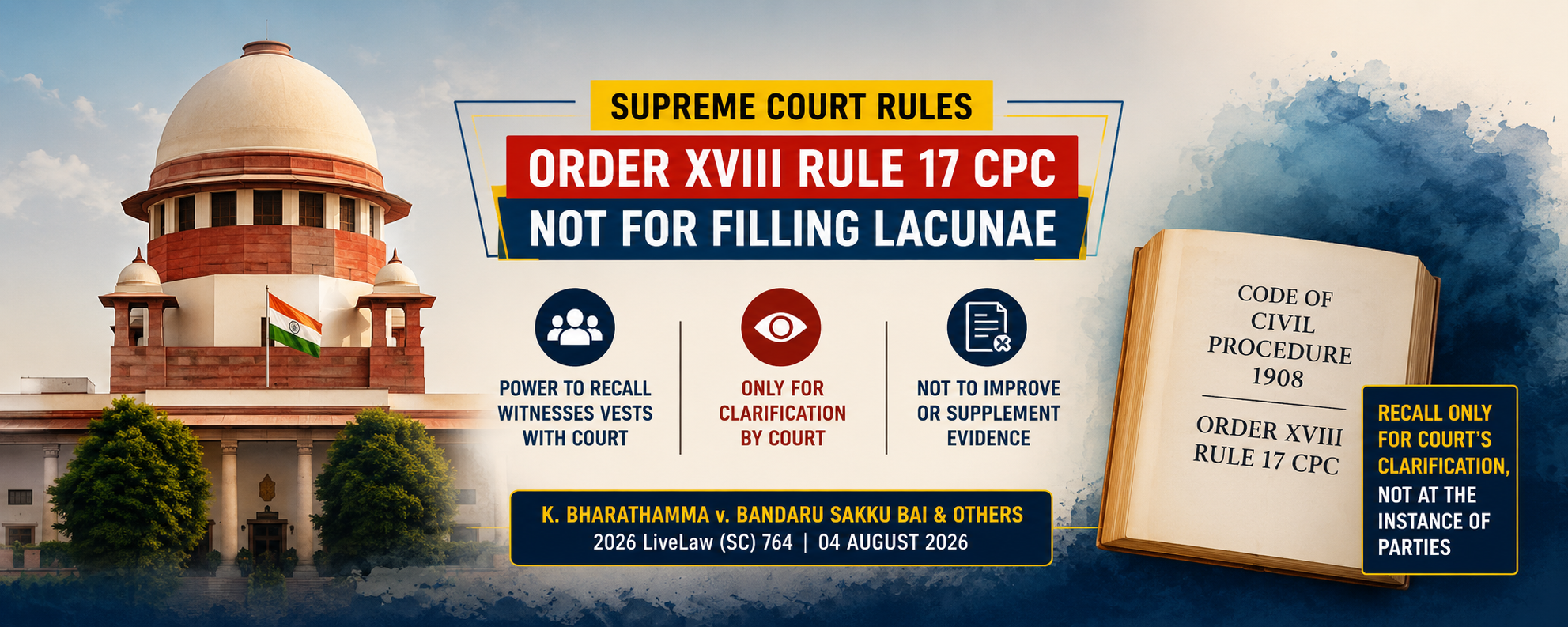
- The Court reiterated that the object of Order XVIII Rule 17 CPC is limited. The provision empowers the Court to recall a witness only when it requires clarification regarding the evidence already recorded. It does not create a right in favour of any party to reopen evidence, produce additional material, or conduct further examination or cross-examination after the evidence has concluded.
- The Court emphasized that Order XVIII Rule 17 CPC cannot be invoked to cure defects, fill omissions, or improve the evidence already led. It also observed that the deletion of Order XVIII Rule 17A CPC, which earlier permitted production of additional evidence under certain circumstances, clearly indicates the legislative intent to restrict such applications.
- Relying upon Vadiraj Naggappa Vernekar and K.K. Velusamy, the Court held that the power under Rule 17 is discretionary, belongs exclusively to the Court, and should be exercised sparingly only when judicial clarification is necessary.
- The Court further clarified that the mere fact that reopening of evidence may not prejudice the opposite party cannot justify invocation of Rule 17. There must exist an independent judicial necessity before such power can be exercised.
- Consequently, the High Court's order permitting recall of PW-1 and reopening of evidence was set aside.
Held
- The appeal was allowed.
- The order passed by the Telangana High Court was set aside.
- Order XVIII Rule 17 CPC empowers only the Court to recall a witness for clarification of evidence.
- The provision cannot be used by parties to reopen evidence, conduct further cross-examination, or fill omissions and lacunae in the evidence already recorded.
Analysis
- This judgment is a significant reaffirmation of the limited scope of Order XVIII Rule 17 CPC and reinforces the principle that procedural provisions should not be misused to prolong litigation or strengthen a weak case after evidence has been concluded.
- The Supreme Court carefully distinguished between the Court's power to seek clarification and a litigant's attempt to improve its own evidence. It emphasized that Rule 17 is a judicial tool intended solely to assist the Court in arriving at a correct decision where clarification of existing evidence is genuinely required.
- The Court relied upon earlier precedents, particularly Vadiraj Naggappa Vernekar and K.K. Velusamy, to reiterate that Rule 17 cannot be used as a substitute for the deleted Order XVIII Rule 17A CPC. This interpretation preserves the legislative intent behind deleting Rule 17A and prevents parties from circumventing procedural limitations.
- Another important aspect of the judgment is the Court's observation that absence of prejudice to the opposite party is not an independent ground for recalling a witness. Instead, the Court held that there must be a genuine judicial necessity for clarification before Rule 17 can be invoked.
- The decision strengthens procedural discipline in civil trials by discouraging repeated applications for reopening evidence after parties have completed their examination. It promotes judicial efficiency, ensures certainty in trial proceedings, and protects litigants from unnecessary delays caused by repeated attempts to improve evidence.
- Overall, the judgment serves as an authoritative precedent clarifying that Order XVIII Rule 17 CPC is a discretionary power vested in the Court and not a procedural right available to litigants for curing defects or filling gaps in their evidence.