
XXX v. State of Punjab & Others, 2026
By holding that a Habeas Corpus petition is maintainable in child custody disputes, the Court reaffirmed the availability of a speedy constitutional remedy where illegal or unjustified custody is alleged.
Judgement Details
Court
Punjab and Haryana High Court
Date of Decision
15 July 2026
Judges
Justice Jasjit Singh Bedi
Citation
Acts / Provisions
Facts of the Case
-
The petitioner married her husband in August 2021, after which the couple sought protection of their life and liberty from the District and Sessions Judge, Amritsar.
-
A son, Yuvrajpreet Singh, was born to the couple on 12 May 2023.
-
According to the petitioner, she was subjected to harassment for dowry by her husband's relatives soon after the marriage.
-
She alleged that her husband, who was addicted to drugs, later went to Dubai for employment.
-
The petitioner claimed that she was forced to leave the matrimonial home along with her minor son due to harassment.
-
She further alleged that her husband threatened to have her father and brother killed, compelling her to return to the matrimonial home out of fear.
-
The petitioner contended that after she was driven out of the matrimonial home, her in-laws illegally retained the custody of her three-year-old son.
-
She filed a writ petition seeking Habeas Corpus for restoration of the child's custody.
-
The respondents argued that the child was receiving proper education and care, that the petitioner had no female family member to support her after her mother's death, and that her pregnancy and financial dependence made her incapable of looking after the child.
-
The respondents also contended that the proper remedy was under the Hindu Minority and Guardianship Act, 1956 or the Guardians and Wards Act, 1890, and not through a writ of Habeas Corpus.
-
Mediation between the parties failed, and the matter was decided by the High Court.
Issues
-
Whether a writ of Habeas Corpus is maintainable at the instance of a parent seeking custody of a minor child from the other parent or relatives?
-
Whether the custody of a child below five years should ordinarily remain with the mother unless she is shown to be wholly unsuitable?
-
Whether the petitioner's pregnancy and financial dependence rendered her unsuitable to retain custody of her three-year-old son?
-
Whether the welfare of the child required that custody be restored to the mother?
Judgement
-
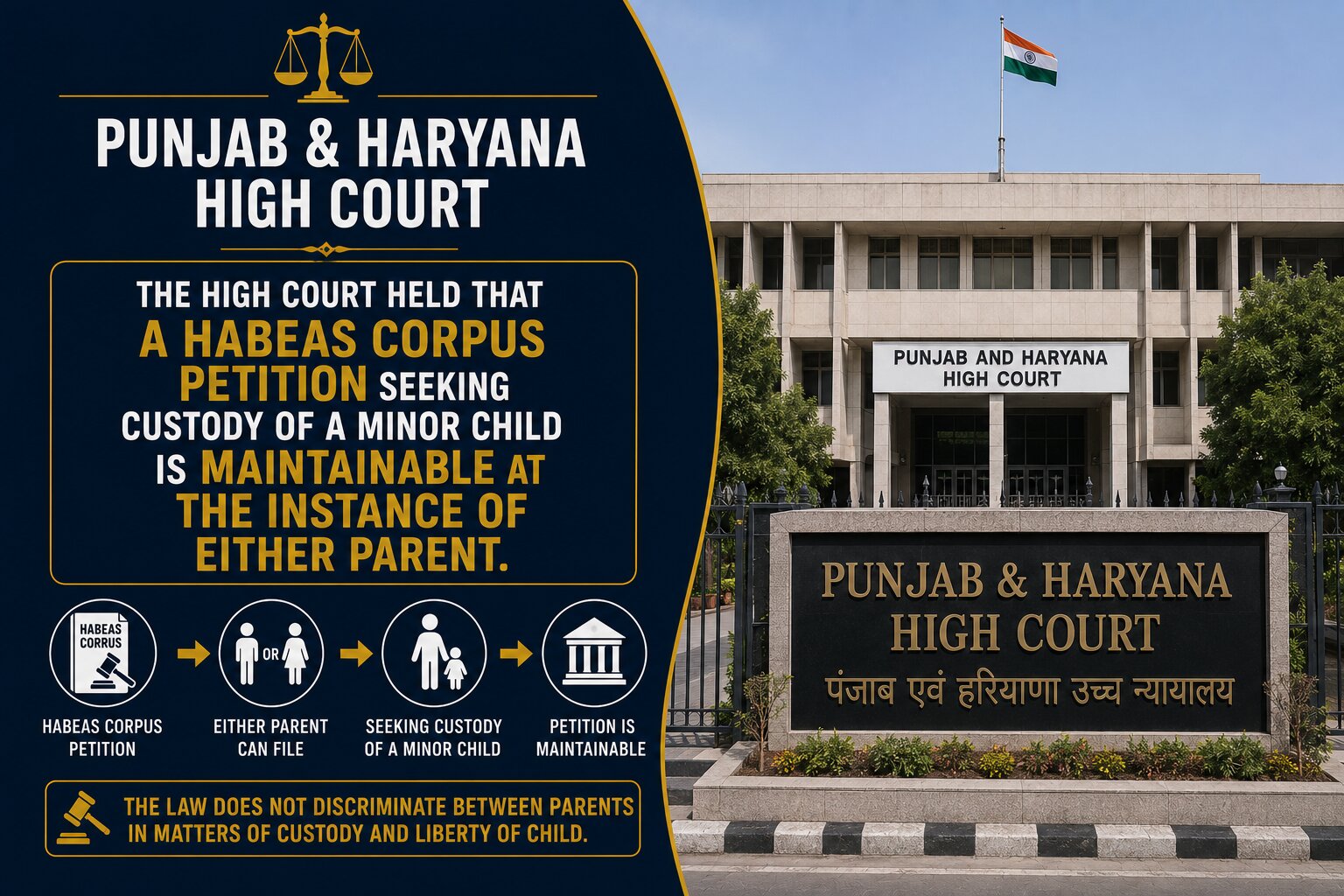
The High Court held that a Habeas Corpus petition seeking custody of a minor child is maintainable at the instance of either parent.
-
The Court reiterated that the welfare of the child is the paramount consideration in deciding custody disputes.
-
Referring to Section 6 of the Hindu Minority and Guardianship Act, 1956, the Court observed that although the father is the natural guardian, the custody of a child below five years of age shall ordinarily remain with the mother.
-
The Court found no material to establish that the petitioner was wholly unsuitable to care for her son.
-
The Court rejected the respondents' contention that the petitioner's pregnancy and financial dependence constituted sufficient grounds to deny her custody.
-
The Court observed that depriving a pregnant mother of the custody of her first-born child would amount to grave cruelty.
-
The Court held that no other family member, including the father, grandmother, uncles, or aunts, could substitute the care and affection ordinarily provided by the mother.
-
The Court allowed the Habeas Corpus petition and directed the respondents to hand over the custody of the minor child to the petitioner immediately.
-
The Senior Superintendent of Police was directed to ensure compliance with the order and submit a compliance affidavit within one week after custody was handed over.
-
The Court clarified that the father would be entitled to reasonable access and visitation, subject to the convenience of the parties and the welfare of the child.
Held
-
A Habeas Corpus petition for child custody is maintainable at the instance of either parent.
-
The welfare of the child is the paramount consideration in custody matters.
-
Unless the mother is proved to be wholly unsuitable, custody of a child below five years should ordinarily remain with her.
-
Pregnancy and financial dependence alone do not render a mother unsuitable for custody.
-
Custody of the three-year-old child was directed to be handed over to the petitioner-mother, while preserving the father's visitation rights.
Analysis
-
The judgment reaffirms the welfare principle as the governing consideration in child custody disputes, overriding technical objections regarding the nature of the proceedings.
-
The Court gave full effect to the proviso to Section 6 of the Hindu Minority and Guardianship Act, 1956, recognizing the legislative preference that children below five years ordinarily remain in the mother's custody.
-
The decision clarifies that financial dependence or pregnancy cannot, by themselves, be treated as evidence of parental unfitness.
-
The judgment rejects stereotypical assumptions regarding a mother's ability to care for a child during pregnancy and instead focuses on concrete evidence of suitability.
-
The Court balanced the competing interests by restoring custody to the mother while protecting the father's right to reasonable access, thereby promoting the child's emotional and familial welfare.
-
The ruling strengthens the jurisprudence that allegations of unsuitability must be supported by credible evidence rather than conjecture or personal circumstances.
-
Overall, the decision reinforces both the statutory preference for maternal custody of very young children and the overarching principle that every custody determination must ultimately serve the child's best interests.