
X v. Y, 2026
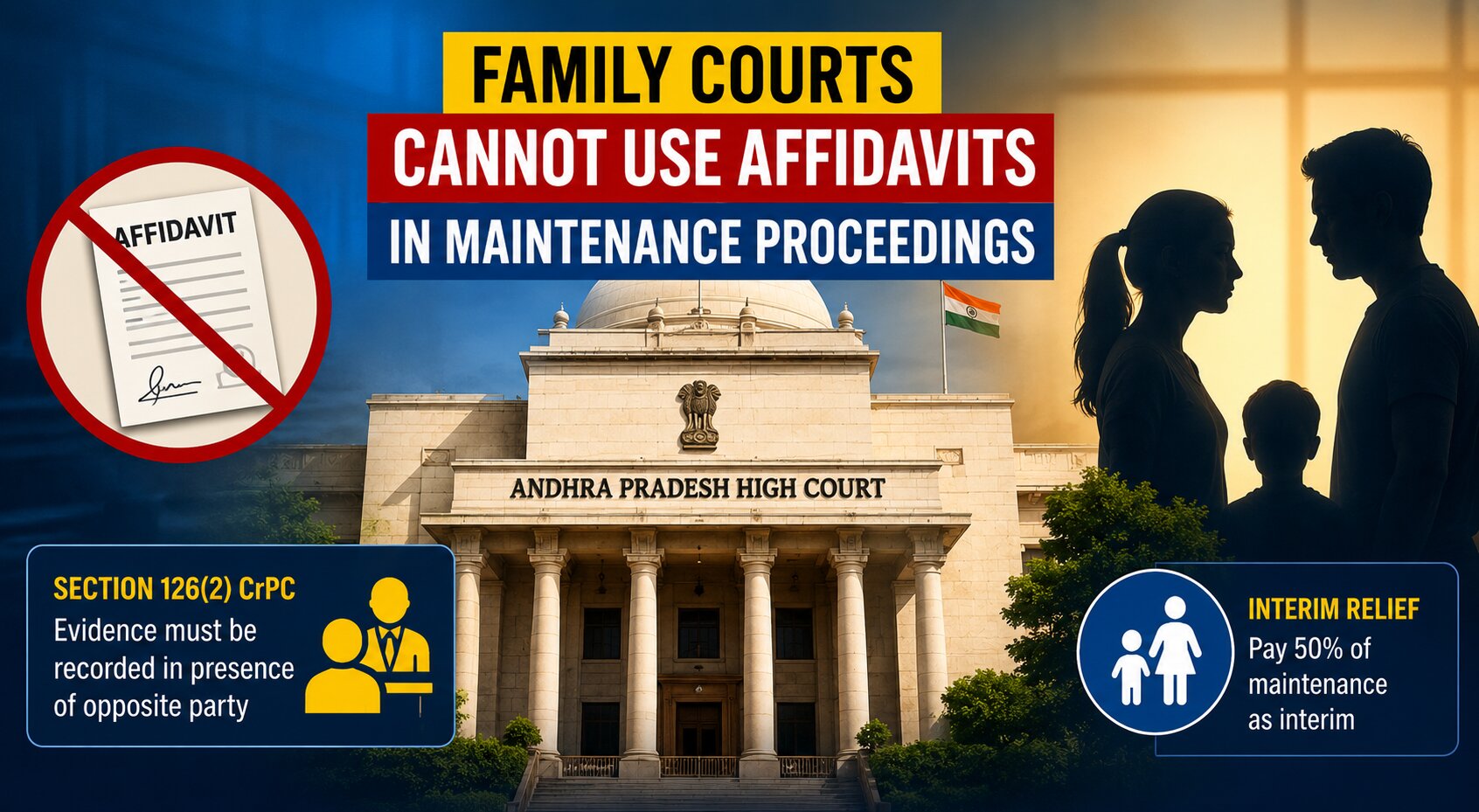
Examination-in-chief by affidavit is not permissible in maintenance proceedings under Section 125 CrPC.
Judgement Details
Court
Andhra Pradesh High Court
Date of Decision
21 July 2026
Judges
Justice Venkata Jyothirmai Pratapa
Citation
Acts / Provisions
Facts of the Case
-
The Family Court awarded monthly maintenance of ₹30,000 to the wife and ₹20,000 to the minor son under Section 125 CrPC.
-
The husband challenged the maintenance order by filing a criminal revision before the Andhra Pradesh High Court.
-
He contended that the Family Court had accepted the wife's examination-in-chief through an affidavit instead of recording oral evidence in accordance with Section 126(2) CrPC.
-
The husband further argued that the wife was employed as a software professional and had an independent source of income, which was ignored by the Family Court.
-
He also submitted that he had resigned from his employment and lacked sufficient financial means to pay the maintenance awarded.
-
The petitioner asserted that his application seeking production of income tax records had not been considered by the Family Court.
-
The respondents argued that proceedings under Section 125 CrPC are quasi-civil in nature and that the procedure under Order XVIII Rule 4 CPC permitting affidavit evidence could validly be followed.
-
The High Court examined whether Family Courts could adopt the CPC procedure for recording examination-in-chief by affidavit in maintenance proceedings governed by Chapter IX of the CrPC.
Issues
-
Whether examination-in-chief by way of affidavit is permissible in maintenance proceedings under Section 125 CrPC in view of Section 126(2) CrPC?
-
Whether the procedure prescribed under Order XVIII Rule 4 CPC can be imported into maintenance proceedings before Family Courts?
-
Whether the Family Court failed to comply with the mandatory directions issued by the Supreme Court in Rajnesh v. Neha regarding disclosure of income, assets, liabilities, and expenditure?
-
Whether the maintenance order passed by the Family Court was legally sustainable in the absence of compliance with the mandatory statutory procedure?
-
Whether the matter required remand for fresh adjudication after recording evidence in accordance with law?
Judgement
-
The Andhra Pradesh High Court allowed the criminal revision petition and set aside the Family Court's maintenance order.
-
The Court held that Section 126(2) CrPC uses the expression "shall", making it mandatory that evidence be recorded in the presence of the person against whom maintenance is sought or, where personal attendance is dispensed with, in the presence of the person's advocate.
-
The Court observed that Section 126(2) CrPC contains no provision permitting examination-in-chief through affidavits.
-
It held that the procedure under Order XVIII Rule 4 CPC cannot be imported into maintenance proceedings because the CrPC prescribes a complete and specific procedure for such cases.
-
The Court harmoniously interpreted Sections 126(2) and 254 CrPC and concluded that oral evidence remains mandatory in maintenance proceedings.
-
The Court reiterated that Family Courts, while dealing with applications under Chapter IX of the CrPC, are bound to follow the procedure specifically prescribed under the CrPC.
-
The Bench clarified that cross-examination in maintenance proceedings should be confined to matters relevant to determination of maintenance and should not become an inquiry into unrelated matrimonial disputes.
-
The Court found that the Family Court had failed to secure mandatory financial disclosure affidavits from both parties as directed by the Supreme Court in Rajnesh v. Neha.
-
The Court held that the absence of such disclosures prevented an objective assessment of the parties' financial capacities.
-
Since both procedural defects affected the very foundation of the adjudication, the maintenance order was held to be legally unsustainable.
-
The matter was remanded to the Family Court with directions to record evidence afresh in accordance with Section 126(2) CrPC (Section 145(2) BNSS) and dispose of the case preferably within two months.
-
The husband was directed to continue paying 50% of the maintenance amount awarded by the Family Court as interim maintenance until fresh adjudication.
Held
-
Section 126(2) CrPC mandates that evidence must be recorded in the presence of the opposite party or the party's advocate.
-
The procedure under Order XVIII Rule 4 CPC cannot be applied to maintenance proceedings unless expressly authorized by statute.
-
Family Courts must strictly follow the procedure prescribed under Chapter IX of the CrPC while deciding maintenance applications.
-
Compliance with the Supreme Court's directions in Rajnesh v. Neha regarding financial disclosure affidavits is mandatory.
-
The Family Court's maintenance order was set aside.
-
The matter was remanded for fresh adjudication in accordance with law.
-
The husband shall continue paying 50% of the awarded maintenance as interim maintenance until disposal of the proceedings.
Analysis
-
The judgment reinforces the mandatory nature of the procedural safeguards contained in Section 126(2) CrPC by emphasizing that the statutory requirement of recording evidence in the presence of the opposite party cannot be diluted through judicial innovation.
-
The Court reaffirmed the well-established principle that where a special statute prescribes a specific procedure, that procedure alone must be followed and cannot be replaced by provisions borrowed from the Civil Procedure Code unless expressly authorized.
-
The decision strengthens procedural fairness in maintenance proceedings by ensuring that parties have the opportunity to observe and challenge oral testimony during examination-in-chief.
-
The judgment clarifies the procedural framework applicable before Family Courts, holding that they remain bound by the special procedure under Chapter IX of the CrPC despite their quasi-civil jurisdiction.
-
By insisting upon compliance with Rajnesh v. Neha, the Court emphasized transparency and financial disclosure as essential prerequisites for determining fair and realistic maintenance.
-
The Court balanced the interests of both parties by directing payment of interim maintenance during the pendency of the remanded proceedings, thereby protecting the wife and child while ensuring procedural compliance.
-
The ruling is likely to serve as an important precedent discouraging Family Courts from routinely accepting affidavit evidence in maintenance proceedings where the governing criminal procedure mandates oral evidence.
-
The judgment promotes uniformity in maintenance adjudication and reinforces that procedural safeguards are integral to ensuring substantive justice.