
X v. Y, 2026
The judgment adopts a pragmatic and justice-oriented approach to transfer of matrimonial proceedings by prioritising substantive justice over procedural formalities.
Judgement Details
Court
Rajasthan High Court
Date of Decision
15 July 2026
Judges
Justice Farjand Ali
Citation
Acts / Provisions
Facts of the Case
-
The petitioner-wife filed a transfer application before the Rajasthan High Court seeking transfer of her husband's divorce petition under Section 13 of the Hindu Marriage Act from the Family Court at Bikaner to the Family Court at Jaisalmer.
-
The transfer petition remained pending for more than one year because notice had not yet been served upon the respondent-husband.
-
During the pendency of the transfer application, interim orders had continued to operate.
-
The wife contended that several matrimonial and allied proceedings between the parties were already pending before courts situated at Jaisalmer, where she resided.
-
The Court considered the practical difficulties arising from requiring the parties to contest connected matrimonial proceedings at different places.
-
The principal question before the Court was whether service of notice upon the husband could be dispensed with and whether the matrimonial proceedings should be consolidated before one Family Court.
Issues
-
Whether the High Court could dispense with service of notice upon the respondent-husband while deciding a transfer petition in matrimonial proceedings?
-
Whether continuation of connected matrimonial proceedings at different places causes unnecessary hardship and multiplicity of litigation?
-
Whether the power under Section 24 of the Code of Civil Procedure should be exercised to consolidate matrimonial proceedings before one court in the interest of justice?
Judgement
-
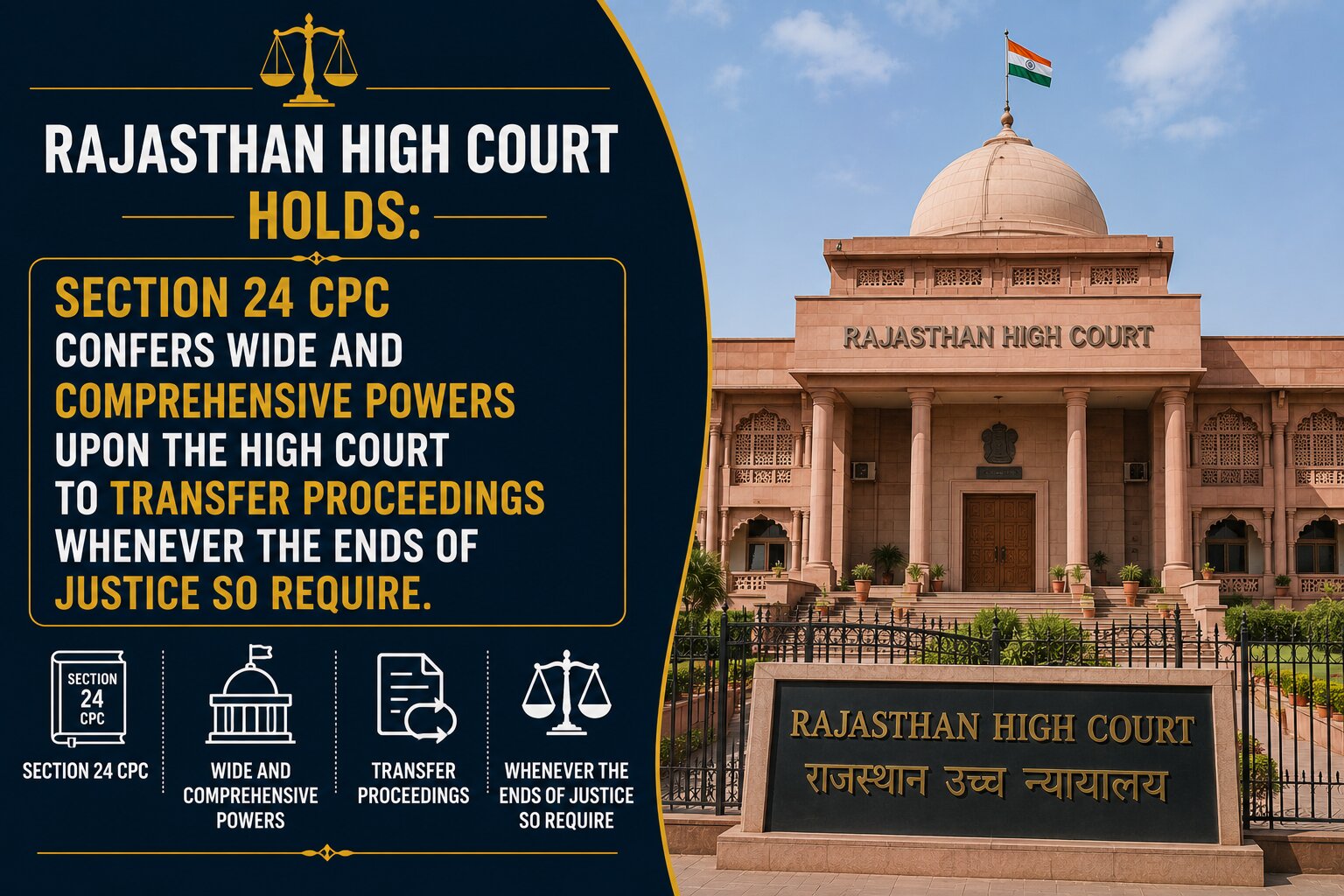
The Rajasthan High Court held that Section 24 CPC confers wide and comprehensive powers upon the High Court to transfer proceedings whenever the ends of justice so require.
-
The Court observed that transfer petitions in matrimonial disputes often remain pending for years merely because service of notice is awaited, despite interim orders operating throughout that period.
-
The Court held that such procedural delays do not advance the cause of justice.
-
The Court noted that in most matrimonial disputes, proceedings such as those under Section 498A IPC, the Domestic Violence Act, Section 125 CrPC, and Sections 9 and 13 of the Hindu Marriage Act are ordinarily instituted at the place where the wife resides.
-
Consequently, the husband is generally required to appear before courts situated at the wife's place of residence in any event.
-
The Court observed that requiring the wife simultaneously to contest proceedings instituted by the husband at another distant location imposes unnecessary travel, financial burden, mental hardship, and delay.
-
The Court further held that where the respondent is already attending proceedings before courts situated at the place where transfer is sought, no irreversible prejudice is caused by transferring another connected matrimonial proceeding to that place.
-
Accordingly, the Court dispensed with the requirement of serving notice upon the respondent-husband.
-
The transfer application was allowed, and the husband's matrimonial proceedings pending before the Family Court at Bikaner were transferred to the Family Court at Jaisalmer.
-
The Court also directed the District Judge and the Family Court to coordinate listing of all pending and future proceedings between the parties on the same dates, as far as administratively feasible, to minimise repeated appearances and facilitate effective adjudication.
Held
-
The High Court may dispense with service of notice in appropriate matrimonial transfer petitions where the interests of justice so require.
-
Keeping matrimonial transfer petitions pending merely for service of notice, while interim orders continue, unnecessarily delays justice.
-
Consolidation of connected matrimonial proceedings before one court reduces inconvenience, avoids conflicting orders, and promotes efficient adjudication.
-
The matrimonial proceedings were transferred from Bikaner to Jaisalmer.
Analysis
-
The Court recognized the practical realities of matrimonial litigation, where multiple connected proceedings often arise before different courts, causing considerable hardship to the parties.
-
By invoking the broad powers under Section 24 CPC, the Court reaffirmed that procedural law exists to facilitate justice and should not become an obstacle to its effective administration.
-
The decision highlights the importance of consolidating matrimonial proceedings before a single forum to reduce travel, litigation expenses, multiplicity of proceedings, and the possibility of conflicting judicial orders.
-
The Court also addressed systemic delays caused by prolonged pendency of transfer petitions awaiting service of notice, particularly where interim orders remain operative for extended periods.
-
The direction to coordinate hearing dates reflects a practical case-management approach aimed at reducing unnecessary appearances and improving judicial efficiency.
-
Overall, the judgment strengthens access to justice in matrimonial disputes by emphasizing convenience, coordinated adjudication, and expeditious resolution.