
X v. Y, 2026
A spouse cannot obtain divorce under Section 13(1A) HMA by relying on non-resumption of cohabitation where that spouse's own conduct prevented the resumption of matrimonial life.
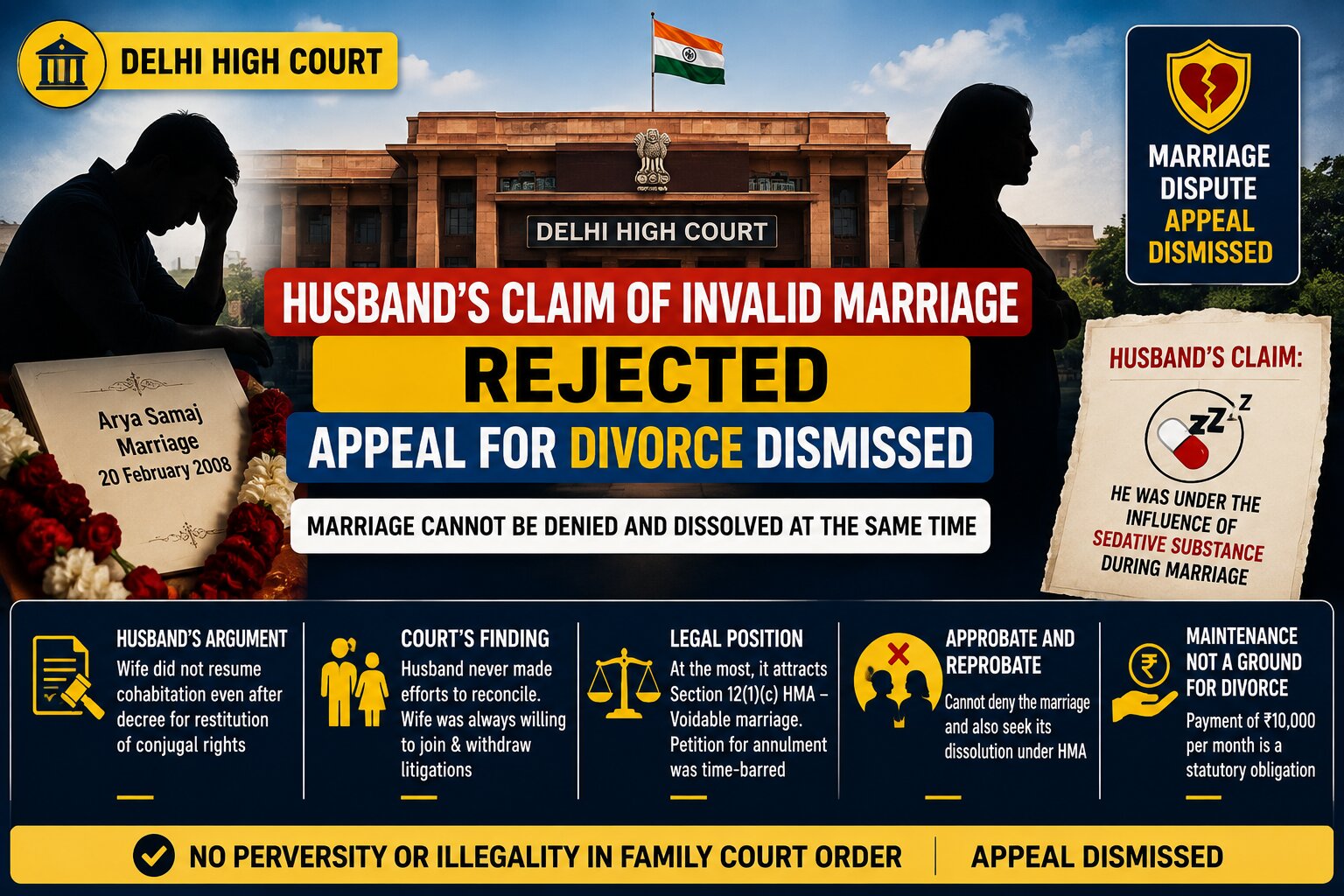
Judgement Details
Court
Delhi High Court
Date of Decision
20 August 2026
Judges
Justice Vivek Chaudhary and Justice Renu Bhatnagar
Citation
Acts / Provisions
Facts of the Case
-
The parties were married on 20 February 2008 at an Arya Samaj Mandir.
-
No child was born from the marriage.
-
The wife subsequently lodged a complaint under Section 498-A IPC in June 2008.
-
The wife thereafter instituted proceedings under Section 9 of the Hindu Marriage Act seeking restitution of conjugal rights.
-
The wife's petition for restitution of conjugal rights was allowed in September 2013.
-
Despite the decree, the parties did not resume cohabitation.
-
In 2016, the husband approached the Family Court seeking dissolution of the marriage under Sections 13(1A) and 13(1)(ib) of the Hindu Marriage Act.
-
The husband contended that the parties had not resumed cohabitation despite the decree for restitution of conjugal rights and that he was therefore entitled to a decree of divorce.
-
The husband also disputed the validity of the marriage and claimed that he had been under the influence of a sedative substance when the marriage ceremonies were performed in 2008.
-
The husband contended before the High Court that the wife's failure to resume cohabitation after obtaining the restitution decree entitled him to divorce.
-
The record, however, showed that the husband himself had not made efforts to reconcile or resume matrimonial life.
-
The wife had expressed willingness to join the husband's company and to withdraw the pending litigation between the parties.
-
The husband had also disputed the existence and validity of the marriage while simultaneously seeking dissolution of the same marriage under the Hindu Marriage Act.
-
The Family Court dismissed the husband's divorce petition.
-
The husband challenged that decision before the Delhi High Court.
Issues
-
Whether the husband was entitled to dissolution of marriage under Section 13(1A) of the Hindu Marriage Act merely because the parties did not resume cohabitation after the decree for restitution of conjugal rights?
-
Whether the husband's own refusal to resume cohabitation and failure to make efforts to bring his wife back constituted his own wrong within the meaning of Section 23(1)(a) of the Hindu Marriage Act?
-
Whether the husband's challenge to the validity of the marriage on the ground that he was under the influence of a sedative substance could be raised as a ground for dissolution of marriage after the prescribed period for seeking annulment had expired?
-
Whether the husband's challenge to the validity of the marriage was barred after the earlier proceedings under Section 9 of the Hindu Marriage Act had attained finality?
-
Whether a spouse can simultaneously dispute the existence or validity of a marriage and seek dissolution of that very marriage under the Hindu Marriage Act?
-
Whether the husband's payment of monthly maintenance of ₹10,000 to the wife entitled him to a decree of divorce?
-
Whether the Family Court's judgment suffered from perversity, illegality or any other infirmity warranting interference by the High Court?
Judgement
-
The Delhi High Court dismissed the husband's appeal and upheld the Family Court's decision refusing divorce.
-
The Court held that mere non-resumption of cohabitation after a decree for restitution of conjugal rights does not automatically entitle a spouse to divorce under Section 13(1A) of the Hindu Marriage Act.
-
The Court examined the conduct of both parties and found that the husband himself had failed to make efforts to resume matrimonial life.
-
The Court noted that the wife had been willing to live with the husband and had even expressed willingness to withdraw the pending litigation between them.
-
The Court found that the husband's refusal to reside with the wife had frustrated the execution of the restitution decree.
-
The Bench held that the husband's conduct fell within the concept of “own wrong” contemplated by Section 23(1)(a) of the Hindu Marriage Act.
-
The Court also considered the husband's contention that he had been under the influence of a sedative substance when the marriage was solemnised.
-
The Court observed that such a contention could, at the most, attract Section 12(1)(c) HMA, concerning a voidable marriage where consent was obtained in circumstances contemplated by that provision.
-
The Court noted that a petition seeking annulment on such a ground was required to be presented within the statutory period after discovery of the alleged fraud.
-
The Court further noted that the validity of the marriage had already been disputed in the wife's Section 9 proceedings, which had been decided against the husband and had attained finality.
-
The Bench rejected the husband's attempt to simultaneously dispute the validity of the marriage and seek dissolution of the same marriage.
-
The Court described such conduct as approbating and reprobating simultaneously.
-
The Court held that the husband's conduct was sufficient to attract Section 23(1)(a) HMA.
-
The Court rejected the argument that payment of ₹10,000 per month as maintenance entitled the husband to a divorce decree.
-
It held that payment of maintenance was a statutory obligation and could not, by itself, constitute a ground for dissolution of marriage.
-
The Court found no perversity, illegality or infirmity in the Family Court's judgment.
-
The appeal was accordingly dismissed.
Held
-
A party who refuses to comply with or frustrates a decree for restitution of conjugal rights may be treated as taking advantage of his or her own wrong under Section 23(1)(a) HMA.
-
A challenge based on alleged fraud or absence of valid consent may attract Section 12(1)(c) HMA, but such a challenge must be brought within the statutory limitation period.
-
A party cannot dispute the validity or existence of a marriage while simultaneously seeking its dissolution under the Hindu Marriage Act.
-
Such inconsistent conduct amounts to approbating and reprobating simultaneously and can constitute the petitioner's own wrong.
-
Payment of maintenance does not, by itself, confer a right to obtain a decree of divorce.
-
The Family Court's refusal to grant divorce was legally sustainable.
-
The husband's appeal was dismissed.
Analysis
-
Own wrong principle: The central principle is that a spouse cannot create or contribute to the circumstances preventing reconciliation and then rely upon those circumstances as a ground for obtaining matrimonial relief. Section 23(1)(a) prevents a party from taking advantage of such conduct.
-
Restitution of conjugal rights: The judgment clarifies that a decree for restitution of conjugal rights is not merely a mechanical stepping stone to divorce. The conduct of the parties after the decree remains relevant when determining entitlement to relief under Section 13(1A).
-
Husband's conduct: The Court found that it was the husband who failed to make meaningful efforts to resume cohabitation. The wife's willingness to return to the matrimonial relationship weakened the husband's argument that the non-resumption of cohabitation was attributable to her.
-
Section 12(1)(c): The husband's claim that he was under the influence of a sedative at the time of marriage was treated, at the highest, as a possible ground concerning the validity of consent under Section 12(1)(c). Such a ground concerns voidability, rather than automatically rendering the marriage void.
-
Delay in challenging marriage: The Court emphasized the statutory time requirement applicable to a petition for annulment. A party cannot indefinitely preserve a challenge to the validity of marriage and later use it strategically while seeking other relief under the HMA.
-
Finality of earlier proceedings: The fact that the validity of the marriage had already been raised in the earlier restitution proceedings, which had attained finality, further weakened the husband's attempt to reopen the issue.
-
Approbate and reprobate: The judgment applies the principle that a litigant cannot take mutually inconsistent positions to obtain a legal advantage. The husband could not, on one hand, contend that the marriage itself was invalid and, on the other, ask the court to dissolve that same marriage.
-
Maintenance payments: The Court correctly distinguished between a statutory financial obligation and a substantive ground for divorce. Regular payment of maintenance does not establish a right to dissolution of marriage.
-
Section 23 as a safeguard: Section 23(1)(a) operates as an important safeguard against granting matrimonial relief to a party whose own conduct has contributed to the breakdown or prevented the statutory ground from being legitimately established.
-
Impact on matrimonial law: The ruling reinforces that courts examining divorce petitions must consider the petitioner's conduct and cannot grant relief solely by mechanically applying the existence of a prior restitution decree.
-
Broader significance: The decision is significant for cases under Section 13(1A) because it makes clear that a spouse cannot deliberately frustrate restitution and subsequently rely upon the resulting period of non-cohabitation as an automatic entitlement to divorce.