
X v. X and Others, 2026
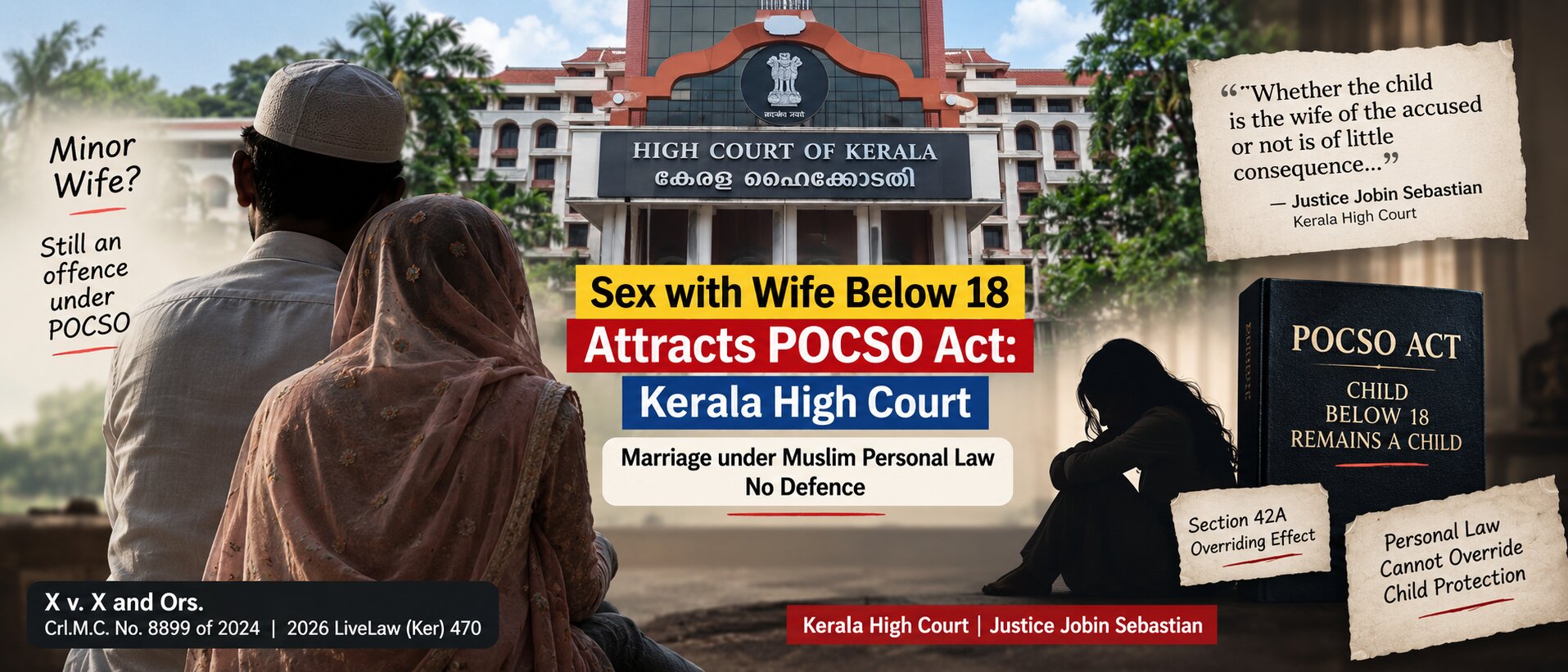
A person below 18 years of age is a “child” under POCSO, irrespective of whether that person is married.
Judgement Details
Court
Kerala High Court
Date of Decision
25 August 2026
Judges
Justice Jobin Sebastian
Citation
Acts / Provisions
Facts of the Case
-
The petitioner was the first accused in a criminal case alleging offences under Sections 366 and 376(2)(n) of the IPC and Sections 5(l), 6(1) and 15(1) of the POCSO Act.
-
The prosecution alleged that the petitioner kidnapped the victim in a car, took her to his house and subjected her to sexual assault repeatedly for approximately four days.
-
The second and third accused were allegedly involved in facilitating the commission of the offences.
-
The victim's parents were also accused of failing to report the alleged offence to the authorities.
-
The petitioner approached the Kerala High Court seeking quashing of the criminal proceedings against him.
-
His principal defence was that the victim was his legally wedded wife.
-
According to the petitioner, he had married the victim when she was approximately 17 years and one month old, in accordance with Islamic religious rites and ceremonies.
-
The petitioner relied upon Exception 2 to Section 375 IPC, contending that sexual intercourse with his wife, provided she was above the age mentioned in the statutory exception, would not constitute rape.
-
The prosecution and the de facto complainant opposed the petition.
-
The materials relied upon by the petitioner to establish the alleged marriage consisted primarily of statements made to the police by the de facto complainant, her brother and the Qazi of the mosque where the alleged marriage was performed.
-
No documentary evidence establishing the marriage was produced before the High Court.
-
The Court held that whether a valid marriage actually took place was a matter that could appropriately be determined after a full trial.
-
The Court nevertheless considered whether, even assuming that a valid Muslim marriage had taken place, the alleged marriage could exempt the petitioner from liability under the POCSO Act.
-
The victim was undisputedly below 18 years of age at the relevant time.
Issues
-
Whether the criminal proceedings against the petitioner should be quashed on the ground that the alleged victim was his legally wedded wife under Muslim personal law?
-
Whether sexual intercourse by a Muslim man with his wife who is below 18 years of age attracts criminal liability under the POCSO Act notwithstanding the alleged validity of the marriage under Muslim personal law?
-
Whether Exception 2 to Section 375 IPC can protect the petitioner from criminal liability where the wife is below 18 years of age?
-
Whether the provisions of the POCSO Act, particularly Sections 2(1)(d) and 42A, override any inconsistent protection claimed under personal law or the IPC?
-
Whether the alleged marriage between the petitioner and the minor victim could be conclusively determined at the stage of a petition seeking quashing of criminal proceedings?
-
Whether the allegations and materials on record prima facie disclose the commission of offences under the IPC and the POCSO Act so as to justify continuation of the criminal proceedings?
Judgement
-
The Kerala High Court dismissed the petition seeking quashing of the criminal proceedings.
-
Justice Jobin Sebastian held that sexual intercourse with a girl below 18 years of age attracts the provisions of the POCSO Act.
-
The Court made it clear that the fact that the minor girl is alleged to be the accused's wife does not, by itself, remove the conduct from the operation of POCSO.
-
The Court relied upon Section 2(1)(d) of the POCSO Act, which expressly defines a child as a person below 18 years of age.
-
The Court also relied upon Section 42A, which gives the POCSO Act overriding effect where there is inconsistency between POCSO and another law.
-
The Court observed that whether the marriage was actually valid under Muslim personal law could not be conclusively decided merely on the materials produced in the quashing petition.
-
Even assuming that the marriage had been solemnised according to Muslim religious rites, the Court held that this would not eliminate the petitioner's criminal liability under POCSO.
-
The Court rejected the petitioner's reliance on the marital exception under Section 375 IPC.
-
In doing so, the Court relied upon the Supreme Court's decision in Independent Thought v. Union of India, where Exception 2 to Section 375 IPC was read down so that the marital exception does not apply where the wife is below 18 years of age.
-
The Court also relied upon Khaledur Rahman v. State of Kerala & Anr. in considering the applicability of POCSO to sexual acts involving a minor spouse.
-
At the stage of considering a petition for quashing, the Court found that the allegations, if taken at face value, prima facie disclosed the alleged offences.
-
Accordingly, the Court declined to interfere with the criminal prosecution and dismissed the petition.
Held
- A marriage under Muslim personal law does not provide immunity from prosecution under POCSO for sexual intercourse with a wife who is below 18 years of age.
-
The alleged validity of the marriage cannot override the statutory protection afforded to children under POCSO.
-
Section 42A of POCSO gives the Act overriding effect where its provisions are inconsistent with another law.
-
The marital exception under Section 375 IPC does not protect sexual intercourse with a wife below 18 years of age, following the Supreme Court's interpretation in Independent Thought.
-
The question of whether the alleged marriage was legally valid could be determined at trial, particularly where the petitioner had not produced documentary proof establishing the marriage.
-
Since the allegations prima facie disclosed the commission of the alleged offences, the High Court refused to quash the criminal proceedings.
Analysis
-
Child protection takes precedence over marital status: The most significant aspect of the judgment is that marriage does not alter the statutory definition of a child under POCSO. A girl below 18 remains a child even if she is claimed to be the accused's wife.
-
POCSO has overriding effect: Section 42A was central to the Court's reasoning. Where personal law or another statutory provision is inconsistent with POCSO's child-protection framework, POCSO prevails.
-
Personal law cannot create an exception to POCSO: The Court's reasoning establishes that even assuming a Muslim marriage is valid under personal law, that validity cannot be used as a defence to alleged sexual offences against a person whom POCSO expressly treats as a child.
-
Effect of Independent Thought: The Supreme Court's 2017 decision significantly altered the operation of the marital exception under Section 375 IPC by extending protection to wives below 18. The Kerala High Court applied this principle to reject the petitioner's argument.
-
Marriage validity was not conclusively decided: The Court distinguished two questions: whether a valid marriage actually occurred and whether such a marriage, if valid, would provide a defence under POCSO. It answered the latter against the petitioner while leaving the former for determination during trial.
-
Limited scope of quashing jurisdiction: At the stage of considering a petition for quashing, the High Court generally examines whether the allegations, taken at face value, disclose the commission of an offence. It does not ordinarily conduct a detailed appreciation of disputed evidence as would occur during trial.
-
Prima facie standard: Because the allegations were sufficient on their face to disclose the offences alleged, the Court found no justification for terminating the prosecution at the preliminary stage.
-
Interaction between IPC and POCSO: The decision demonstrates that the IPC's provisions concerning rape cannot be read in isolation where the alleged victim is a child. POCSO independently criminalises specified sexual conduct involving children.
-
Significance for child marriage cases: The judgment reinforces the legal distinction between the validity or recognition of a marriage and the criminal consequences of sexual conduct involving a person below the statutory age of 18.
-
Broader legal principle: The decision strengthens the proposition that statutory child-protection legislation cannot be circumvented by invoking marital status or personal law.