
X v. Union of India & Others, 2026
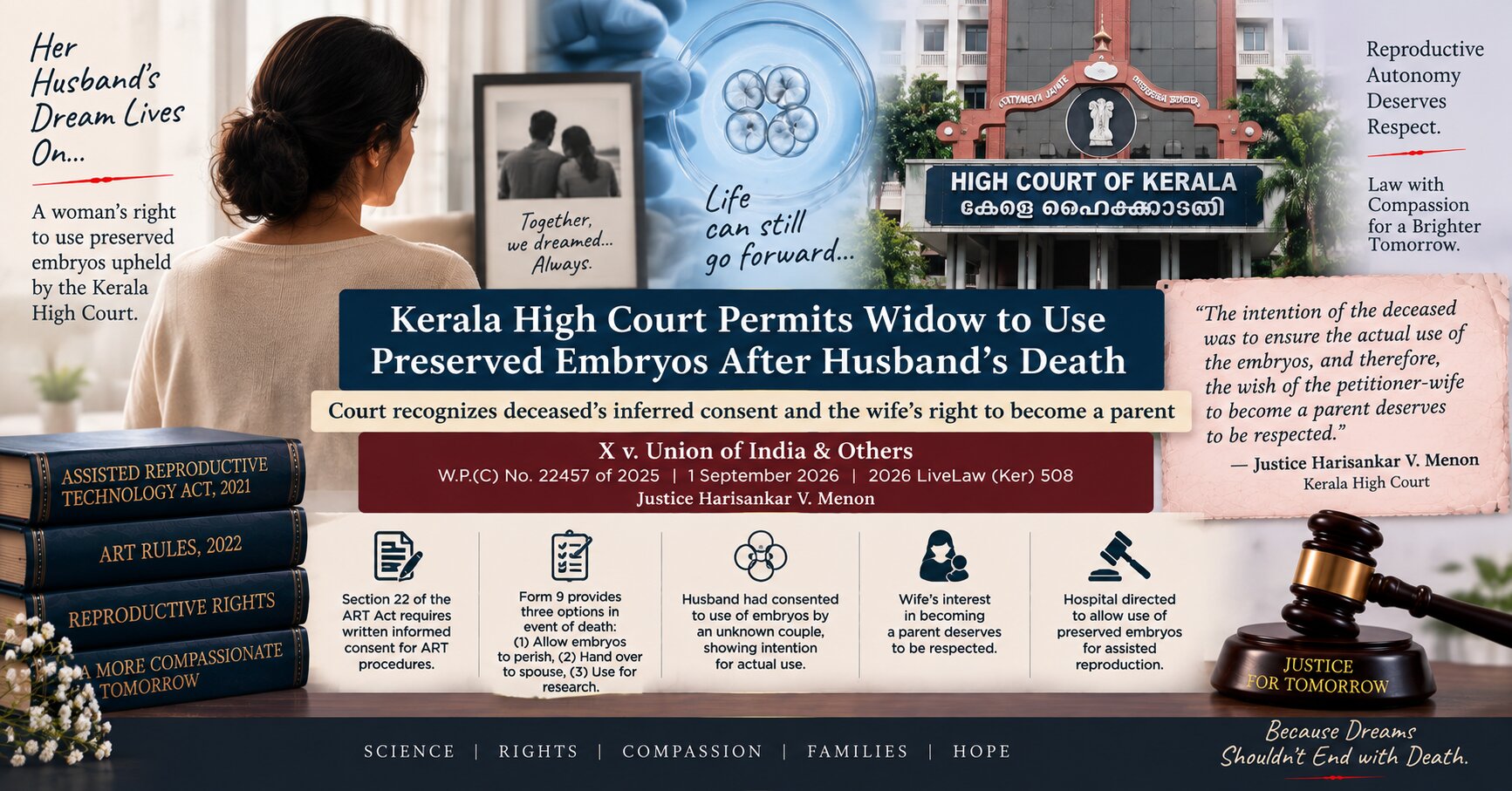
The Court gave weight to the deceased's inferred consent and the surviving wife's interest in becoming a parent.
Judgement Details
Court
Kerala High Court
Date of Decision
16 September 2026
Judges
Justice Harisankar V. Menon
Citation
Acts / Provisions
Facts of the Case
-
The petitioner and her husband were undergoing fertility treatment and IVF procedures at a hospital.
-
During the husband's lifetime, embryos were created and cryopreserved for assisted reproduction.
-
The husband subsequently died in 2021.
-
After his death, the petitioner sought permission from the hospital to use the cryopreserved embryos for assisted reproduction.
-
The hospital refused to permit their use, stating that specific written consent under Section 22 of the ART Act was not available for continuing the procedure after the husband's death.
-
The petitioner argued that the couple had already provided written consent at the time of cryopreservation.
-
She contended that the existing consent amounted to substantial compliance with the statutory consent requirement.
-
The petitioner also relied upon the 129th Report of the Department-related Parliamentary Standing Committee on Health and Family Welfare, which had discussed posthumous collection and use of reproductive material.
-
Reliance was also placed on a Delhi High Court decision concerning the use of preserved semen of a deceased person.
-
The Union Government drew attention to Form 9 under the ART Rules, 2022.
-
Form 9 requires consideration of what should happen to preserved embryos in the event of the death of a spouse.
-
The Court noted that the statutory framework contemplates three broad choices:
-
Allow the embryos to perish;
-
Hand over the embryos to the surviving spouse; or
-
Use the embryos for research purposes.
-
-
The Court found that the hospital had not required the petitioner and her husband to execute the prescribed Form 9 and had not provided them with these specific choices.
-
The husband had nevertheless given written consent permitting the embryos to be used by an unknown couple in the event of his death.
-
The Court considered this consent important in determining the husband's intention regarding the future use of the embryos.
-
The Court therefore examined whether the deceased husband's consent, together with the petitioner's desire to become a parent, justified allowing her to use the embryos.
Issues
-
Whether the written consent given by the deceased husband at the time of cryopreservation could establish his intention regarding the use of the embryos after his death?
-
Whether the absence of a separate consent in Form 9 prevented the surviving wife from using the cryopreserved embryos?
-
Whether the husband's consent permitting an unknown couple to use the embryos after his death demonstrated an intention that the embryos should be actually used?
-
Whether the petitioner's interest in becoming a parent could be considered while interpreting the consent requirements under Section 22 of the ART Act?
-
Whether the hospital could refuse the petitioner's request merely because a specific post-death consent under Form 9 had not been obtained?
Judgement
-
The Kerala High Court allowed the writ petition.
-
The Court directed the concerned hospital to permit the petitioner to use the preserved embryos for assisted reproduction.
-
The Court examined Section 22 of the ART Act, the 2022 Rules and Form 9 together.
-
The Court observed that the statutory framework requires the parties to consider the fate of the embryos in the event of the death of either spouse.
-
The Court identified the three options contemplated under the framework: destruction/perishing of the embryos, handing them over to the surviving spouse, or use for research.
-
The Court found that the hospital had not obtained Form 9 from the couple.
-
Since the hospital itself had not provided the prescribed choices, the absence of such a form could not be treated as an absolute bar against the petitioner's request.
-
The deceased husband had expressly consented to the use of the embryos by an unknown couple in the event of his death.
-
The Court inferred from this that the deceased intended the embryos to be actually used rather than allowed to perish.
-
The Court also considered the surviving wife's interest in becoming a parent.
-
Taking these circumstances together, the Court permitted the petitioner to use the cryopreserved embryos.
Held
-
Section 22 of the ART Act requires informed written consent for ART treatment and procedures.
-
Form 9 under the ART Rules, 2022 provides a framework for determining the fate of embryos after the death of a spouse.
-
The statutory framework contemplates:
-
Allowing the embryos to perish;
-
Handing the embryos to the surviving spouse; or
-
Using the embryos for research.
-
-
The hospital's failure to obtain Form 9 meant that the couple had not been given the opportunity to make the specific choices contemplated by the Rules.
-
The deceased husband's written consent allowing an unknown couple to use the embryos showed his intention that the embryos should be put to actual use after his death.
-
The absence of a specific Form 9 consent did not, in the circumstances of the case, justify preventing the petitioner from using the embryos.
-
The hospital was directed to allow the petitioner to use the cryopreserved embryos for assisted reproduction.
Analysis
-
The judgment deals with the complex issue of posthumous use of cryopreserved embryos.
-
The central consideration was the intention and consent of the deceased husband.
-
The Court did not treat the absence of Form 9 as automatically ending the petitioner's claim.
-
Instead, it examined the actual written consent given by the deceased at the time of cryopreservation.
-
The husband's willingness to allow an unknown couple to use the embryos demonstrated that he contemplated continued use of the embryos even after his death.
-
The Court therefore inferred that his intention was not for the embryos to be destroyed or left unused.
-
The judgment highlights the importance of informed consent documentation in assisted reproduction.
-
Hospitals and ART clinics have an important responsibility to ensure that the consent procedure prescribed by law and the Rules is properly followed.
-
The Court's reasoning also recognises the surviving spouse's interest in parenthood and reproductive autonomy.
-
However, the decision is closely connected to the specific facts and evidence of the husband's consent in this case.
-
It does not establish that every surviving spouse automatically has an unrestricted right to use cryopreserved embryos after the death of the other spouse.
-
The case illustrates the need for clear advance instructions concerning the storage, transfer, destruction, research use and reproductive use of embryos.
-
The judgment may have significant implications for IVF clinics, fertility hospitals, cryopreservation agreements and future disputes involving posthumous reproduction.
-
It also demonstrates the interaction between statutory consent requirements and individual reproductive choices.