
Vinod Shivakumar v. State of Maharashtra, 2026
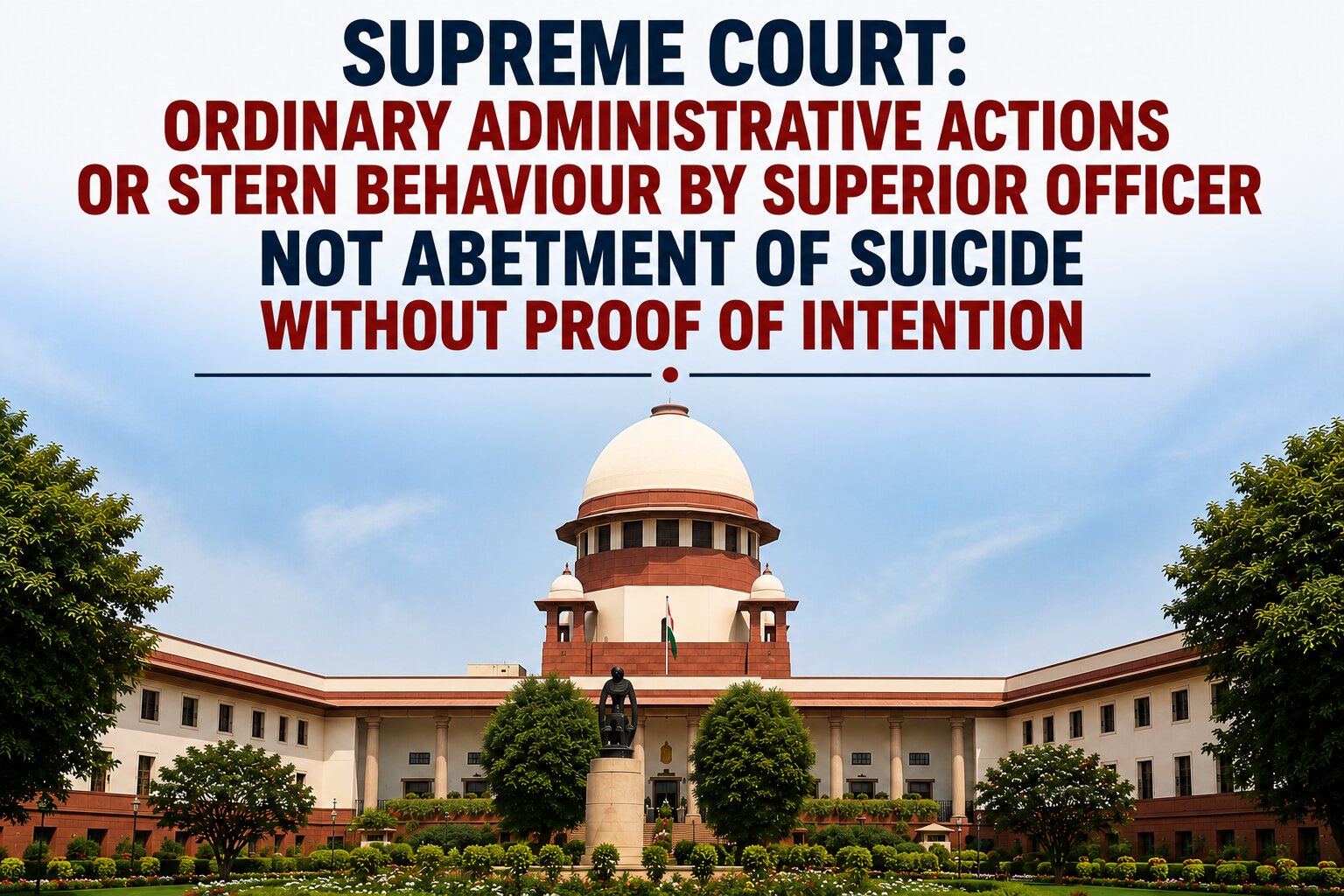
Mere workplace harassment or strict administrative conduct does not automatically constitute abetment of suicide.
Judgement Details
Court
Supreme Court of India
Date of Decision
18 August 2026
Judges
Justice Satish Chandra Sharma and Justice Nongmeikapam Kotiswar Singh
Citation
Acts / Provisions
Facts of the Case
-
The deceased was a Forest Range Officer posted at Harisal Range.
-
She died by suicide on 25 March 2021.
-
She left three suicide notes addressed to senior forest officials, her mother and her husband.
-
The suicide notes contained allegations against the appellant and another individual.
-
An FIR was registered against the appellant based principally on the allegations contained in the suicide notes.
-
The appellant was a Deputy Conservator of Forests and was the superior officer of the deceased.
-
The allegations included repeated reprimands, suspension-related action and rejection of leave applications.
-
The deceased also alleged that the appellant had assigned her difficult field duties while she was pregnant.
-
She alleged that she had been required to trek for several consecutive days and that this resulted in a miscarriage.
-
The deceased also alleged that an FIR had been registered against her under the Scheduled Castes and Scheduled Tribes (Prevention of Atrocities) Act, 1989.
-
She attributed responsibility for her death to the appellant.
-
The charge under Section 312 IPC concerning miscarriage was subsequently quashed by the High Court.
-
Charges under Sections 306, 504 and 506 IPC continued.
-
The appellant sought discharge before the Additional Sessions Judge, Achalpur.
-
His application was rejected.
-
He thereafter approached the Nagpur Bench of the Bombay High Court, which also dismissed his revision.
-
The appellant then approached the Supreme Court.
-
He argued that the alleged incidents were not sufficiently proximate to the suicide and did not demonstrate an intention to instigate the deceased to take her own life.
-
The prosecution relied upon the allegations of continuous harassment and another FIR concerning alleged mistreatment of a subordinate by the appellant.
Issues
-
Whether ordinary administrative directions, disciplinary supervision, adverse remarks or stern conduct by a superior officer can constitute abetment of suicide under Section 306 IPC in the absence of a conscious intention to drive the subordinate to suicide?
-
Whether the allegations against the appellant disclosed direct or indirect instigation within the meaning of Section 107 IPC?
-
Whether an act of alleged harassment must be proximate to the suicide and accompanied by clear mens rea to constitute abetment of suicide under Section 306 IPC?
-
Whether the allegations contained in the suicide notes, even if accepted at face value, disclosed the essential ingredients of abetment of suicide against the appellant?
-
Whether the continuation of criminal proceedings under Sections 306, 504 and 506 IPC against the appellant would amount to an abuse of the process of law?
Judgement
-
The Supreme Court allowed the appeal.
-
The Court set aside the orders of the Bombay High Court and the Sessions Court.
-
The appellant was discharged from the Sessions case.
-
The Court held that Section 306 IPC must be read with Section 107 IPC, which defines abetment.
-
The Court identified three essential requirements for establishing abetment of suicide:
-
Direct or indirect instigation.
-
Instigation occurring in close proximity to the suicide.
-
Clear mens rea to abet the commission of suicide.
-
-
The Court held that the allegations against the appellant did not satisfy these requirements.
-
The Court found a complete absence of a proximate act of instigation immediately preceding the suicide.
-
The alleged miscarriage had occurred approximately five months before the suicide.
-
Other allegations concerning encroachment work and registration of the FIR dated back to earlier periods.
-
The Court held that ordinary administrative directions and disciplinary supervision cannot automatically be elevated into criminal abetment.
-
The Court also found that the appellant was not the competent authority to independently suspend the deceased without approval from a superior authority.
-
Consequently, the allegations did not establish the offences under Sections 504 and 506 IPC either.
-
The Court held that continuation of the proceedings would amount to an abuse of the process of law.
Held
-
For Section 306 IPC, there must be instigation or intentional conduct showing a clear intention to drive the deceased to suicide.
-
The relevant act must be proximate to the suicide.
-
A suicide note blaming a superior officer, by itself, does not establish the necessary mens rea.
-
Ordinary administrative directions, disciplinary action, adverse remarks or stern behaviour cannot constitute abetment without additional material showing a conscious intention to cause suicide.
-
The allegations against the appellant did not satisfy the essential ingredients of Sections 306 and 107 IPC.
-
The ingredients of Sections 504 and 506 IPC were also not established.
-
The appellant was therefore discharged, and continuation of the criminal proceedings was held to be an abuse of the process of law.
Analysis
-
Proximity is crucial: The Court reaffirmed that there must be a proximate connection between the alleged instigation and the suicide. Remote or historical incidents are ordinarily insufficient by themselves.
-
Mens rea is essential: Abetment requires a clear mental element. The accused must have intended or consciously acted in a manner capable of driving the victim to suicide.
-
Administrative conduct is not automatically criminal: A superior officer may issue reprimands, show-cause notices, adverse remarks or demanding work assignments. Such conduct, even if unpleasant, does not automatically become abetment.
-
Suicide note is not conclusive: A victim's attribution of responsibility in a suicide note is important evidence but does not by itself establish every legal ingredient of Section 306 IPC.
-
Objective legal test: The Court focused on whether the alleged acts objectively demonstrated instigation, proximity and mens rea, rather than simply examining the deceased's perception of the conduct.
-
Abhinav Mohan Delkar principle: The Court relied on the requirement of a proximate prior act that can be identified as the event that effectively drove the victim to the extreme step.
-
“Straw that broke the camel's back”: The judgment uses this concept to explain that there must be a sufficiently proximate incident demonstrating the direct connection between the accused's conduct and the suicide.
-
Earlier incidents: The alleged miscarriage and other incidents occurred months before the suicide. The Court considered the temporal gap significant in determining whether they could constitute proximate instigation.
-
Section 504 and 506: The Court separately examined the allegations supporting intentional insult and criminal intimidation and found the necessary ingredients absent.
-
Protection against over-criminalisation: The judgment prevents ordinary supervisory or disciplinary conduct from being converted into a serious criminal prosecution without evidence of the required intention.
-
Broader significance: The decision is important for cases involving alleged workplace harassment, superior-subordinate relationships and Section 306 IPC, particularly where prosecution relies heavily on allegations contained in a suicide note.