
Vincent Correa v. Viyola Prathvi Correa, 2026
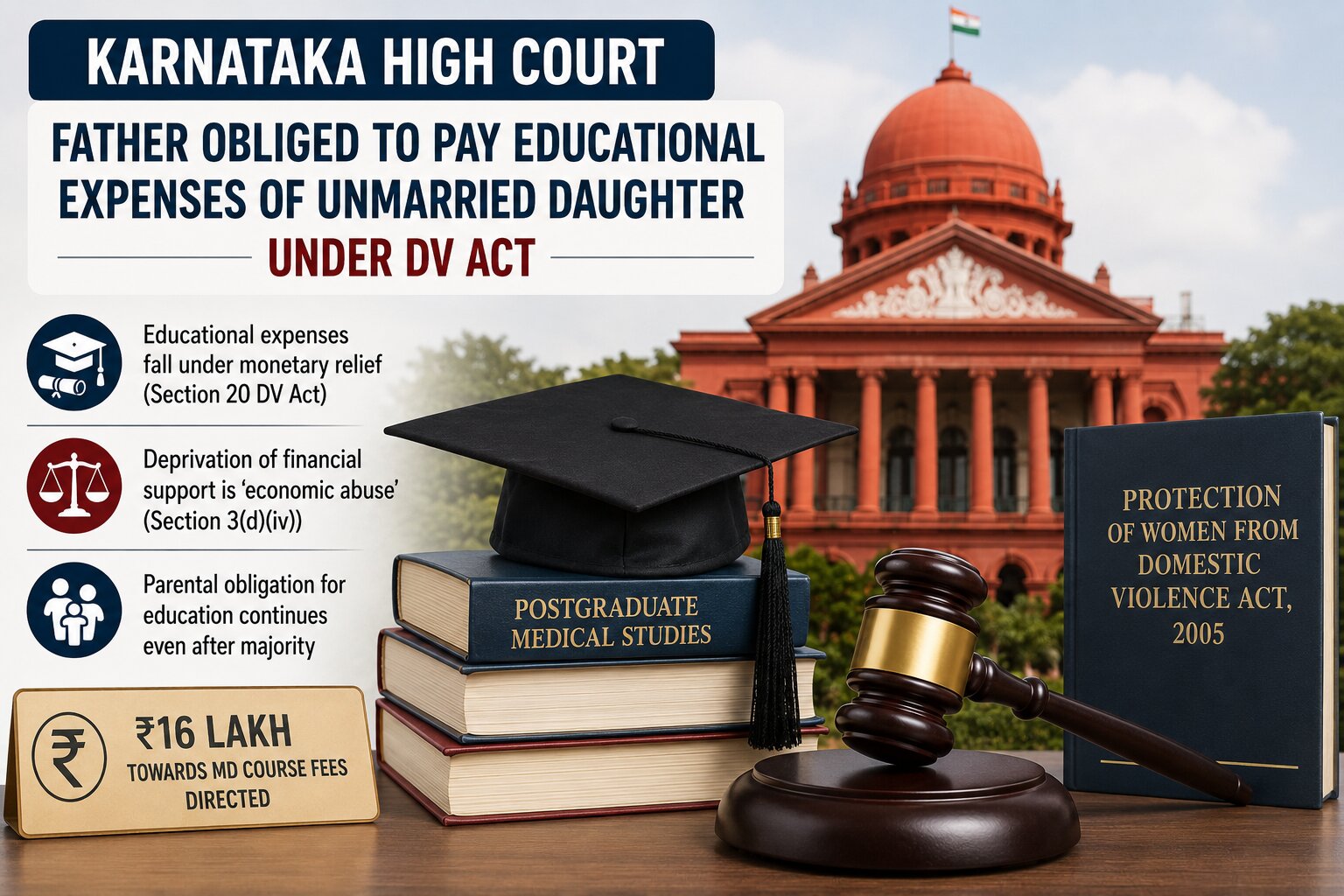
A father remains legally liable to bear the educational expenses of his unmarried daughter pursuing higher education even after she attains majority.
Judgement Details
Court
Karnataka High Court
Date of Decision
21 July 2026
Judges
Justice H.P. Sandesh
Citation
Acts / Provisions
Facts of the Case
-
The respondent was the unmarried daughter of the petitioner-father and had qualified the NEET-PG examination.
-
She secured admission to the MD Dermatology programme at Father Muller's Institute of Medical Education & Research, Mangaluru.
-
Due to the urgency of securing the postgraduate medical seat, she borrowed ₹14 lakh from her grandfather to pay the admission fee.
-
She sought monetary relief under the Protection of Women from Domestic Violence Act, 2005, seeking reimbursement of her educational expenses.
-
The Trial Court directed the father to pay ₹16 lakh towards the first-year course fee.
-
The appellate court affirmed the Trial Court's order.
-
The father challenged the concurrent findings before the Karnataka High Court through a criminal revision petition.
-
He argued that the daughter had already attained majority, was receiving a stipend during her postgraduate course, and therefore was not entitled to claim educational expenses under the DV Act.
-
He further contended that she did not fall within the definition of an "aggrieved person" under Section 2(a) of the DV Act.
-
The daughter maintained that despite attaining majority, she remained financially dependent while pursuing continuous higher education and that denial of educational expenses amounted to economic abuse.
Issues
-
Whether an unmarried daughter who has attained majority can claim educational expenses under the Protection of Women from Domestic Violence Act, 2005?
-
Whether educational expenses constitute monetary relief under Section 20 of the DV Act?
-
Whether denial of financial support for higher education amounts to "economic abuse" under Section 3(d)(iv) of the DV Act?
-
Whether a daughter pursuing postgraduate medical education continues to be an "aggrieved person" entitled to relief under the DV Act?
-
Whether the father's financial capacity justified the direction to pay ₹16 lakh towards the daughter's postgraduate medical education?
Judgement
-
The Karnataka High Court dismissed the father's revision petition.
-
The Court held that the obligation of parents to provide education does not automatically cease when a child attains majority.
-
The Court observed that educational expenses are covered within the scope of monetary relief under Section 20 of the DV Act.
-
It held that denial of financial support for education amounts to economic abuse under Section 3(d)(iv) of the Act.
-
The Bench rejected the father's contention that the daughter ceased to be entitled to relief merely because she had attained majority.
-
The Court reiterated that upon attaining majority, a daughter becomes a "woman" within the meaning of Section 2(a) of the DV Act and can independently seek monetary relief if subjected to domestic violence.
-
The Court relied upon the Supreme Court's decision in Neelima Choure v. Vijay Choure (2025) recognizing the legally enforceable right of a daughter to seek educational expenses from her parents.
-
The Court also relied upon its earlier judgment in Kum. Bhavana N. v. Sri Nagaraju S. and the Madras High Court's judgment in Jagadesan v. State of Tamil Nadu (2015).
-
It interpreted the expressions "but is not limited to" and "in addition to maintenance" in Section 20 broadly, holding that the Magistrate's powers are not confined only to maintenance.
-
The Court found that the father possessed sufficient financial capacity, noting his acquisition of substantial fixed assets and borrowings indicating financial strength.
-
It rejected the argument that the daughter should finance her education through a bank loan, observing that she was pursuing continuous education and was not independently earning.
-
Accordingly, the Court affirmed the orders directing payment of ₹16 lakh towards the daughter's MD Dermatology course fees.
Held
- Educational expenses fall within the scope of monetary relief under Section 20 of the DV Act.
-
Denial of educational expenses constitutes economic abuse under Section 3(d)(iv) of the DV Act.
-
A major unmarried daughter is an "aggrieved person" capable of independently seeking relief under the DV Act.
-
The father's financial capacity justified the direction to pay ₹16 lakh.
-
The revision petition was dismissed and the concurrent orders of the Trial Court and Appellate Court were affirmed.
Analysis
-
The judgment significantly expands the understanding of economic abuse under the DV Act by recognizing denial of educational support as a form of domestic violence.
-
The Court adopted a purposive interpretation of Section 20, emphasizing that monetary relief extends beyond conventional maintenance and includes educational expenses necessary for the child's welfare.
-
By relying on the expression "in addition to maintenance", the Court clarified that educational expenses constitute an independent head of monetary relief.
-
The decision harmonizes the protective objectives of the DV Act with evolving constitutional and societal recognition of higher education as an essential aspect of a child's development.
-
The Court reaffirmed that parental responsibility extends beyond attaining majority where the child continues to pursue uninterrupted higher education and remains financially dependent.
-
The judgment also emphasizes that the father's financial capacity is a relevant consideration while determining educational expenses.
-
By rejecting the suggestion that the daughter should depend upon educational loans, the Court prioritized parental responsibility over financial indebtedness of students.
-
The ruling strengthens the rights of daughters pursuing professional and postgraduate education and is likely to become an important precedent for claims relating to educational expenses under the DV Act.