
Vikrant Kotwal v. UT of J&K & Anr., 2026
The prima facie genuineness of the allegations is also a relevant consideration while deciding anticipatory bail.
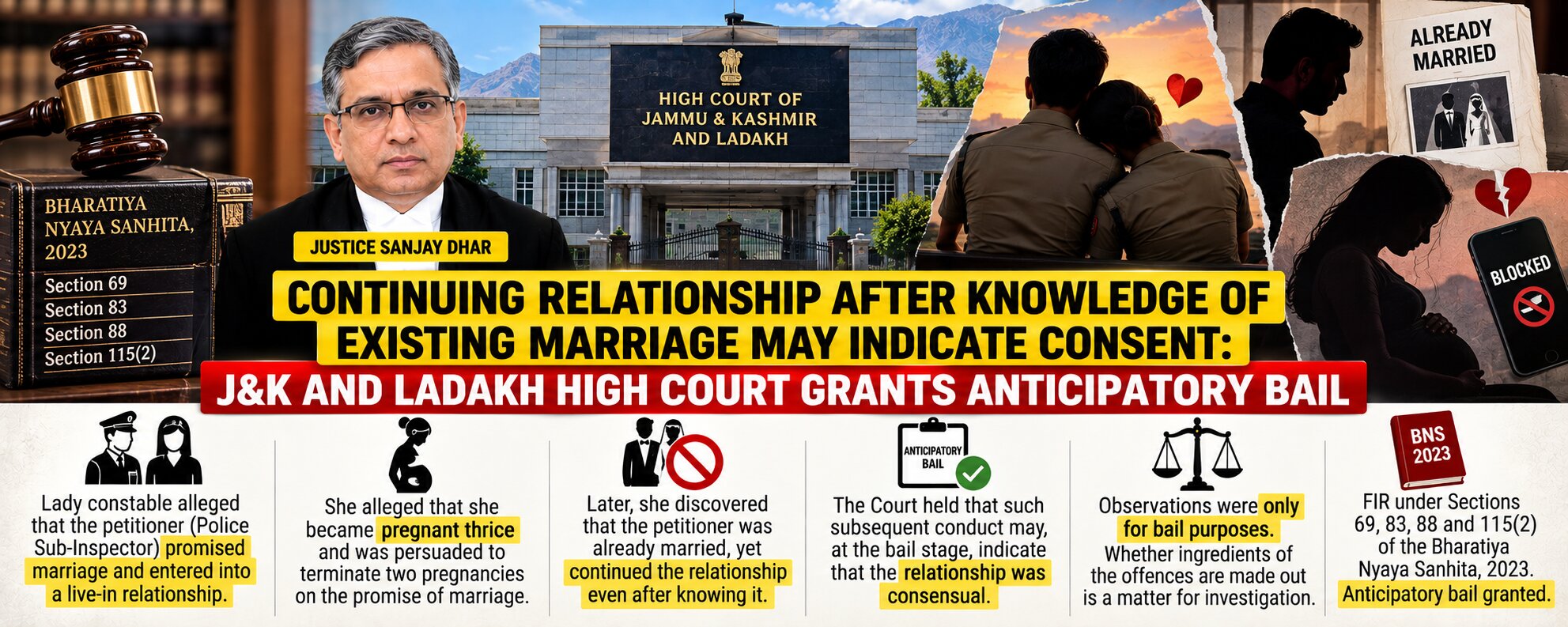
Judgement Details
Court
High Court of Jammu & Kashmir and Ladakh
Date of Decision
30 September 2026
Judges
Justice Sanjay Dhar
Citation
Acts / Provisions
Facts of the Case
-
The petitioner, Vikrant Kotwal, was serving as a Police Sub-Inspector.
-
The prosecutrix was a lady constable who came into contact with the petitioner in September 2024, when both were posted at Police Station Samba.
-
According to the prosecutrix, the petitioner proposed marriage to her and repeatedly assured her that he would marry her.
-
On the basis of these assurances, the two allegedly entered into a live-in relationship and lived together as husband and wife for several months.
-
The prosecutrix alleged that she became pregnant twice during the relationship.
-
She alleged that on both occasions the petitioner persuaded her to terminate the pregnancies by assuring her that they would marry.
-
The prosecutrix subsequently discovered that the petitioner was already married and had children.
-
According to the prosecutrix, even after learning about his existing marriage, the petitioner continued assuring her that he would not continue living with his wife and would eventually marry her.
-
She alleged that the petitioner repeatedly postponed the marriage while continuing the physical and emotional relationship.
-
The prosecutrix subsequently became pregnant for a third time.
-
According to her allegation, after she informed the petitioner about the third pregnancy, he blocked her.
-
Before registration of the FIR, the matter was examined through a fact-finding inquiry by the Additional SP, Samba.
-
The Inquiry Officer recommended a detailed investigation and recorded allegations concerning the petitioner's assurances and the alleged promise of marriage.
-
An FIR was thereafter registered at Police Station Samba under Sections 69, 83, 88 and 115(2) of the Bharatiya Nyaya Sanhita, 2023.
-
The petitioner apprehended arrest and approached the Principal Sessions Judge, Samba seeking anticipatory bail.
-
The Sessions Court rejected the anticipatory bail application.
-
The Sessions Court took the view that the material indicated that the petitioner had repeatedly promised marriage and allegedly obtained sexual relations on the assurance that he would marry the prosecutrix.
-
The petitioner then approached the High Court.
-
Before the High Court, the petitioner argued that the FIR itself disclosed a prolonged relationship between two adults and that there was insufficient material at the bail stage to establish that the prosecutrix's consent had been obtained because of a false promise of marriage.
-
The High Court examined the chronology of the relationship and, particularly, the conduct of the prosecutrix after she became aware that the petitioner was already married.
Issues
-
Whether the continued consensual relationship between two adults after the prosecutrix became aware of the petitioner's existing marriage is relevant at the stage of considering anticipatory bail?
-
Whether the subsequent conduct of the prosecutrix in continuing the relationship despite knowledge of the petitioner's marital status can, at the bail stage, give rise to an inference that the relationship was consensual rather than based upon a misconception of fact?
-
Whether the allegations disclose a prima facie case that the petitioner obtained the prosecutrix's consent through a false promise of marriage within the meaning of Section 69 of the Bharatiya Nyaya Sanhita, 2023?
-
Whether the gravity of the offences alleged, by itself, is sufficient to deny anticipatory bail without considering the prima facie genuineness of the allegations?
-
Whether the petitioner's status as a serving police officer, his participation in the preliminary inquiry and his continued availability to the department reduce the possibility of his absconding or evading investigation?
Judgement
-
The High Court allowed the anticipatory bail application filed by Vikrant Kotwal.
-
The Court held that the gravity of the alleged offences is an important consideration, but it is not the only consideration while deciding an application for anticipatory bail.
-
The Court observed that the prima facie genuineness of the allegations must also be examined while determining whether anticipatory bail should be granted.
-
The Court examined the chronology of the relationship between the petitioner and the prosecutrix.
-
The Court noted that the prosecutrix initially claimed that she was unaware of the petitioner's existing marriage.
-
However, according to the material before the Court, she subsequently became aware that the petitioner was already married and had children.
-
Despite acquiring this knowledge, she continued the relationship with the petitioner.
-
The Court also considered the fact that the relationship continued for a considerable period and that the prosecutrix allegedly conceived for a third time after learning of the petitioner's marital status.
-
The Court treated this subsequent conduct as relevant to assessing, at the limited bail stage, whether the relationship was based upon a misconception of fact arising from a promise of marriage.
-
The Court observed that these circumstances created a genuine doubt concerning the allegation that the prosecutrix's consent throughout the relationship was based upon a false promise of marriage.
-
The Court referred to the distinction between a genuine promise to marry that is subsequently not fulfilled and a promise that was false from the very beginning and made with an intention to deceive.
-
The Court nevertheless clarified that it was not making a final determination on the merits of the allegations.
-
The Court held that the question whether the ingredients of the alleged offences were ultimately established would have to be examined during investigation and, if necessary, trial.
-
The State argued that the petitioner was absconding and was not cooperating with the investigation.
-
The High Court noted that the petitioner had appeared before the Inquiry Officer and answered the questionnaire served upon him.
-
The Court also considered that the petitioner remained a serving police employee and was subject to the investigative and disciplinary control of the department.
-
In these circumstances, the Court considered the possibility of the petitioner absconding to be limited.
-
The High Court therefore directed that, in the event of arrest, the petitioner be released on bail subject to appropriate conditions.
Held
-
The gravity of the alleged offence alone is not sufficient to reject an application for anticipatory bail.
-
Where an adult prosecutrix continues a relationship after becoming aware of the accused's existing marriage, such subsequent conduct may be relevant at the bail stage in assessing whether the relationship was based upon a misconception of fact.
-
The continuation of the relationship despite knowledge of the existing marriage may, in the circumstances of a particular case, give rise to an inference of consensual conduct at the preliminary bail stage.
-
The Court must distinguish between a genuine promise to marry that is subsequently not fulfilled and a promise allegedly made from the beginning with an intention to deceive.
-
The High Court's observations were confined to the consideration of anticipatory bail and did not constitute a final finding on guilt or innocence.
-
The question whether the ingredients of the alleged offences were ultimately established was left to the investigating agency and the competent court.
-
The petitioner's continued service in the police department, his participation in the preliminary inquiry and his availability to the authorities were relevant to assessing the possibility of absconding.
-
The petitioner was therefore granted anticipatory bail subject to appropriate conditions.
Analysis
-
Anticipatory bail is discretionary: The judgment reiterates that anticipatory bail requires the court to balance the seriousness of the allegations with the circumstances indicating whether custodial arrest is necessary.
-
Gravity is not the sole test: Even where allegations involve serious offences, the court must examine whether the accusations appear prima facie genuine and whether arrest is justified in the circumstances.
-
Promise of marriage and Section 69 BNS: Section 69 addresses sexual intercourse obtained through specified deceitful means, including a promise to marry made without an intention to fulfil it. Therefore, the distinction between a false promise from inception and a genuine promise subsequently not fulfilled is legally significant.
-
Timing of knowledge: The Court considered the point at which the prosecutrix became aware of the petitioner's existing marriage. Her conduct after acquiring that knowledge became relevant to the Court's preliminary assessment.
-
Subsequent conduct: The Court treated the continuation of the relationship after knowledge of the existing marriage as a circumstance capable of creating doubt about whether the entire relationship was founded upon a misconception of fact.
-
Limited bail-stage assessment: Importantly, the Court did not conclusively determine whether the relationship was consensual or whether the allegations were false. It only considered whether the available material justified the extraordinary step of arrest at that stage.
-
No final finding of consent: The observation concerning consent was expressly confined to the anticipatory-bail stage. The investigating agency and trial court remain free to assess the evidence according to law.
-
Distinction between broken promise and false promise: The judgment relies upon the established distinction that the mere failure to fulfil a promise to marry does not automatically establish that the promise was false from the outset.
-
Prolonged relationship: The Court considered the length and nature of the relationship, including the allegation that the parties lived together and that the prosecutrix became pregnant multiple times.
-
Existing marriage: Knowledge of the petitioner's existing marriage became particularly important because the alleged promise of marriage had to be assessed against the factual circumstances known to the prosecutrix during the later period of the relationship.
-
Possibility of absconding: The Court considered the petitioner's status as a serving police officer and his participation in the preliminary inquiry while assessing whether custodial arrest was necessary.
-
Investigation versus adjudication: The High Court recognised that the investigation was still ongoing. Questions concerning the ultimate truth of the allegations were therefore left open.
-
Protection of liberty: Anticipatory bail protects personal liberty where arrest is not shown to be necessary, while still allowing the investigation to proceed subject to conditions.
-
Caution regarding the ruling: The judgment should not be read as establishing that continuation of a relationship after knowledge of an existing marriage automatically proves consent or defeats a prosecution. The relevance of such conduct depends upon the facts and the stage of proceedings.
-
Practical significance: The case illustrates that, in allegations involving a promise of marriage, courts at the bail stage may examine the complete chronology of the relationship, including what the parties knew and how they behaved after material facts became known.