
Vikram Singh v. State of Rajasthan, 2026
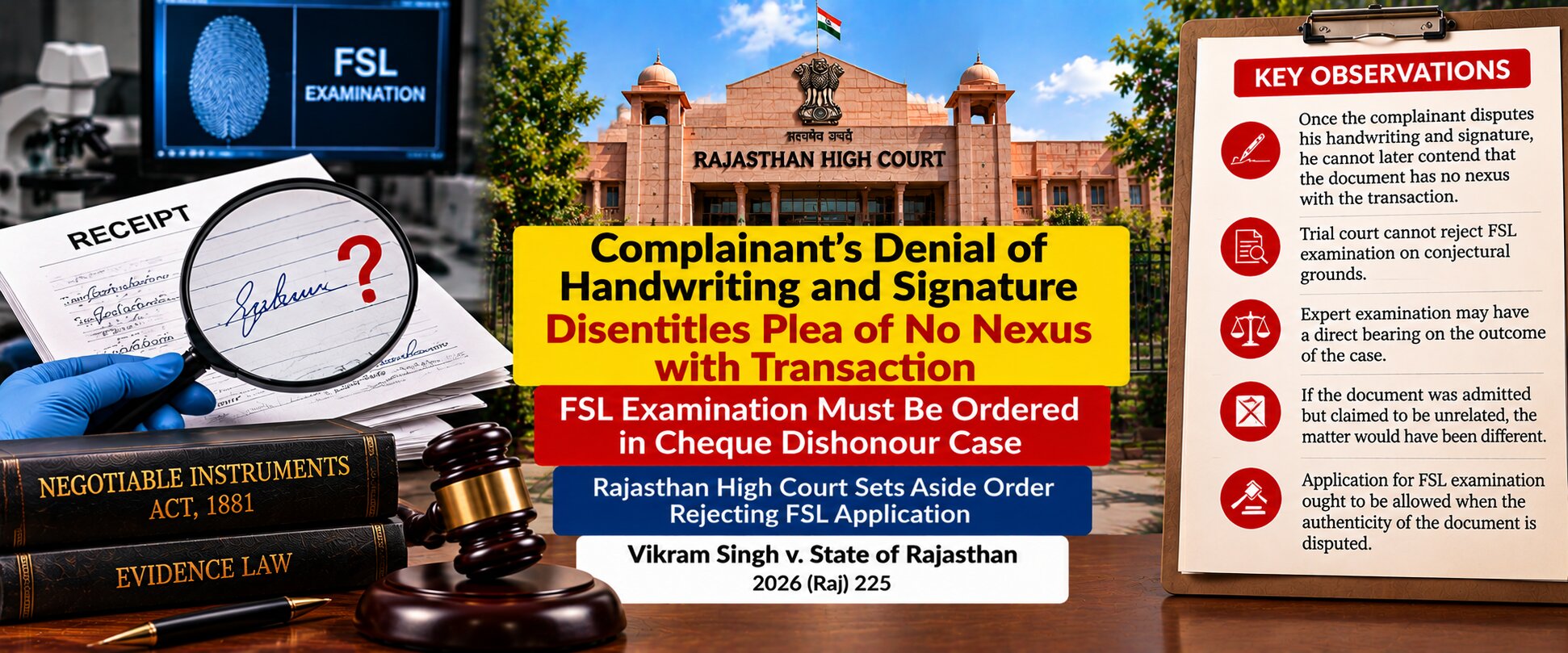
Where a document relied upon by the accused may have a bearing on the transaction underlying a Section 138 NI Act prosecution, its forensic examination can be relevant.
Judgement Details
Court
Rajasthan High Court
Date of Decision
1 September 2026
Judges
Justice Farjand Ali
Citation
Acts / Provisions
Facts of the Case
-
The petitioner was facing prosecution under Section 138 of the Negotiable Instruments Act, 1881 in connection with a cheque dishonour case.
-
During the proceedings, after his statement was recorded, the petitioner produced a document marked as Exhibit D01A.
-
The petitioner claimed that Exhibit D01A was a receipt relating to the very amount involved in the cheque dishonour complaint.
-
The complainant, however, categorically denied the authenticity of the document.
-
Significantly, the complainant did not merely contend that the receipt was unrelated to the transaction. He specifically denied both the signatures and the handwriting appearing on Exhibit D01A.
-
Taking the position that the document was relevant to the disputed transaction, the petitioner moved an application seeking that the document be sent to the Forensic Science Laboratory (FSL) for examination of the handwriting and signatures.
-
The trial court rejected the application on the reasoning that forensic verification of the document would have no bearing on the ultimate outcome of the trial.
-
Aggrieved by the rejection, the petitioner approached the Rajasthan High Court.
-
Before the High Court, the petitioner contended that the disputed receipt could have a direct bearing on the cheque dishonour proceedings and that its authenticity could appropriately be tested through expert examination.
Issues
-
Whether the trial court was justified in refusing to send Exhibit D01A to the FSL on the assumption that its examination would have no bearing on the outcome of the trial?
-
Whether the complainant's categorical denial of both the handwriting and signatures appearing on the disputed receipt justified forensic examination of the document?
-
Whether a document relied upon by the accused as a receipt concerning the amount involved in the complaint could be subjected to expert examination when its execution and authenticity were specifically disputed?
-
Whether the trial court's rejection of the FSL application on conjectural grounds was sustainable in law?
Judgement
-
The Rajasthan High Court allowed the petition and set aside the order of the trial court.
-
The Court found that the trial court had rejected the application on “conjectural premises.”
-
The High Court observed that the complainant had taken a categorical stand that the handwriting and signatures appearing on Exhibit D01A were not his.
-
According to the Court, the situation would have been materially different if the complainant had admitted execution of the receipt but had explained that the receipt related to some transaction other than the one forming the subject matter of the complaint.
-
However, once the complainant completely denied the handwriting and signatures, the authenticity of the document itself became a matter requiring appropriate examination.
-
The Court held that forensic examination of the disputed document might have a direct bearing on the outcome of the case.
-
The trial court therefore ought not to have rejected the application merely on the assumption that FSL examination would be irrelevant.
-
The impugned order was consequently held to be unsustainable in law and set aside.
-
The trial court was directed to send the disputed document to the FSL for examination.
Held
-
A complainant who categorically disputes both the handwriting and signatures on a document cannot simultaneously seek to treat the document as merely unrelated to the transaction without addressing its authenticity.
-
The trial court should not reject an application for expert examination on the basis of conjecture regarding its possible evidentiary value.
-
The potential relevance of expert examination must be assessed in light of the defence taken and the disputed facts.
-
The disputed receipt was therefore directed to be examined by the FSL.
Analysis
-
Disputed document was central to the defence: Exhibit D01A was not an unrelated document introduced incidentally. The accused specifically claimed that it was a receipt concerning the same amount that formed the subject matter of the cheque dishonour complaint. Its authenticity could therefore potentially affect the factual controversy.
-
Importance of the complainant's stand: The High Court drew a distinction between two possible positions. If the complainant had accepted that he executed the receipt but argued that it related to another transaction, the Court could examine the question of nexus separately. Here, however, the complainant denied the very handwriting and signatures on the document.
-
Forensic examination as an evidentiary aid: Once authorship and execution were specifically disputed, scientific examination could assist the trial court in determining whether the document was genuinely connected with the complainant.
-
Trial court could not prejudge the evidentiary value: The High Court found that the lower court had effectively concluded in advance that the FSL report could not affect the trial. The High Court considered this approach conjectural because the relevance of the report depended upon what the scientific examination ultimately established and how that evidence interacted with the other evidence.
-
Defence opportunity in cheque dishonour proceedings: Proceedings under Section 138 NI Act involve determination of legally relevant factual issues concerning the cheque, underlying liability and the defences raised by the accused. A defence document having a potential connection with the disputed amount should not ordinarily be excluded merely because the trial court assumes beforehand that it will not matter.
-
Distinction between authenticity and relevance: The case highlights that when a party disputes the execution of a document, the question of whether the document is genuine can itself become an evidentiary issue. Its ultimate weight is a matter for adjudication after the evidence is properly tested.
-
No final finding on genuineness: Importantly, the High Court did not itself declare Exhibit D01A to be genuine or forged. It only held that the circumstances warranted forensic examination and directed the FSL process.
-
Practical significance: The ruling reinforces that applications for expert examination should be considered on the basis of the document's potential connection with the issues in the case rather than on speculative assumptions about what the eventual expert report may show.