
Vikas Sharma v. State of U.P. and Another, 2026
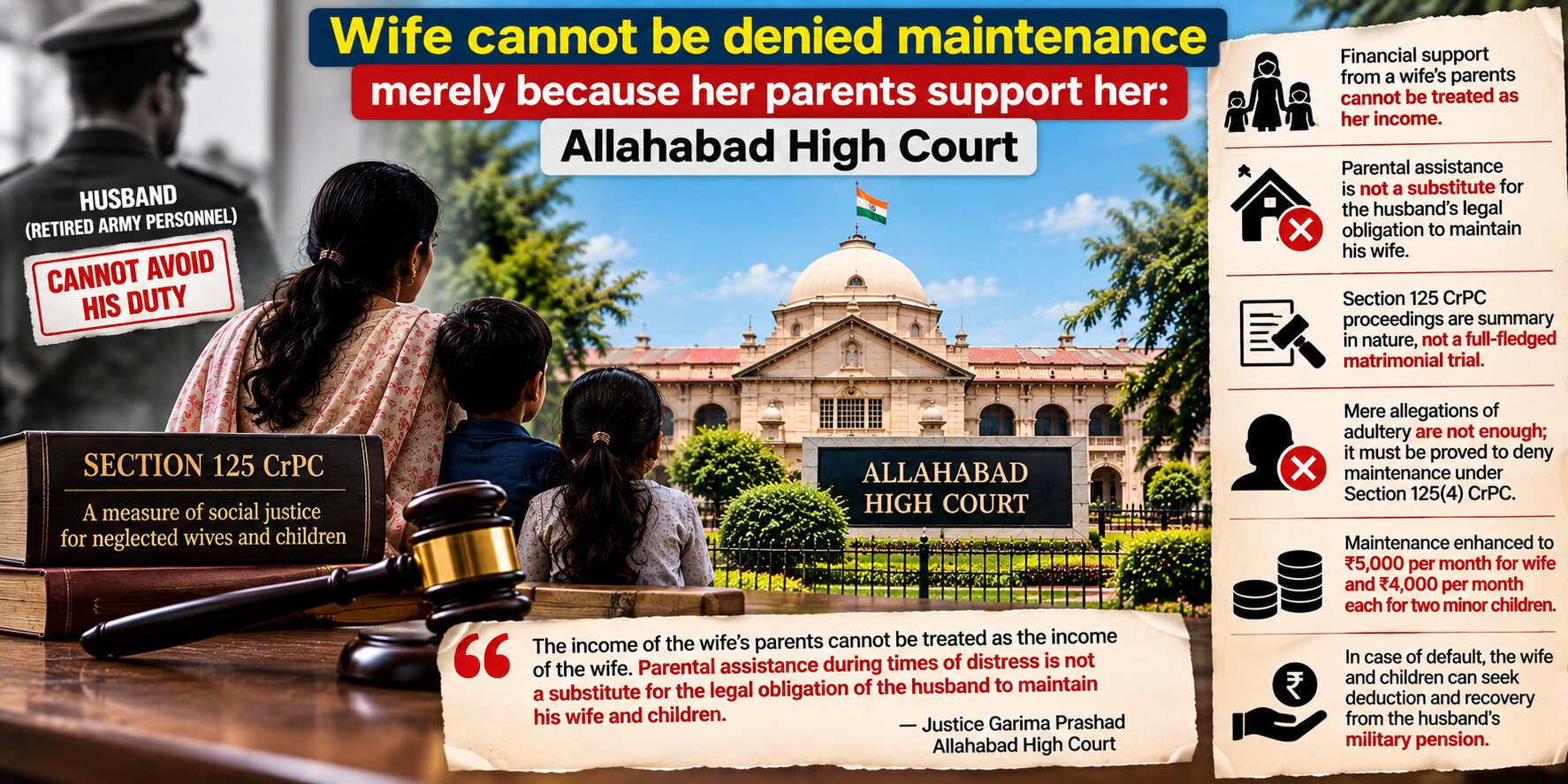
Section 125 CrPC is a social-justice provision intended to prevent destitution and provide basic financial security to neglected wives and children.
Judgement Details
Court
High Court of Allahabad
Date of Decision
8 September 2026
Judges
Justice Garima Prashad
Citation
Acts / Provisions
Facts of the Case
-
The revisionist-wife approached the Family Court, Bulandshahr seeking maintenance from her husband under Section 125 CrPC.
-
The wife also sought maintenance for her two minor children.
-
She alleged that after marriage she was subjected to harassment, taunts and cruelty by her husband and his family members.
-
She further alleged that the husband had stopped maintaining normal marital relations with her and subsequently informed her that he had married another woman.
-
According to the wife, she was assaulted in January 2020 and expelled from the matrimonial home along with her two children.
-
Thereafter, she began residing at her parental home with the children.
-
She asserted that she had no independent source of income and was dependent upon her parents for financial support.
-
The husband was a retired Army personnel.
-
The husband disputed the wife's allegations and claimed that she had voluntarily left the matrimonial home without sufficient cause.
-
He further alleged that the wife was maintaining illicit relations with certain persons.
-
The husband stated that during his Army service, approximately ₹11,303 per month was deducted from his salary and paid towards the maintenance of his wife and children.
-
He retired from Army service in November 2020.
-
After retirement, he claimed to be receiving a pension of approximately ₹21,025 per month and asserted that he had no other source of income.
-
The Family Court, Bulandshahr, rejected the wife's claim for maintenance.
-
The Family Court reasoned that the wife had failed to prove specific incidents of dowry demand, assault or the alleged second marriage.
-
The Family Court also found that the allegations made by both sides remained unsubstantiated.
-
On that basis, it concluded that the wife had failed to establish cruelty and was residing separately without sufficient cause.
-
However, the Family Court awarded ₹3,000 per month to each of the two minor children.
-
Aggrieved by the rejection of her own maintenance claim and the amount awarded to the children, the wife and her two minor children approached the Allahabad High Court through a criminal revision.
-
Before the High Court, the wife argued that the Family Court had incorrectly treated the Section 125 proceedings as though they were a full-fledged matrimonial trial.
-
She contended that the object of Section 125 was to prevent destitution and provide basic financial security to neglected dependants.
-
She also pointed out that the husband had admitted that he had not paid maintenance to the wife and children after November 2020.
Issues
-
Whether the Family Court was justified in denying maintenance to the wife merely because she failed to prove specific allegations of cruelty, dowry harassment, assault or second marriage in proceedings under Section 125 CrPC?
-
Whether the wife could be treated as residing separately without sufficient cause when the parties were admittedly living separately amid serious matrimonial discord and the husband had not maintained her after November 2020?
-
Whether mere allegations or suspicion of adultery were sufficient to attract the bar contained in Section 125(4) CrPC?
-
Whether financial assistance provided by the wife's parents could be treated as the wife's own income so as to disentitle her from claiming maintenance from her husband?
-
Whether the maintenance of ₹3,000 per month awarded to each minor child by the Family Court was adequate having regard to their reasonable needs and prevailing living expenses?
-
Whether the husband's failure to fully disclose his financial assets, agricultural holdings and dairy activities justified drawing an adverse inference against him while determining maintenance?
-
Whether the High Court was justified in modifying the Family Court's order and enhancing maintenance to ₹5,000 per month for the wife and ₹4,000 per month for each minor child?
Judgement
-
The Allahabad High Court allowed the criminal revision filed by the wife and her two minor children and modified the Family Court's order.
-
The High Court held that the Family Court had adopted an unsustainable approach in deciding the wife's maintenance claim.
-
Justice Garima Prashad clarified that proceedings under Section 125 CrPC are summary proceedings and are not intended to become a complete trial into every allegation and counter-allegation concerning matrimonial misconduct.
-
The Court held that the relevant inquiry was whether the wife had a reasonable ground to live separately and whether the husband, despite having sufficient means, had neglected or refused to maintain her.
-
The Court specifically stated that the standard applicable in Section 125 proceedings is not the same as proof beyond reasonable doubt required in a criminal prosecution.
-
The High Court took note of the admitted circumstances that there was serious matrimonial discord between the parties, that the wife and children were living separately, and that the husband had admitted that he had not paid maintenance after November 2020.
-
The Court held that these circumstances were sufficient to show that the wife could not simply be treated as living separately without cause.
-
The Court further observed that where the husband himself had initiated divorce proceedings, the parties were admittedly living separately because of serious matrimonial discord and the wife had custody of two minor children, it would be inappropriate to lightly conclude that the wife had no sufficient reason to reside separately.
-
Regarding the allegation of adultery, the High Court found that the husband had not produced any independent witness, document or reliable material establishing that the wife was living in adultery.
-
The Court held that the statutory bar under Section 125(4) CrPC requires proof of living in adultery and cannot be triggered merely by allegations, suspicion or character assassination.
-
On the wife's financial position, the Court found no evidence establishing that she possessed sufficient independent income.
-
The Court held that the financial assistance provided by the wife's parents could not be treated as the wife's own income.
-
The Court emphasized that parental assistance during financial distress cannot substitute the husband's statutory obligation to maintain his wife and children.
-
The Court also considered the husband's failure to make complete disclosure of his financial circumstances.
-
He had not fully disclosed information relating to his financial assets, family agricultural holdings and dairy activities.
-
Since such information was within his exclusive possession or knowledge, the High Court drew an adverse inference against him.
-
The High Court found that the Family Court's award of ₹3,000 per month for each child was “wholly inadequate” and unrealistic.
-
The Court observed that such an amount was insufficient even to reasonably meet the basic expenses of school-going children, including food, clothing, education, books, transportation and medical requirements.
-
The High Court accordingly modified the Family Court's order.
-
The husband was directed to pay ₹5,000 per month to the wife.
-
The maintenance for each of the two minor children was enhanced to ₹4,000 per month each.
-
The Court further provided an enforcement mechanism by observing that, in case of default, the wife and children could approach the competent court for deduction and recovery of the maintenance amount from the husband's military pension and other lawful receivables.
Held
-
A Section 125 proceeding should not be converted into a full-fledged trial concerning every allegation of matrimonial misconduct.
-
The wife is not required to prove cruelty with the same strictness as would be required in a criminal prosecution or a contested matrimonial proceeding.
-
The relevant inquiry is whether the wife has a reasonable ground for living separately and whether the husband, despite having means, has neglected or refused to maintain her.
-
The fact that specific allegations of cruelty or second marriage were not conclusively proved did not automatically defeat the wife's maintenance claim.
-
Mere allegations of adultery do not attract Section 125(4) CrPC.
-
The bar under Section 125(4) applies only where the wife is proved to be living in adultery.
-
Financial assistance provided by the wife's parents cannot be treated as the wife's own income.
-
Parental support does not substitute the husband's statutory duty of maintenance.
-
The husband cannot avoid his maintenance obligation merely by relying upon the fact that the wife's parents are supporting her.
-
Where the wife has no sufficient independent income, she cannot be denied maintenance merely because her parents are meeting some of her expenses.
-
The maintenance of ₹3,000 per month awarded to each minor child was inadequate in the circumstances.
-
Failure of the husband to disclose material financial information justified an adverse inference against him.
-
The husband was liable to pay ₹5,000 per month to the wife and ₹4,000 per month to each minor child.
Analysis
-
Parental support does not extinguish the husband's maintenance obligation.
-
The wife's parents' income cannot automatically be treated as the wife's income.
-
Section 125 proceedings should not become a full-fledged trial concerning every matrimonial allegation.
-
Strict proof of cruelty is not the controlling test for determining entitlement to maintenance under Section 125.
-
Mere allegations of adultery cannot defeat a wife's maintenance claim.
-
The husband bears a continuing legal obligation to maintain his wife and minor children when the statutory requirements are satisfied.
-
Courts can draw an adverse inference where a husband withholds material financial information.
-
Maintenance for children must be realistic and sufficient to meet reasonable living and educational expenses.
-
The decision also emphasizes that maintenance orders should have an effective enforcement mechanism.