
Vijayalakshmi R. v. C. L. Balaji, 2026
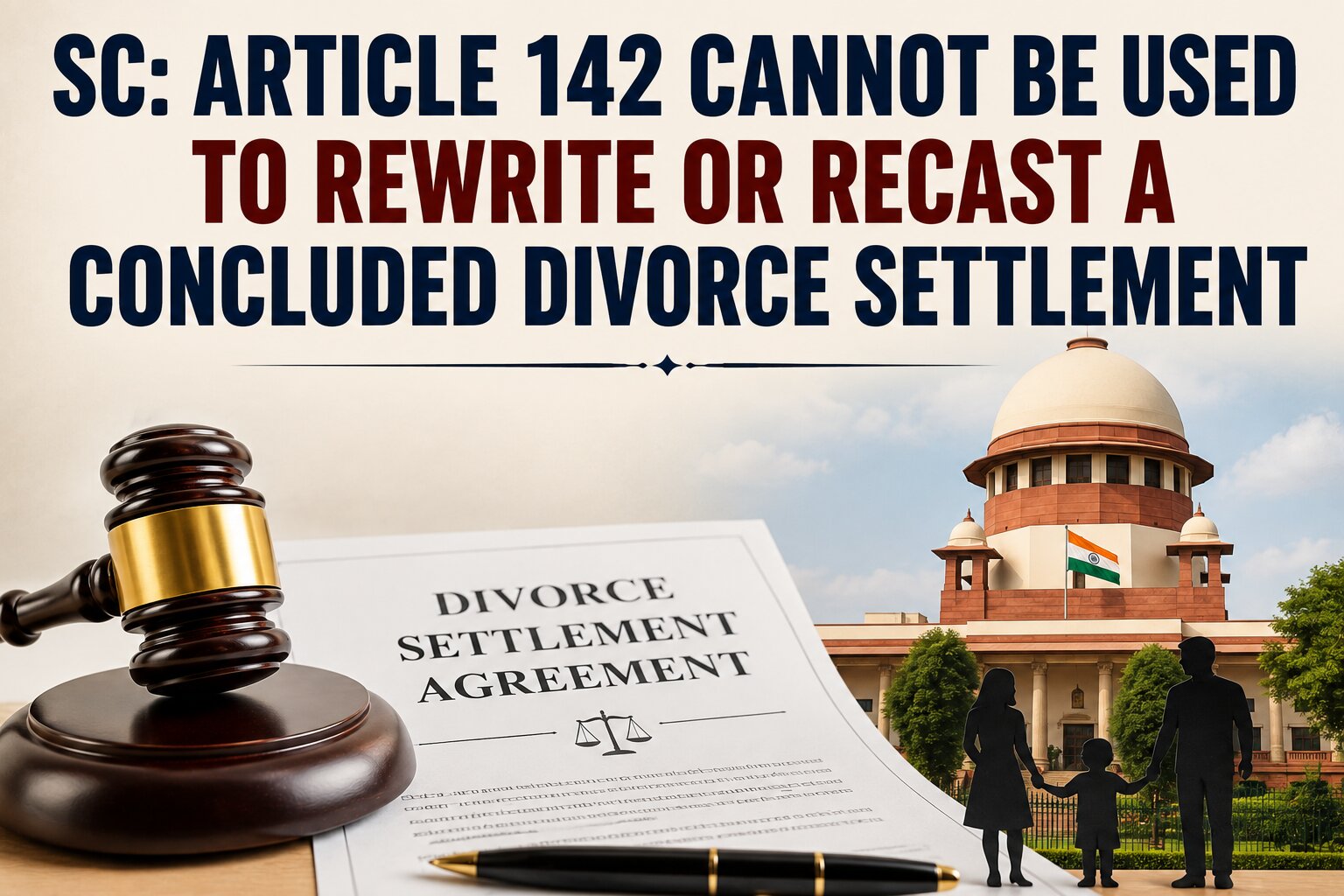
Article 142 Cannot Rewrite a Concluded Divorce Settlement.
Judgement Details
Court
Justice Sanjay Karol and Justice Augustine George Masih
Date of Decision
13 August 2026
Judges
Justice Sanjay Karol and Justice Augustine George Masih
Citation
Acts / Provisions
Facts of the Case
-
The parties' marriage was dissolved by mutual consent in 2015.
-
They entered into a settlement concerning maintenance of their minor son.
-
Under the settlement, the husband agreed to pay ₹2.20 crore as a lump sum towards the child's maintenance.
-
The settlement also contained a provision concerning payment of 20% of the husband's annual income towards the child's maintenance.
-
Another clause provided that after payment of ₹1 crore, the husband would have no further maintenance liability, with the remaining amount also being paid under the settlement.
-
The husband ultimately paid the entire ₹2.20 crore by July 2017.
-
Nearly five years later, the wife filed an execution petition seeking enforcement of the clause requiring payment of 20% of the husband's annual income.
-
The Family Court rejected her claim, finding that the settlement had been fully discharged.
-
The High Court upheld the Family Court's decision.
-
The wife approached the Supreme Court challenging those findings.
-
She additionally sought exercise of Article 142 to create a corpus of approximately ₹6 crore to ₹6.50 crore for her son's higher education.
-
The Supreme Court examined whether Article 142 could be used to reopen or modify a settlement that had already been fully performed.
Issues
-
Whether the Supreme Court can exercise its jurisdiction under Article 142 of the Constitution to modify or recast a consensual divorce settlement that has already been fully performed?
-
Whether a wife can seek enforcement of an additional maintenance obligation after the husband has discharged the settlement by making the agreed lump-sum payment?
-
Whether Article 142 can be invoked to create a fresh corpus for the higher education of a child when such an obligation was not part of the concluded settlement?
-
Whether exercise of Article 142 in such circumstances would amount to undertaking a fresh determination of maintenance between the parties?
Judgement
-
The Supreme Court dismissed the wife's plea.
-
The Court declined to interfere with the Family Court and High Court findings.
-
It held that the settlement had been fully performed and discharged after payment of the agreed ₹2.20 crore.
-
The Court refused to reopen the concluded arrangement through Article 142.
-
The request to create an additional corpus of approximately ₹6–6.50 crore for the son's higher education was rejected.
-
The Court held that doing so would effectively recast the settlement between the parties.
-
Article 142, despite its wide scope, cannot be used to substitute new terms for a consensual arrangement that has already been acted upon.
-
The Court consequently declined to impose a fresh maintenance obligation upon the husband.
Held
-
Article 142 cannot be used to rewrite or supplement a concluded and fully performed consensual settlement.
-
The Supreme Court's power to do complete justice does not authorise it to disregard the terms voluntarily agreed upon by the parties.
-
Once the settlement has been fully performed and discharged, reopening it requires more than merely invoking Article 142.
-
Creating a new corpus for the child's higher education would amount to a fresh determination of maintenance.
-
Such a fresh determination was not permissible in the execution proceedings before the Court.
-
The wife's claim for additional financial provision was therefore rejected.
Analysis
-
Article 142 is wide but not unlimited: The Court reaffirmed that the power to do complete justice is extraordinary, but it cannot be used indiscriminately to rewrite contractual or consensual arrangements.
-
Finality of settlements: The judgment reinforces the importance of finality in matrimonial settlements. Parties who voluntarily settle financial obligations should ordinarily be able to rely upon the concluded terms.
-
Settlement already discharged: The husband's payment of the full ₹2.20 crore was central to the Court's reasoning. Once the agreed obligation had been completely performed, the settlement could not simply be reopened through execution proceedings.
-
Execution cannot become fresh adjudication: Execution proceedings are ordinarily concerned with enforcing an existing obligation. They should not become a vehicle for creating a substantially new maintenance liability.
-
Article 142 and maintenance: The Court distinguished between using Article 142 to prevent injustice in an appropriate case and using it to impose a new financial obligation that was never part of the concluded settlement.
-
Child's education: The Court did not suggest that a child's educational needs are unimportant. Rather, it held that the requested additional corpus could not be imposed through Article 142 in the circumstances of this already concluded settlement.
-
Consensual arrangements: The decision protects the principle that courts should respect agreements voluntarily entered into by parties, particularly where those arrangements have been completely acted upon.
-
Finality versus continuing needs: Matrimonial financial obligations can sometimes involve continuing circumstances, but the Court held that the particular settlement before it had been concluded and discharged, preventing the requested reopening in the present proceedings.
-
Practical significance: Parties entering divorce settlements should clearly specify continuing maintenance obligations, educational expenses, escalation clauses and future contingencies to avoid later disputes about interpretation or enforcement.