
Vijay Kumar v. State of Chhattisgarh, 2026
The Court noted that the defence had failed to explain why the victim's clothes were found in a torn condition if the relationship was genuinely consensual.
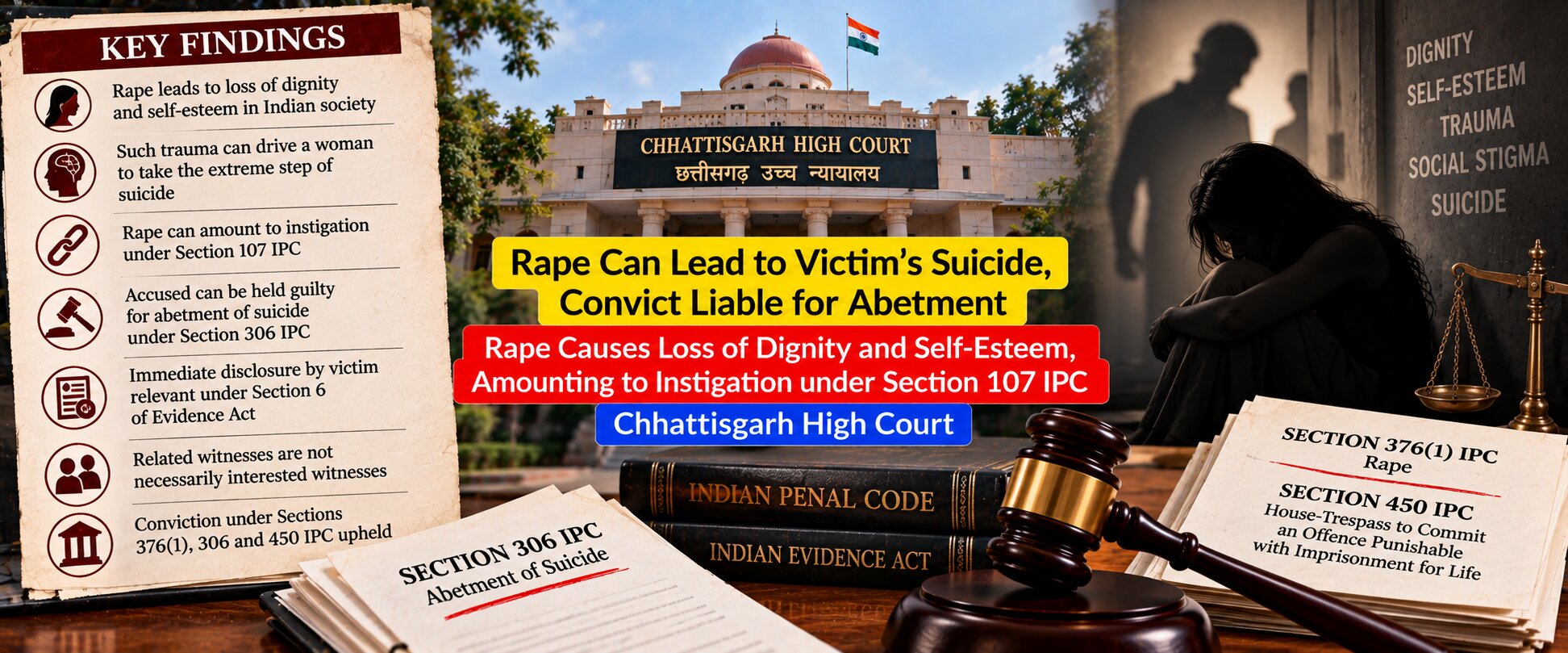
Judgement Details
Court
Chhattisgarh High Court
Date of Decision
2 September 2026
Judges
Justice Narendra Kumar Vyas
Citation
Acts / Provisions
Facts of the Case
-
The appellant, Vijay Kumar, challenged the judgment of the First Additional Sessions Judge, Baloda Bazar, which had convicted him for offences under Sections 376(1), 306 and 450 IPC.
-
The prosecution case related to an incident dated 22 August 2004.
-
The deceased woman was residing with her brother and sister-in-law.
-
According to the prosecution, while the deceased was alone in the house, the appellant entered the house, closed the door and forcibly committed sexual intercourse with her against her will and without her consent.
-
When the woman's brother returned to the house and called for the door to be opened, the victim raised an alarm.
-
After the door was opened, she allegedly told her brother that the appellant had committed rape upon her.
-
The brother caught hold of the appellant and assaulted him with a stick.
-
The appellant thereafter fled from the spot.
-
Shortly thereafter, the victim poured kerosene upon herself and set herself on fire.
-
She sustained extensive burn injuries and died on the same day while being taken for medical treatment.
-
Before her death, the victim allegedly told her sister-in-law that the appellant had raped her and that the sexual assault was the reason for her taking the extreme step.
-
The prosecution relied substantially upon the evidence of the deceased's brother and sister-in-law, who testified about the victim's immediate disclosure.
-
The prosecution also relied upon physical and forensic evidence, including the condition of the victim's clothes and the presence of sperm/semen stains.
-
The medical officer was unable to give a definite opinion regarding recent sexual assault because the victim had suffered approximately 85% burns, including burns to her private parts.
-
The defence attempted to establish that the appellant and the deceased were involved in a romantic relationship.
-
The defence relied upon certain letters allegedly written by the deceased to the appellant to suggest that the sexual relationship was consensual.
-
The defence also argued that the victim may have committed suicide because she was allegedly discovered in a compromising situation by her brother.
-
The appellant further argued that the prosecution had failed to establish the necessary ingredients of abetment of suicide under Section 306 IPC, particularly the requirement of instigation under Section 107 IPC.
-
The trial court rejected the defence and convicted the appellant.
-
The appellant thereafter preferred the present criminal appeal under Section 374(2) CrPC.
Issues
-
Whether the appellant forcibly committed sexual intercourse with the deceased against her will and without her consent, thereby committing an offence under Section 376(1) IPC?
-
Whether the appellant committed house-trespass with the intention of committing an offence punishable with imprisonment for life, thereby attracting Section 450 IPC?
-
Whether the evidence of the deceased's brother and sister-in-law was sufficient to establish the prosecution case despite their relationship with the deceased?
-
Whether the victim's statements made immediately after the incident were relevant and admissible under Section 6 of the Indian Evidence Act as part of the same transaction?
-
Whether the evidence regarding the victim's torn clothes and forensic material supported the prosecution case of forcible sexual assault rather than the defence theory of a consensual relationship?
-
Whether the forcible sexual assault committed by the appellant constituted instigation within the meaning of Section 107 IPC?
-
Whether the appellant could be held guilty under Section 306 IPC where the victim committed suicide on the same day following the alleged rape?
-
Whether the trial court's conviction under Sections 376(1), 450 and 306 IPC suffered from any illegality or perversity warranting interference in appeal?
Judgement
-
The Chhattisgarh High Court dismissed the criminal appeal and affirmed the conviction and sentences imposed by the trial court.
-
The Court held that the prosecution had established the commission of rape by the appellant beyond reasonable doubt.
-
The evidence of the deceased's brother was found material because he returned to the house, heard the alarm, encountered the appellant and was immediately informed by the victim about the sexual assault.
-
The evidence of the sister-in-law was also considered significant because the victim disclosed to her, while severely burnt, that she had taken the extreme step because of the rape committed by the appellant.
-
The Court rejected the argument that the witnesses should be discarded merely because they were relatives of the deceased.
-
It reiterated the settled principle that a related witness is not necessarily an interested witness.
-
A witness becomes “interested” in the legal sense when the witness has a particular interest in securing the conviction of the accused, whereas a relative who is naturally present at the scene cannot be disbelieved merely because of the relationship.
-
The Court found the testimony of the brother and sister-in-law to be reliable and consistent.
-
The Court also treated the victim's immediate disclosure to her sister-in-law as relevant under Section 6 of the Evidence Act, as it formed part of the same transaction.
-
The defence theory of a romantic or consensual relationship was rejected.
-
The letters relied upon by the defence were held insufficient to establish consent or a consensual sexual relationship.
-
The absence of a definite medical opinion regarding recent sexual assault was not treated as fatal to the prosecution case.
-
The Court considered the medical limitations caused by the extensive burn injuries and examined the medical and forensic evidence together with the oral evidence.
-
The presence of sperm/semen stains on the relevant clothing was also considered as corroborative material.
-
The Court consequently upheld the conviction under Section 376(1) IPC.
-
The conviction under Section 450 IPC was also upheld because the appellant had entered the house with the intention of committing an offence punishable with imprisonment for life.
-
With respect to Section 306 IPC, the Court found a direct nexus between the sexual assault and the victim's subsequent suicide.
-
The Court reasoned that the forcible sexual assault had caused extreme mental trauma and humiliation to the victim and that, in the circumstances established by the evidence, this constituted instigation within the meaning of Section 107 IPC.
-
The fact that the suicide occurred on the same day as the sexual assault was considered significant in establishing the causal connection between the appellant's conduct and the victim's death.
-
The Court therefore held that the ingredients of Section 306 IPC were established.
-
The conviction and sentences imposed by the trial court were accordingly affirmed.
-
Since the appellant was on bail during the appeal, his bail bonds were ordered to stand cancelled.
-
He was directed to surrender before the concerned trial court within two months to serve the remaining sentence.
Held
-
The prosecution successfully established the appellant's guilt for rape under Section 376(1) IPC.
-
The testimony of close relatives cannot be rejected merely because they are related to the victim; their evidence must be assessed for reliability, consistency and credibility.
-
The immediate disclosure made by the victim to her sister-in-law formed part of the same transaction and was relevant under Section 6 of the Evidence Act.
-
The absence of a conclusive medical opinion regarding recent sexual assault was not sufficient to discard the prosecution case when the oral, circumstantial and forensic evidence collectively supported the charge.
-
The defence theory of a consensual romantic relationship was not established.
-
The condition of the victim's torn clothes was inconsistent with the defence theory and supported the prosecution case of forcible sexual assault.
Analysis
- The appellant's entry into the victim's house with the intention of committing rape established the ingredients of Section 450 IPC.
-
The Court found a direct nexus between the forcible sexual assault and the victim's suicide occurring on the same day.
-
In the particular facts proved in the case, the sexual assault constituted instigation under Section 107 IPC, thereby attracting liability under Section 306 IPC.
-
The conviction under Sections 376(1), 450 and 306 IPC was therefore affirmed.