
Vijay Kumar Rajpoot Alias Vijju v. State of Chhattisgarh & Ors., 2026
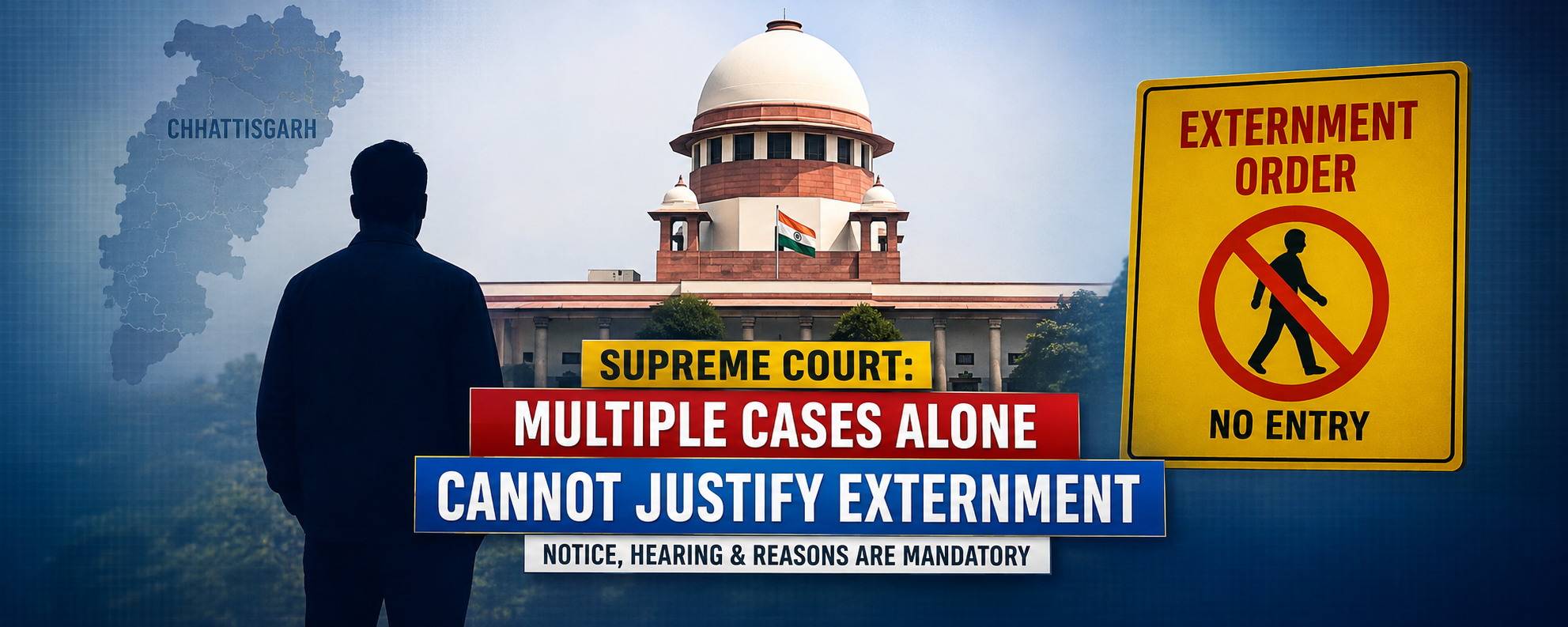
Multiple Criminal Cases Alone Cannot Justify Externment
Judgement Details
Court
Supreme Court of India
Date of Decision
31 August 2026
Judges
Justice Dipankar Datta and Justice Sheel Nagu
Citation
Acts / Provisions
Facts of the Case
-
The appellant, Vijay Kumar Rajpoot, had several criminal cases registered against him between 2009 and 2019.
-
The District Magistrate (DM) had initially closed the externment proceedings, taking note of the fact that the appellant had been acquitted in the relevant cases and that no fresh police report had been submitted after 2019. The appellant was merely warned to refrain from criminal activities.
-
Subsequently, two fresh FIRs were registered against him. One related to an alleged incident involving the recording and circulation of a video containing abusive remarks concerning Baba Guru Ghasidas, a revered figure of the Satnami community.
-
On the basis of a report submitted by the Superintendent of Police, the DM reopened the earlier closed proceedings and passed an externment order directing the appellant not to enter Raigarh and its contiguous districts for one year.
-
Importantly, the appellant was neither served the mandatory notice nor given an opportunity of hearing before the externment order was passed.
-
The appellant approached the Chhattisgarh High Court, but the High Court declined to entertain the writ petition on the ground that an alternative statutory remedy was available under Section 9 of the Adhiniyam.
-
The appellant consequently approached the Supreme Court.
Issues
- Whether an externment order can be passed without complying with the mandatory requirement of notice and opportunity of hearing under Section 8 of the Chhattisgarh Rajya Suraksha Adhiniyam, 1990?
- Whether the District Magistrate had jurisdiction to review or reopen the previously closed proceedings in the absence of an express statutory power of review?
- Whether the existence of multiple criminal cases, by itself, is sufficient justification for passing an externment order?
- Whether the externment order contained sufficient objective material and reasons establishing a nexus between the alleged conduct and the necessity for externment?
- Whether the High Court was justified in refusing to exercise its writ jurisdiction under Article 226 merely because an alternative statutory remedy was available?
Judgement
The Supreme Court allowed the appeal and quashed the externment order passed against the appellant.
The Court found serious violations of the statutory safeguards governing externment proceedings.
A. Violation of Section 8
The Court held that notice and an effective opportunity of hearing under Section 8 are mandatory requirements.
The purpose of these safeguards is to ensure that a person facing externment:
-
knows the allegations and material relied upon against him; and
-
has a meaningful opportunity to explain or rebut those allegations.
Since the appellant was not given such an opportunity, the externment order was legally unsustainable.
B. No Power of Review with the District Magistrate
The Supreme Court further held that the District Magistrate had no power to review his earlier order closing the proceedings because the Adhiniyam did not confer any express or implied power of review upon him.
The subsequent police report could not automatically revive the closed proceedings without following the statutory procedure afresh.
C. Multiple Criminal Cases Are Not Enough
The Court emphasized that the mere existence of multiple criminal cases cannot, by itself, justify externment.
Externment is an extraordinary measure that significantly affects a person's fundamental freedoms. Therefore, the authority must demonstrate:
-
objective material;
-
a genuine and informed subjective satisfaction;
-
cogent reasons; and
-
a discernible nexus between the material and the necessity for externment.
D. High Court's Approach Criticized
The Supreme Court also strongly criticized the Chhattisgarh High Court for refusing to entertain the writ petition merely because an alternative remedy was available.
According to the Supreme Court, the case involved egregious violations of law, including breach of mandatory procedural safeguards and lack of jurisdiction on the part of the District Magistrate.
Consequently, the High Court should have exercised its writ jurisdiction rather than simply relegating the appellant to the statutory remedy.
Held
-
The Supreme Court quashed the externment order.
-
An externment order cannot be sustained when mandatory notice and hearing requirements are violated, when the authority lacks jurisdiction to reopen closed proceedings, and when there is no sufficient objective material or cogent reasoning supporting the necessity of externment.
-
The Court also reaffirmed that multiple criminal cases, by themselves, do not constitute sufficient grounds for externment.
-
Externment must be imposed sparingly and only in extraordinary circumstances, with a clear connection between the available material and the need to restrict the person's movement.
Analysis
- The judgment reinforces the principle that externment is not an ordinary preventive measure. It places a significant restriction on an individual's freedom of movement and therefore cannot be ordered mechanically.
- One of the most important aspects of the judgment is the Court's treatment of Section 8.
- Notice and hearing are not merely technical formalities. They are substantive safeguards designed to prevent arbitrary administrative action.
- The failure to provide the appellant an opportunity to explain the allegations meant that the decision-making process itself was fundamentally defective.
- The judgment reiterates an important administrative-law principle: An administrative authority cannot review its own earlier order unless the governing statute provides such power.
- Since the District Magistrate had already closed the proceedings, reopening them without statutory authority amounted to an exercise of jurisdiction not vested by law.
- The existence of subsequent FIRs or a fresh police report did not eliminate the procedural obligations under Section 8.
- If the authority intended to act on the new material, it was required to restart and comply with the prescribed statutory procedure, including notice and hearing.
- The Court rejected the use of broad assertions such as “public outrage” or “resentment” without supporting material.
- An externment order must demonstrate, at least broadly: Material → Reasoned satisfaction → Necessity of externment
- There must be a discernible nexus between the evidence available to the authority and the conclusion that externment is necessary.
- The judgment is particularly significant because it prevents authorities from treating the number of criminal cases as an automatic justification for externment.
- The authority must independently consider whether the facts demonstrate a genuine apprehension that requires such an extreme preventive measure.
- The Supreme Court also reaffirmed that the existence of an alternative statutory remedy does not invariably prevent a High Court from exercising Article 226 jurisdiction.
- Where there is a serious violation of: natural justice, mandatory statutory procedure, or and jurisdictional limits,
- the High Court may—and in appropriate cases should—exercise its writ jurisdiction.
- The judgment strengthens procedural fairness, administrative accountability and judicial review in externment proceedings.