
Venkatesha & Another v. K.M. Venkatamuniyappa (D) through LRs. & Others, 2026
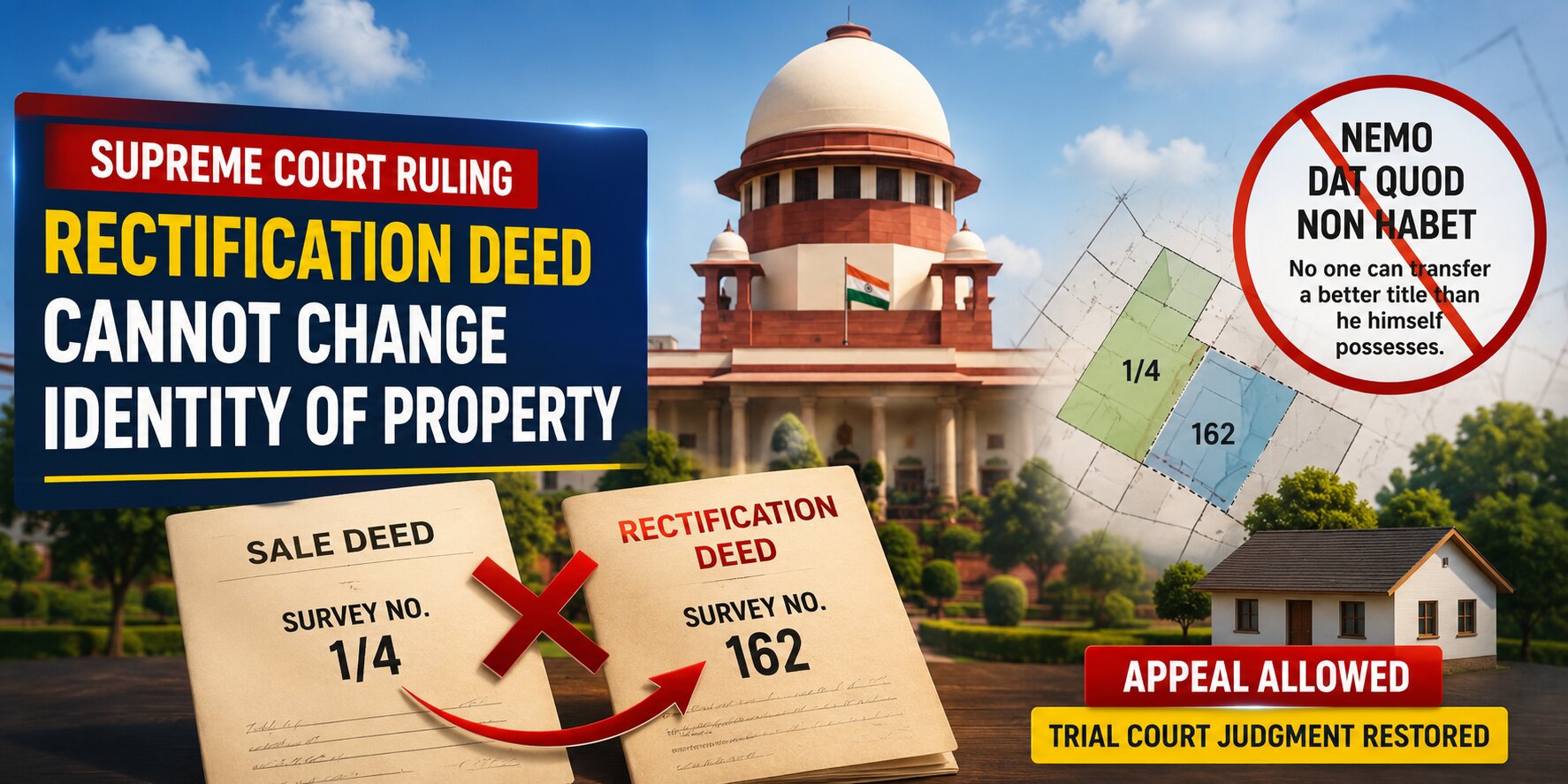
A rectification deed cannot substitute or change the identity of the property conveyed unless the original transferor is a party to the rectification.
Judgement Details
Court
Supreme Court of India
Date of Decision
14 July 2026
Judges
Justice Dipankar Datta & Justice Vipul M. Pancholi
Citation
Acts / Provisions
Facts of the Case
-
Thimmadasappa owned land in Survey No. 1/4, which he sold in 1971.
-
The property subsequently changed hands twice before being purchased by K.M. Venkatamuniyappa (the plaintiff) in 1973.
-
In 1982, the Government separately re-granted Survey No. 162 to Thimmadasappa.
-
In 1997, the plaintiff and his immediate vendor executed a rectification deed, claiming that the survey number mentioned in the 1973 sale deed was incorrectly described as Survey No. 1/4 and should actually have been Survey No. 162.
-
Thimmadasappa, the original owner of the property, was not a party to the rectification deed.
-
In 2005, Thimmadasappa partitioned Survey No. 162 among his two sons.
-
The plaintiff filed a suit challenging the partition, asserting ownership over Survey No. 162 on the strength of the rectification deed.
-
The Trial Court dismissed the suit, holding that the plaintiff failed to establish that Survey Nos. 1/4 and 162 referred to the same property.
-
The First Appellate Court reversed the decree after comparing the boundaries of the properties.
-
The High Court affirmed the appellate court's decision.
-
Aggrieved, Thimmadasappa's sons approached the Supreme Court.
Issues
-
Whether a rectification deed can alter the identity of the property conveyed in the original sale deed without the participation or consent of the original transferor?
-
Whether the plaintiff established that Survey Nos. 1/4 and 162 referred to the same property?
-
Whether the First Appellate Court and the High Court erred in reversing the Trial Court's findings?
-
Whether a plaintiff seeking declaration of title can succeed without proving his own title?
Judgement
-
The Supreme Court allowed the appeal and restored the judgment of the Trial Court.
-
The Court held that a rectification deed cannot be used to substitute an entirely different property under the guise of correcting an error.
-
The Bench observed that since Thimmadasappa never transferred Survey No. 162, no subsequent purchaser could acquire title to that property through derivative conveyances.
-
Applying the maxim "Nemo dat quod non habet", the Court held that a person cannot transfer a better title than he himself possesses.
-
The Court observed that the plaintiff's vendor did not possess title to Survey No. 162 and therefore could not transfer that property merely by executing a rectification deed.
-
The Court held that the rectification deed executed only between the plaintiff and his vendor, without the participation of the original owner, was ineffective to alter the subject matter of the earlier conveyance.
-
The Court further held that the plaintiff failed to discharge the burden of proving that Survey Nos. 1/4 and 162 were in fact the same property.
-
The Bench noted that despite execution of the rectification deed in 1997, the plaintiff made no effort to have the revenue records mutated in his favour until filing the suit in 2007.
-
The Court observed that although revenue entries do not confer title, the plaintiff's prolonged inaction was a relevant circumstance against his claim.
-
Holding that the First Appellate Court and the High Court had misappreciated both the evidence and the governing legal principles, the Supreme Court restored the Trial Court's decree dismissing the suit.
Held
-
A derivative transferee cannot acquire or convey a better title than what the transferor himself possessed.
-
A plaintiff seeking declaration of title must succeed on the strength of his own title and cannot rely upon weaknesses in the defence.
-
The plaintiff failed to prove that Survey Nos. 1/4 and 162 referred to the same property.
-
The partition executed by Thimmadasappa in respect of Survey No. 162 was valid.
Analysis
-
The judgment reinforces the fundamental property law principle embodied in the maxim "Nemo dat quod non habet", emphasizing that ownership cannot be enlarged through derivative transactions.
-
The Supreme Court clarified the limited scope of a rectification deed, holding that it is intended only to correct genuine mistakes in an existing instrument and cannot fundamentally alter the identity of the property conveyed.
-
The ruling protects the rights of original owners by preventing subsequent purchasers from unilaterally modifying completed conveyances without their participation.
-
The Court also reiterated the settled principle governing declaratory suits that the plaintiff must establish his own title affirmatively, and cannot obtain relief merely because the defendant's case appears weak.
-
By emphasizing the plaintiff's failure to seek mutation in revenue records for nearly a decade after the rectification deed, the Court highlighted that prolonged silence or inaction may constitute an important evidentiary circumstance while assessing ownership claims.
-
The judgment further cautions appellate courts against reversing well-reasoned findings of trial courts without a proper appreciation of documentary evidence and settled legal principles.
-
Overall, the decision strengthens certainty in land transactions by ensuring that rectification deeds remain instruments for correcting mistakes rather than vehicles for creating new proprietary rights.