
Venkappa Gowda v. State of Karnataka & Anr., 2026
The essential ingredients of Section 505(2) IPC must be specifically disclosed before criminal proceedings can continue under that provision.
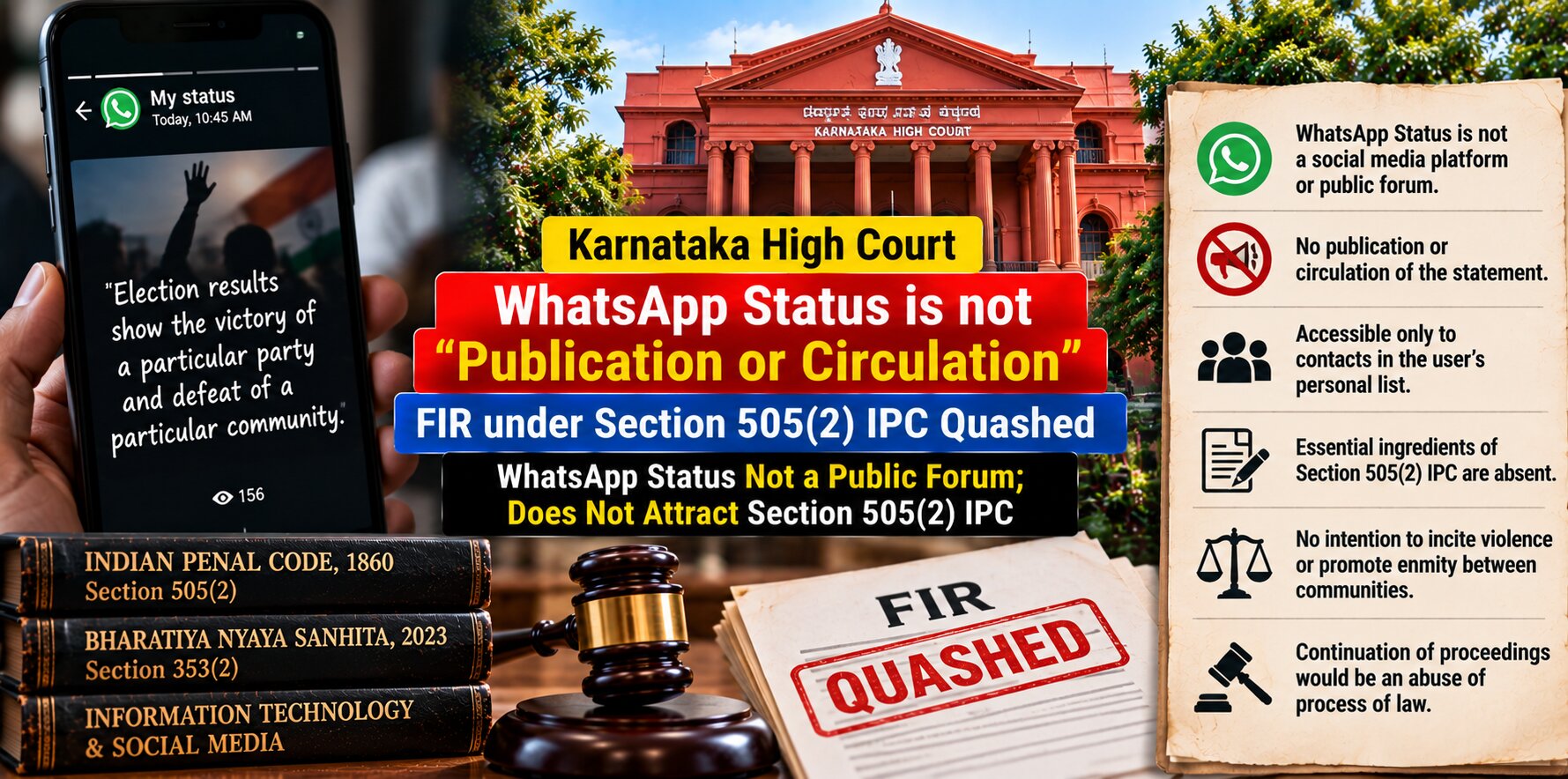
Judgement Details
Court
High Court of Karnataka
Date of Decision
24 September 2026
Judges
Justice Rajesh Rai K.
Citation
Acts / Provisions
Facts of the Case
-
The case arose from a complaint concerning a WhatsApp status uploaded by the petitioner shortly after the announcement of the 2024 Lok Sabha election results.
-
The petitioner allegedly uploaded the WhatsApp status on 5 June 2024, one day after the election results were announced.
-
The complainant alleged that the status referred to the electoral outcome and stated, in substance, that while the ruling party had won, people belonging to a particular community had suffered defeat.
-
According to the complainant, the statement had the potential to create enmity between different communities.
-
A complaint was lodged on 7 June 2024 by respondent No. 2, who was described as a member of the Indian National Congress.
-
Following the complaint, Crime No. 38/2024 was registered at Subramanya Police Station in Dakshina Kannada for the offence punishable under Section 505(2) IPC.
-
The petitioner approached the Karnataka High Court seeking quashing of the FIR and consequential criminal proceedings.
-
The petitioner contended that the WhatsApp status did not disclose any intention to cause public disorder or incite violence.
-
He further contended that the complaint did not establish the necessary mens rea required to attract Section 505(2) IPC.
-
The petitioner also argued that the complainant was not an aggrieved person and that the complaint had allegedly been lodged for political purposes.
-
The State opposed the petition, arguing that the complaint disclosed the ingredients of the offence and that the investigation was still underway.
-
The High Court therefore examined whether the allegations, even if taken at face value, disclosed the statutory ingredients necessary to constitute an offence under Section 505(2) IPC.
Issues
-
Whether posting a statement as a WhatsApp status accessible to persons in the user's contact list amounts to “publication or circulation” within the meaning of Section 505(2) IPC?
-
Whether the contents of the petitioner's WhatsApp status disclosed the requisite intention or motive to cause disorder or incite people to violence?
-
Whether the allegations in the complaint disclosed the essential ingredients of the offence punishable under Section 505(2) IPC?
-
Whether the principles laid down by the Supreme Court in Bilal Ahmed Kaloo v. State of A.P. were applicable to the present case?
-
Whether continuation of the criminal proceedings in Crime No. 38/2024 would amount to an abuse of the process of law warranting exercise of the High Court's inherent jurisdiction?
Judgement
-
The Karnataka High Court allowed the criminal petition and quashed the FIR registered against the petitioner under Section 505(2) IPC.
-
Justice Rajesh Rai K held that the allegations did not disclose the necessary ingredients of Section 505(2) IPC.
-
The Court examined the actual WhatsApp status relied upon in the complaint and found no sufficient indication of an intention or motive on the part of the petitioner to cause disorder or incite violence.
-
The Court further considered the nature of the medium through which the statement was allegedly communicated.
-
The Court observed that the WhatsApp status was accessible normally to persons who were in the petitioner's contact list and, in the circumstances of the case, treated it as neither a social-media platform nor a public forum for the purpose of the statutory requirement being considered.
-
The Court therefore found that the fundamental requirement of publication or circulation contemplated by Section 505(2) IPC was absent.
-
The Court relied upon the Supreme Court's decision in Bilal Ahmed Kaloo v. State of A.P. (1997).
-
In Bilal Ahmed Kaloo, the Supreme Court had explained the distinction between Section 153-A and Section 505 IPC and emphasised the requirement of publication for an offence under Section 505.
-
Applying that principle, the High Court held that merely posting the statement as a WhatsApp status, in the circumstances alleged, did not satisfy the statutory requirement of publication or circulation under Section 505(2).
-
The Court concluded that the allegations in the complaint, even if accepted as stated, did not establish the ingredients necessary to constitute the alleged offence.
-
Consequently, continuation of the proceedings was held to amount to an abuse of the process of law.
-
The FIR registered as Crime No. 38/2024 was accordingly quashed.
Held
-
The Court held that, in the circumstances of this case, a WhatsApp status was not “publication or circulation” on a public forum for purposes of Section 505(2) IPC.
-
The fact that a WhatsApp status may be viewed by persons in the user's contact list was not treated as sufficient publication or circulation to attract the provision in the factual circumstances before the Court.
-
The alleged statement also did not disclose the requisite intention or motive to cause disorder or incite violence.
-
The Court relied upon Bilal Ahmed Kaloo v. State of A.P. in determining the statutory requirements of Section 505(2).
-
Where the basic statutory ingredients of an offence are absent from the complaint, continuation of the criminal proceedings can amount to an abuse of process.
-
The FIR in Crime No. 38/2024 was therefore quashed.
Analysis
-
Focus on statutory ingredients: The principal significance of the judgment is that the Court did not treat an allegedly offensive or communal statement, by itself, as sufficient to constitute an offence under Section 505(2). The prosecution must establish the ingredients specifically required by the statutory provision.
-
Publication or circulation: Section 505(2) specifically uses the expressions “publishes or circulates.” The High Court therefore examined whether the particular method of communication alleged in the FIR satisfied this requirement.
-
WhatsApp status and audience: The Court distinguished a WhatsApp status from an open public forum, noting that it was ordinarily accessible to persons within the user's contact list. On the facts before it, this meant the necessary publication or circulation contemplated by Section 505(2) was absent.
-
Importance of Bilal Ahmed Kaloo: The Supreme Court's decision in Bilal Ahmed Kaloo was central to the High Court's reasoning. The precedent emphasises that the ingredients of Section 505 must be independently satisfied and cannot simply be assumed from the nature of the alleged statement.
-
Mens rea and incitement: The Court also found no sufficient indication in the alleged WhatsApp status of an intention or motive to cause disorder or incite people to violence. Thus, the case did not merely fail on the publication requirement; the allegations also failed to establish the requisite culpable intention in the manner alleged.
-
Quashing jurisdiction: The case illustrates the function of the High Court's inherent jurisdiction under Section 482 CrPC. Where the allegations, even if accepted at face value, do not satisfy the basic ingredients of the offence, the criminal process need not be permitted to continue.
-
No trial where foundational ingredients are absent: The Court's approach demonstrates that a person should not be compelled to undergo a full criminal prosecution merely because an FIR has been registered. The foundational legal requirements of the invoked penal provision must first be present.
-
Context of the alleged statement: The alleged WhatsApp status arose in the politically charged context of the 2024 Lok Sabha election results. However, the Court's determination turned on the statutory requirements of Section 505(2), rather than on the political identity of the complainant or the political context itself.
-
Important scope of the ruling: The judgment should be understood on its facts and statutory context. It does not establish that statements made through WhatsApp can never attract criminal liability. The applicability of Section 505(2), or another penal provision, would depend upon the content, manner of dissemination, audience, intention and other statutory ingredients in the particular case.
-
BNS correspondence: Section 505(2) IPC has a corresponding provision in Section 353(2) of the Bharatiya Nyaya Sanhita, 2023. The judgment is therefore relevant to understanding the statutory concept even though the FIR in this case was registered under the IPC.
-
Abuse of process: Once the Court concluded that publication/circulation and the other essential ingredients were not disclosed, allowing the prosecution to proceed would serve no legitimate criminal-law purpose and was therefore characterised as an abuse of process.
-
Broader digital-communication significance: The decision highlights that courts may need to examine the particular architecture and audience of a digital communication platform when determining whether statutory concepts such as publication or circulation are satisfied. The ruling, however, was based on the specific allegations and the wording of Section 505(2), rather than creating a universal rule governing every WhatsApp communication.