
Vasantha K and Another v. Kerala State Road Transport Corporation and Others, 2026
A second wife in a void marriage is not entitled to family pension or retirement benefits of the deceased government employee.
Judgement Details
Court
Kerala High Court
Date of Decision
15 July 2026
Judges
Justice Shoba Annamma Eapen
Citation
Acts / Provisions
Facts of the Case
-
The deceased was an employee of the Kerala State Road Transport Corporation (KSRTC) who died while in service.
-
Following his death, both his legally wedded wife (the first petitioner) and another woman claiming to be his second wife sought release of his terminal and pensionary benefits.
-
KSRTC received competing claims from both women and, therefore, required production of a succession certificate before releasing the benefits.
-
Since no succession certificate was produced, KSRTC declined to disburse the benefits.
-
The woman claiming to be the second wife relied upon the fact that she had been nominated in the deceased employee's LIC policies.
-
The legally wedded wife relied upon the Supreme Court's decision in Rameshwari Devi v. State of Bihar, contending that a second marriage contracted during the subsistence of the first marriage is void and does not confer the status of widow.
-
The legal heirship certificate produced before the Court showed that the first wife, the son born from the first marriage, and the children born from the second relationship were all legal heirs of the deceased.
-
The High Court examined the entitlement of the rival claimants to the deceased employee's service benefits, family pension, and other consequential benefits.
Issues
-
Whether a woman claiming to be the second wife of a deceased government employee is entitled to family pension and retirement benefits where the first marriage was subsisting?
-
Whether children born from a void marriage are entitled to a share in the deceased employee's death-cum-retirement benefits and family pension?
-
Whether nomination in LIC policies confers entitlement to service and pensionary benefits in preference to the legally wedded wife?
-
Whether the son of the deceased was entitled to consideration for compassionate appointment?
Judgement
-
The High Court held that the first petitioner's marriage with the deceased employee was the only legally valid marriage.
-
The Court observed that there was no evidence establishing the validity of the alleged second marriage since the first marriage continued to subsist when the second relationship commenced.
-
Consequently, the alleged second marriage was held to be void under the provisions of the Hindu Marriage Act, 1955.
-
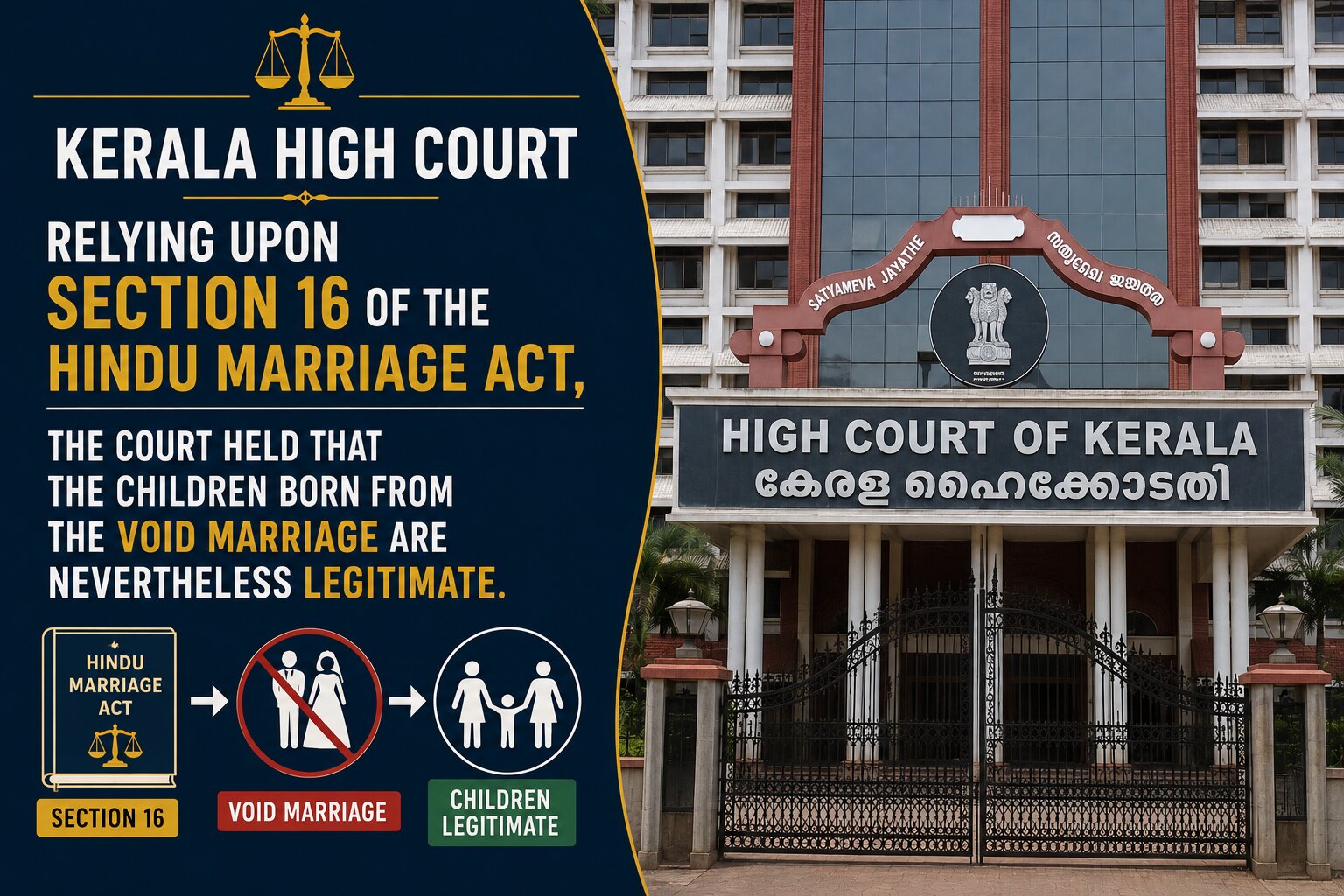
Relying upon Section 16 of the Hindu Marriage Act, the Court held that the children born from the void marriage are nevertheless legitimate.
-
The Court reiterated that although the second wife is not entitled to family pension, retirement benefits, or other service benefits of the deceased employee, the children born from the void marriage are entitled to an equal share in the death-cum-retirement gratuity, retirement benefits, and family pension, subject to law.
-
The Court clarified that the children from the second relationship are entitled to receive family pension only until they attain the age of majority.
-
The Court observed that nomination in LIC policies does not determine entitlement to statutory service and pensionary benefits.
-
Accordingly, the Court directed KSRTC to disburse the death-cum-retirement gratuity, retirement benefits, and family pension among all the legal heirs in accordance with law.
-
The Court further directed KSRTC to consider the pending application of the deceased employee's son for compassionate appointment within three months.
-
It also clarified that if the son did not seek compassionate appointment, the children born from the second relationship would be at liberty to apply, subject to satisfying the eligibility conditions under the applicable scheme.
Held
- Children born from the void marriage are legitimate under Section 16 of the Hindu Marriage Act.
-
Such children are entitled to an equal share in the deceased employee's death-cum-retirement benefits and family pension until attaining majority.
-
Nomination in LIC policies does not determine entitlement to statutory service benefits.
-
KSRTC was directed to disburse benefits in accordance with law and consider the son's application for compassionate appointment.
Analysis
-
The judgment reaffirms the settled legal distinction between the rights of a second spouse in a void marriage and the independent statutory rights of children born from such a relationship.
-
By applying Section 16 of the Hindu Marriage Act, the Court protected the interests of innocent children, ensuring that they are not deprived of statutory benefits because of the legal invalidity of their parents' marriage.
-
The decision faithfully follows the Supreme Court's ruling in Rameshwari Devi v. State of Bihar, maintaining that a void marriage does not confer the legal status of widow upon the second wife for purposes of pensionary benefits.
-
The Court also clarified that nomination under insurance policies or similar instruments does not override statutory rules governing succession and service benefits.
-
By directing consideration of compassionate appointment first in favour of the son from the valid marriage, while permitting eligible children from the second relationship to apply thereafter, the Court balanced competing claims within the framework of the applicable service rules.
-
The ruling promotes the beneficial object of Section 16, which seeks to protect children from the adverse consequences of the invalidity of their parents' marriage.
-
Overall, the judgment harmonizes personal law with service jurisprudence by denying benefits to a person whose marital status lacks legal recognition while safeguarding the legitimate rights of children recognized by statute.