
Vanshika Tomar and Another v. State of Uttarakhand, 2026
Threat to life and personal safety cannot be ignored merely because questions have been raised regarding the legal validity of a marriage.
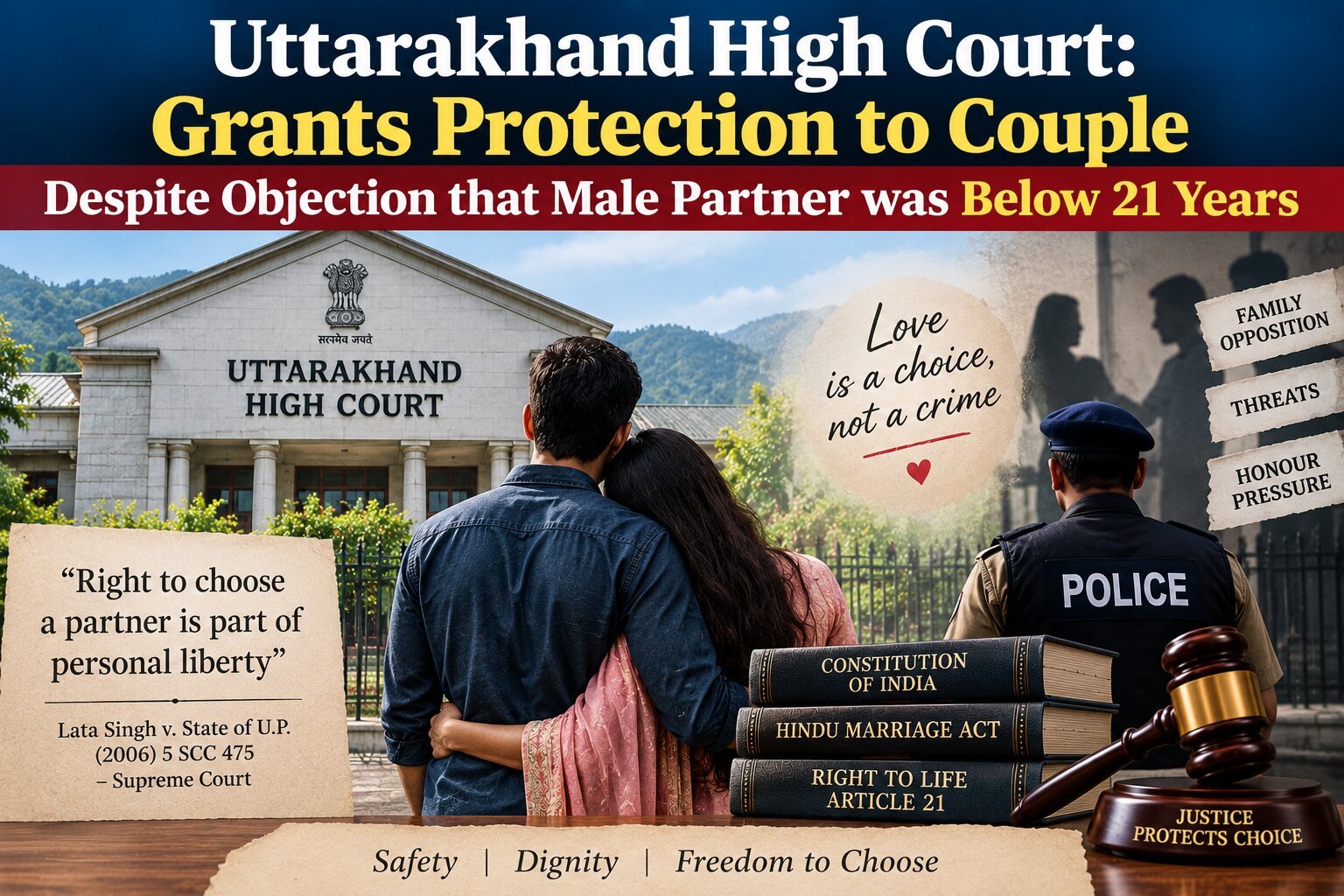
Judgement Details
Court
Uttarakhand High Court
Date of Decision
7 August 2026
Judges
Justice Alok Mahra
Citation
Acts / Provisions
Facts of the Case
-
The petitioners, a young couple, approached the Uttarakhand High Court seeking police protection against alleged threats from the family members of petitioner No. 1.
-
The couple stated that they had solemnised their marriage on 24 March 2026.
-
Petitioner No. 1 was 19 years and 6 months old at the time of marriage, while petitioner No. 2 was 20 years old.
-
The family members of petitioner No. 1 allegedly opposed the marriage and threatened to kill both petitioners.
-
A Coordinate Bench had earlier directed the parties to appear before a counsellor.
-
The counsellor's report recorded that petitioner No. 1 was not willing to return to her parents and was happy in the company of petitioner No. 2.
-
The private respondents objected that petitioner No. 2 had not attained the statutory age of 21 years for a male to marry and therefore questioned the validity of the marriage.
-
The petitioners argued that even if petitioner No. 2 had not attained 21 years, the issue at most affected the validity of the marriage and did not deprive them of protection against threats to their life.
Issues
-
Whether a couple can be granted police protection from threats to life and limb notwithstanding an objection that the male partner had not attained 21 years of age at the time of marriage?
-
Whether the alleged invalidity or voidability of the marriage is a ground to deny protection to adult individuals facing threats from family members?
-
Whether the Court was justified in relying upon the counsellor's report and the petitioner's voluntary choice to remain with her partner while considering the request for protection?
-
Whether the principles laid down in Lata Singh v. State of U.P. require the State to protect consenting adults from threats arising out of opposition to their relationship?
Judgement
-
The High Court allowed the writ petition and directed the concerned police authorities to assess the threat to the petitioners' life and limb.
-
The Court held that the petitioners had made out a case for protection in view of the counsellor's report and the Supreme Court's decision in Lata Singh v. State of U.P., (2006) 5 SCC 475.
-
The Court noted that petitioner No. 1 was not willing to go with her parents and was happy in the company of petitioner No. 2.
-
The Court directed the Station House Officer, Police Station Buggawala, District Haridwar, to provide necessary protection if a genuine threat was found.
-
The SHO was further directed to summon the private respondents and other persons hostile to the marriage and counsel them in accordance with law.
-
The Court did not finally adjudicate the validity of the marriage on account of petitioner No. 2 being below 21 years.
Held
-
The Court relied upon the principle that consenting adults are entitled to make their own personal choices without being subjected to violence or threats from family members.
-
The counsellor's report was relevant in establishing that petitioner No. 1 voluntarily wished to remain with petitioner No. 2.
-
The objection concerning petitioner No. 2's age did not prevent the Court from considering the couple's request for protection.
-
The Court's direction was specifically to assess the existence of threat and provide protection if such threat was found.
-
The judgment was therefore concerned primarily with protection of life and liberty, rather than conclusively determining the validity of the marriage.
Analysis
-
The decision reinforces the constitutional importance of individual choice and personal liberty in matters concerning relationships and marriage.
-
The Court appropriately separated two questions: the legal consequences of the male petitioner's age and the immediate question of whether the couple required protection from threats.
-
Even if a marriage gives rise to a dispute concerning statutory age requirements, family members cannot take the law into their own hands or threaten the couple with violence.
-
The reliance on Lata Singh is significant because the Supreme Court had recognised that an adult's choice of partner cannot be used as a justification for harassment, threats or violence by family members.
-
The counsellor's report provided additional material showing that petitioner No. 1 was making a voluntary choice and did not wish to return to her parental home.
-
Importantly, the High Court did not declare that a male below 21 years can validly marry without legal consequences. Instead, it granted protection against potential threats while leaving the question of matrimonial validity open.
-
The direction to the SHO to assess the threat, rather than automatically provide police protection, also indicates that the Court required the police to make an objective assessment of the circumstances.
-
The judgment therefore reflects the principle that questions concerning marriage validity must be addressed through lawful remedies, not through intimidation, coercion or violence.