
V v. P, 2026
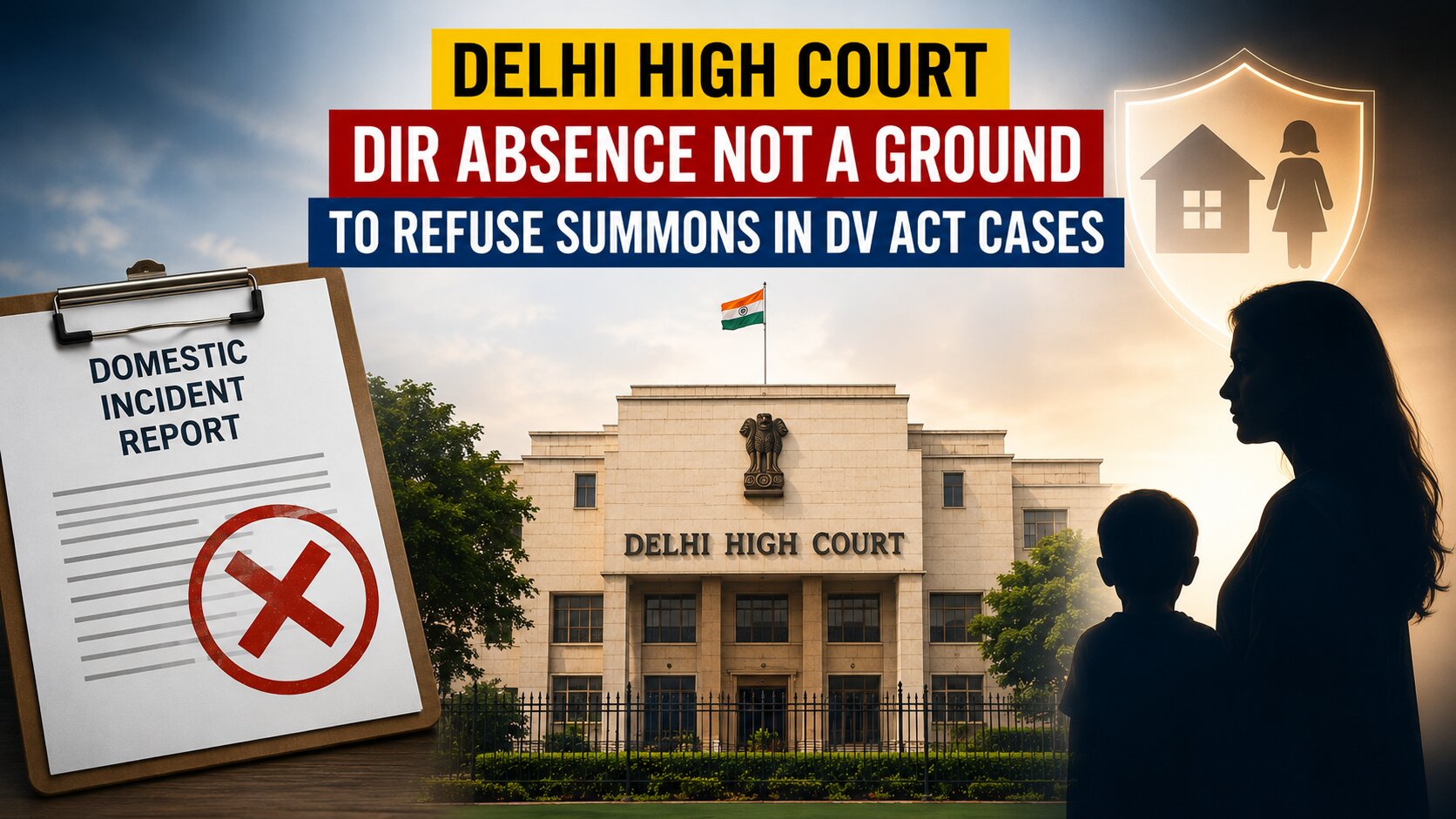
The judgment clarifies the evidentiary value of the Domestic Incident Report by holding that it is only an aid to the Magistrate and not the primary pleading in domestic violence proceedings.
Judgement Details
Court
Delhi High Court
Date of Decision
21 July 2026
Judges
Justice Saurabh Banerjee
Citation
Acts / Provisions
Facts of the Case
-
The petitioner-wife married the respondent in December 2016, after which matrimonial disputes arose between the parties.
-
Alleging acts of domestic violence by her husband and his family members, she filed an application under Section 12 of the Protection of Women from Domestic Violence Act, 2005, seeking protection orders, residence orders, maintenance, and other reliefs.
-
Along with the complaint, a Domestic Incident Report (DIR) was prepared by the Protection Officer as contemplated under the DV Act.
-
The Metropolitan Magistrate issued summons only against certain respondents but deleted two of the husband's relatives from the array of parties.
-
The Magistrate held that no specific allegations had been made against the deleted respondents in the DIR.
-
The appellate court affirmed the Magistrate's decision.
-
The petitioner challenged both orders before the Delhi High Court, contending that the courts below had relied solely on the DIR while ignoring detailed allegations contained in her original complaint.
-
She argued that the DIR is only a standardized report intended to assist the Magistrate and cannot replace or override the complaint filed under Section 12 of the DV Act.
Issues
-
Whether the absence of specific allegations against a respondent in a Domestic Incident Report (DIR) can by itself justify refusal to issue summons under the Protection of Women from Domestic Violence Act, 2005?
-
Whether the Domestic Incident Report can substitute or supersede the complaint filed under Section 12 of the DV Act?
-
Whether the Magistrate and the appellate court erred in considering the DIR in isolation while ignoring the allegations contained in the complaint?
-
Whether the allegations contained in the complaint disclosed a prima facie case of domestic violence against the deleted respondents warranting issuance of summons?
-
Whether proceedings under Section 12 of the DV Act require consideration of the overall facts and circumstances before deciding whether summons should be issued?
Judgement
-
The Delhi High Court allowed the petition and set aside the orders passed by the Metropolitan Magistrate and the appellate court.
-
The Court held that the mere absence of specific allegations in the Domestic Incident Report cannot be a valid ground for refusing to issue summons against a respondent.
-
The Court observed that a DIR is merely a document prepared to facilitate and assist the Magistrate and does not replace or override the complaint filed under Section 12 of the DV Act.
-
The Bench held that both the complaint and the DIR must be read together and considered cumulatively rather than in isolation.
-
The Court noted that Explanation II to Section 3 of the DV Act requires courts to consider the overall facts and circumstances while determining whether domestic violence has occurred.
-
The Court observed that proceedings under Section 12 of the DV Act are not strictly criminal in nature.
-
It further clarified that even after issuance of summons, the Magistrate retains the power to discharge or pass appropriate orders if no case is ultimately made out against any respondent.
-
Upon examining the complaint, the Court found that it contained detailed and specific allegations against the deleted respondents which prima facie fell within the definition of domestic violence under Section 3 of the Act.
-
Accordingly, the High Court restored the deleted respondents as parties to the domestic violence proceedings.
Held
-
A Domestic Incident Report cannot substitute or supersede a complaint filed under Section 12 of the DV Act.
-
The complaint and the DIR must be read together while considering whether summons should be issued.
-
Mere absence of allegations in the DIR is not sufficient to refuse issuance of summons.
-
Courts must consider the overall facts and circumstances as required under Explanation II to Section 3 of the DV Act.
-
The complaint disclosed a prima facie case against the deleted respondents.
-
The orders deleting the respondents from the proceedings were set aside.
-
The deleted respondents were restored as parties to the domestic violence proceedings.
Analysis
-
The Court reaffirmed that the complaint filed under Section 12 of the DV Act remains the foundational document for determining whether a prima facie case exists.
-
The decision prevents courts from mechanically relying upon the DIR while ignoring detailed factual allegations contained in the complaint.
-
By directing that the complaint and the DIR be read together, the Court promoted a holistic approach consistent with Explanation II to Section 3 of the DV Act.
-
The judgment reinforces that proceedings under the DV Act are intended to provide effective civil remedies and should not be frustrated through overly technical procedural requirements.
-
The Court also emphasized that issuance of summons does not amount to a finding of guilt and that the Magistrate retains full authority to pass appropriate orders if the allegations are ultimately found to be unsubstantiated.
-
The ruling strengthens access to remedies for victims of domestic violence by ensuring that genuine complaints are not dismissed merely because every allegation is not reflected in the standardized DIR.
-
The decision is likely to serve as an important precedent guiding Magistrates in appreciating the respective roles of complaints and Domestic Incident Reports under the DV Act.