
V. Amaresh @ Ambarish v. State of Karnataka & Anr., 2026
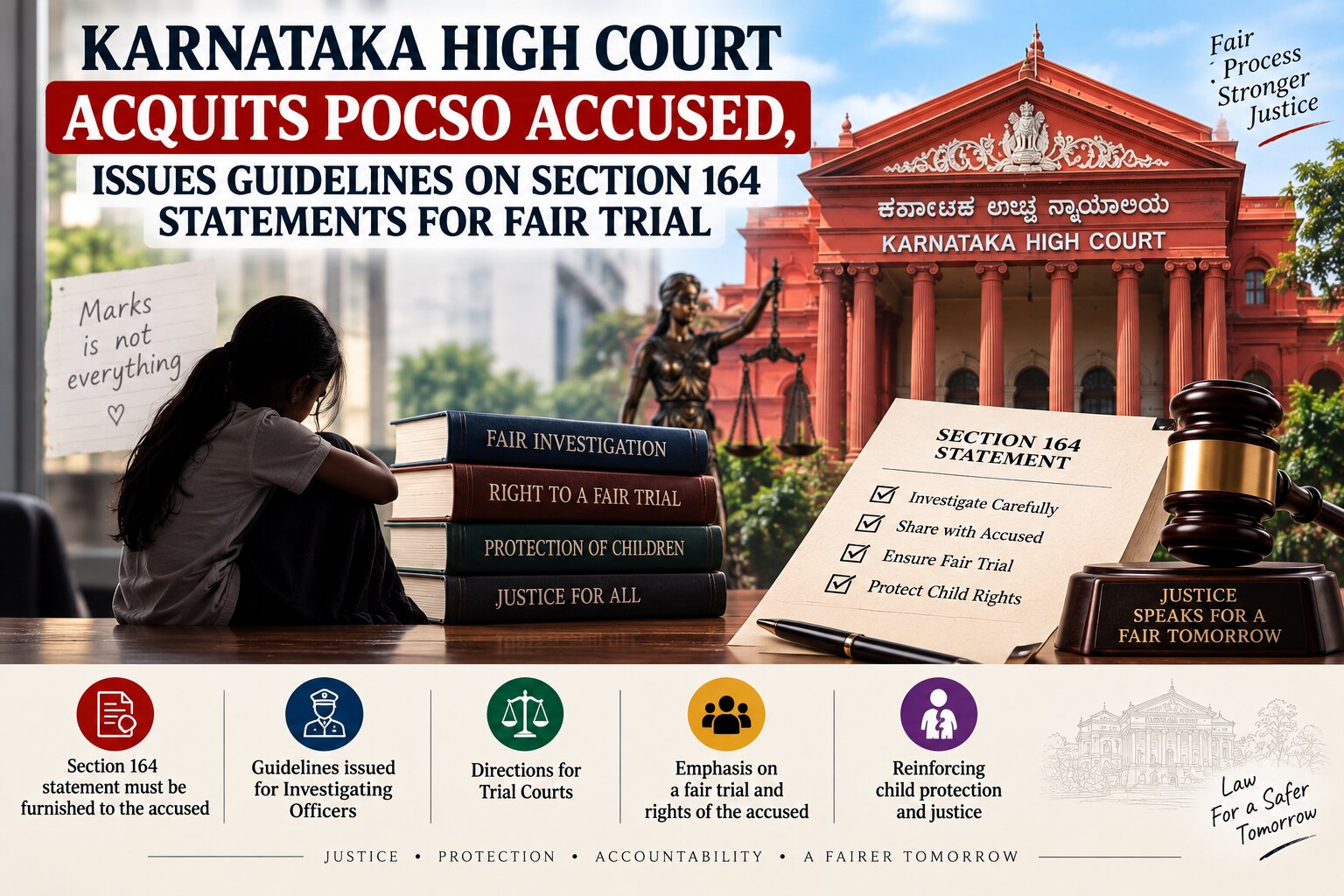
An accused is entitled to know and receive the material documents relied upon by the prosecution, including a Section 164 CrPC statement where applicable.
Judgement Details
Court
Karnataka High Court
Date of Decision
17 August 2026
Judges
Justice Mohammad Nawaz and Justice G. Basavaraja
Citation
Acts / Provisions
Facts of the Case
-
The accused was convicted by the Kolar trial court and sentenced to life imprisonment for offences under the IPC, POCSO Act and SC/ST Act.
-
The prosecution alleged that the accused had taken the minor girl from Kolar to Bengaluru and subsequently to Thoranagal.
-
The prosecution alleged that sexual intercourse had taken place while the victim was a minor.
-
The prosecution relied upon the victim's statements, medical evidence and documents concerning her age.
-
The victim's statement under Section 164 CrPC did not contain an allegation of rape against the accused.
-
The Section 164 statement was not furnished to the accused as required under Section 207(iv) CrPC.
-
The trial court ultimately convicted the accused under Section 376(2)(n) IPC, although a specific charge under that provision had not been framed.
-
The accused challenged the conviction before the Karnataka High Court.
Issues
-
Whether failure to furnish the Section 164 CrPC statement to the accused violates the right to a fair trial under Article 21?
-
Whether the prosecution established the age of the victim beyond reasonable doubt on the evidence produced?
-
Whether the contradictions between the Section 164 statement and trial testimony materially affect the reliability of the prosecution case?
-
Whether conviction under Section 376(2)(n) IPC without framing a specific charge caused prejudice to the accused?
-
Whether the prosecution evidence was sufficient to sustain the conviction under the IPC, POCSO Act and SC/ST Act?
Judgement
-
The Karnataka High Court allowed the appeal and acquitted the accused.
-
The Court held that the Section 164 statement was a material document and its non-furnishing to the accused violated the fair-trial guarantee under Article 21.
-
The Court found significant contradictions between the victim's Section 164 statement and her subsequent testimony before the trial court.
-
The prosecution failed to establish the victim's age to the required legal standard because the best available documents were not properly collected or produced.
-
The Court held that the accused was convicted under Section 376(2)(n) IPC without a specific charge for that aggravated offence.
-
The Court also noted that the medical evidence did not support the allegation of rape.
-
The conviction and sentence imposed by the trial court were consequently set aside.
Held
-
Failure to furnish such a statement can amount to a violation of the accused's Article 21 fair-trial rights.
-
A Section 164 statement can be used for corroboration or contradiction, and material contradictions between that statement and trial evidence cannot be ignored.
-
The prosecution bears the burden of proving the victim's age through legally reliable evidence.
-
Where the best available evidence concerning age is withheld, the court may draw an adverse inference.
-
An accused cannot ordinarily be convicted for a distinct and aggravated offence for which no specific charge was framed when such omission causes prejudice to the defence.
-
The Court emphasised that the more serious the allegation and punishment, the more careful the judicial scrutiny must be.
-
The Court also issued suo motu guidelines for Investigating Officers and trial courts concerning Section 164 statements.
Analysis
-
The judgment strongly reinforces the principle that fair trial is a substantive constitutional protection, not merely a procedural formality.
-
The Court treated furnishing the Section 164 statement as an important safeguard enabling the accused to understand and challenge the prosecution evidence.
-
The contradiction between the victim's Section 164 statement and her trial testimony became particularly significant because the earlier statement did not allege rape.
-
The Court also highlighted deficiencies in proving age, including failure to collect potentially authoritative documents available from the school and educational authorities.
-
The ruling demonstrates that procedural safeguards become especially important where the accused faces serious offences and life imprisonment.
-
Convicting an accused for a more aggravated offence without a corresponding charge was found capable of causing fundamental prejudice to the defence.
-
The Court's guidelines place a positive responsibility on Investigating Officers to read, analyse and properly consider Section 164 statements before filing the chargesheet.
-
Trial courts were directed to preserve such statements and furnish them to accused persons as required by law.
-
The Court further directed that relevant questions concerning Section 164 statements should be put to the accused while recording the statement under Section 313 CrPC.
-
The judgment therefore links investigative fairness, disclosure of evidence, proper framing of charges and constitutional fair-trial rights into a comprehensive safeguard against wrongful conviction.