
Uperndra Khare v. The State of Madhya Pradesh, 2026
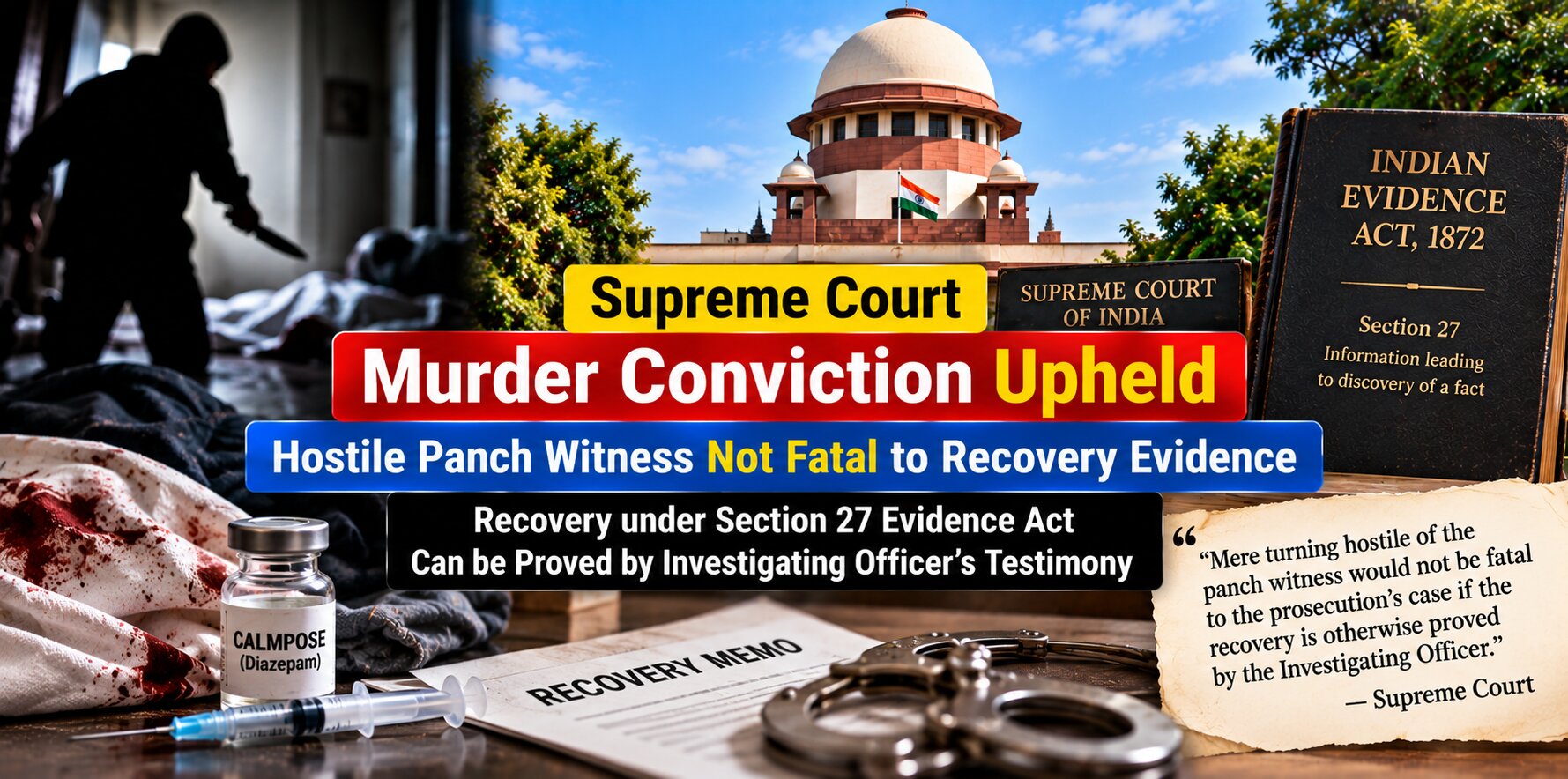
Turning hostile of panch witnesses does not automatically invalidate a recovery under Section 27 of the Evidence Act.
Judgement Details
Court
Supreme Court of India
Date of Decision
3 September 2026
Judges
Justice Pankaj Mithal and Justice Prasanna B. Varale
Citation
Acts / Provisions
Facts of the Case
-
The prosecution arose from the deaths of four members of the same family — Rajesh Shukla, his wife Madhu Shukla, their son Prabhanshu Shukla and Rajesh's sister Vinita Shukla.
-
On 20 July 2002, the informant visited Rajesh Shukla's house after being unable to contact him and found the back door open and the four deceased persons lying inside the premises with injuries.
-
An FIR was registered at City Kotwali Police Station, Satna, initially under Section 302 IPC.
-
During investigation, blood-stained clothes, a bedsheet and empty Calmpose injection phials were seized from the scene.
-
The post-mortem evidence indicated that the deaths resulted from shock caused by external and internal injuries to vital parts and excessive blood loss. The medical evidence also recorded traces of Calmpose/Diazepam in the viscera.
-
The investigation alleged that accused Devendra Singh had an improper interest in deceased Vinita and that the appellant, Uperndra Khare, was associated with Devendra.
-
According to the prosecution, the accused persons entered the house armed with weapons, administered Calmpose injections to the victims and thereafter caused fatal injuries.
-
The appellant was arrested on 21 September 2002.
-
During investigation, certain articles, including Calmpose phials, clothes and a cotton rope, were allegedly recovered at the instance of the appellant pursuant to information attributed to him.
-
The prosecution relied upon these recoveries as an important circumstance connecting the appellant with the crime.
-
The appellant argued that the recovery evidence was unreliable because the independent panch witnesses associated with the seizure had turned hostile.
-
He further argued that the alleged recoveries occurred approximately two months after the incident, that there was no reliable connection between the recovered articles and the murders, and that the chain of circumstantial evidence was incomplete.
-
The First Additional Sessions Judge, Satna convicted the appellant under Section 302 read with Section 149 IPC on four counts, imposing life imprisonment and a fine.
-
The Trial Court, however, acquitted him of the charges under Sections 382 and 404 read with Section 149 IPC.
-
The Madhya Pradesh High Court upheld the conviction on 21 June 2012.
-
The appellant thereafter approached the Supreme Court under its appellate jurisdiction.
Issues
-
Whether recovery of incriminating articles pursuant to the accused's disclosure statement under Section 27 of the Indian Evidence Act becomes unreliable merely because the independent panch witnesses turn hostile?
-
Whether the testimony of the Investigating Officer can independently establish a recovery when the panch witnesses do not support the prosecution's version?
-
Whether the recovery of Calmpose phials, clothes and other articles, when considered with the medical and other circumstantial evidence, sufficiently connected the appellant with the commission of the murders?
-
Whether deficiencies or shortcomings in the investigation were sufficient to discard otherwise reliable material evidence supporting the prosecution case?
-
Whether the prosecution had established the required chain of circumstantial evidence beyond reasonable doubt to sustain the appellant's conviction under Section 302 read with Section 149 IPC?
-
Whether the concurrent findings of the Trial Court and the Madhya Pradesh High Court warranted interference by the Supreme Court?
Judgement
-
The Supreme Court dismissed the appeal and upheld the appellant's conviction and sentence.
-
The Court rejected the principal argument that the recovery evidence automatically became unreliable because the panch witnesses had turned hostile.
-
The Court reaffirmed that hostility of panch witnesses is not, by itself, sufficient to discard recovery evidence where the recovery is otherwise convincingly established through the Investigating Officer's testimony.
-
The Court found that the recovery at the instance of the appellant had been proved through the testimony of Investigating Officer Arun Singh (PW-24).
-
The Court relied upon the settled principles stated in Rameshbhai Mohanbhai Koli v. State of Gujarat, including the principle that convincing testimony of the officer who effected the recovery need not be rejected merely because seizure witnesses do not support the prosecution.
-
The Court also relied upon Mallikarjun v. State of Karnataka, which similarly held that recovery of a weapon does not stand vitiated merely because panch witnesses have turned hostile.
-
The Supreme Court noted that there was no specific challenge demonstrating that the Investigating Officer's testimony regarding the recovery suffered from a material infirmity or inherent doubt.
-
The medical evidence independently established that the victims had died from serious injuries and that traces of Calmpose/Diazepam were present in the viscera.
-
The Court accepted that the investigation was not up to the mark and that, given the deaths of four persons, the investigation ought to have been conducted with greater sensitivity.
-
However, the Court held that deficiencies in investigation could not, by themselves, justify rejection of other reliable and substantial evidence produced by the prosecution.
-
The Court particularly relied upon the recovery of the injection phial at the appellant's instance together with the medical evidence supporting the prosecution's case.
-
Finding no sufficient ground to interfere with the concurrent findings of the courts below, the Supreme Court dismissed the appeal.
Held
-
Recovery evidence can be accepted when it is otherwise convincingly proved through the testimony of the Investigating Officer.
-
The credibility and reliability of the Investigating Officer's evidence must still be assessed; hostility of independent witnesses does not create an automatic rule requiring rejection.
-
The Supreme Court reaffirmed the principles stated in Rameshbhai Mohanbhai Koli v. State of Gujarat and Mallikarjun v. State of Karnataka.
-
In the present case, the recovery evidence was considered reliable and was supported by other material, including the medical evidence.
-
The presence of Calmpose/Diazepam traces in the viscera provided corroborative support to the prosecution's account that the victims had initially been administered the substance.
-
Faulty or imperfect investigation does not necessarily destroy a prosecution case when other reliable evidence sufficiently supports the finding of guilt.
-
The concurrent conviction under Section 302 read with Section 149 IPC was therefore sustained.
-
The appellant's criminal appeal was dismissed.
Analysis
-
Core evidentiary principle: The judgment reinforces an important distinction between the evidentiary value of a hostile panch witness and the existence of the recovery itself. A panch witness turning hostile does not automatically mean that the seizure never occurred.
-
Role of the Investigating Officer: Where the Investigating Officer personally effected or witnessed the recovery and gives credible testimony about it, the court may rely upon that testimony even in the absence of supporting panch evidence. This principle has been repeatedly recognised by the Supreme Court.
-
Section 27 is not rendered ineffective by hostile witnesses: Section 27 permits proof of that portion of information received from an accused in police custody which distinctly relates to the fact discovered. The Court's ruling concerns the proof of the resulting recovery, not a proposition that every statement made to police becomes admissible.
-
Corroboration was important: The Court did not treat the Investigating Officer's testimony in isolation from the entire evidentiary record. The recovery evidence was considered alongside the post-mortem findings and viscera report.
-
Medical evidence: The medical evidence established fatal injuries and also recorded traces of Diazepam/Calmpose. This supported the prosecution's account concerning the administration of the injection before the fatal assault.
-
Circumstantial evidence: The case was based on circumstantial evidence. The Court therefore examined the recovery and surrounding circumstances as part of the overall evidentiary chain rather than treating the recovery as an isolated fact.
-
Investigation defects: The Supreme Court expressly acknowledged that the investigation was not conducted as well as it should have been. However, it distinguished between an imperfect investigation and the absence of reliable evidence. An investigative lapse does not automatically require acquittal where other substantial evidence remains credible.
-
Concurrent findings: Both the Trial Court and the Madhya Pradesh High Court had reached the same conclusion regarding guilt. The Supreme Court found no sufficient reason to disturb those findings.
-
Important limitation: The judgment does not establish that the Investigating Officer's statement must always be accepted when panch witnesses turn hostile. The recovery still has to be proved convincingly, and the credibility of the investigating evidence remains subject to judicial scrutiny.
-
Practical significance: The ruling is particularly relevant to criminal trials involving recovery panchnamas, disclosure statements and hostile independent witnesses. It confirms that hostile panch testimony is a factor for evaluation, not an automatic legal bar to relying on recovery evidence.
-
Overall significance: The judgment strengthens the established evidentiary principle that criminal courts must assess the entire chain of evidence rather than rejecting an otherwise proved recovery solely because an independent seizure witness has resiled from the prosecution case.