
Uperndra Khare v. State of Madhya Pradesh, 2026
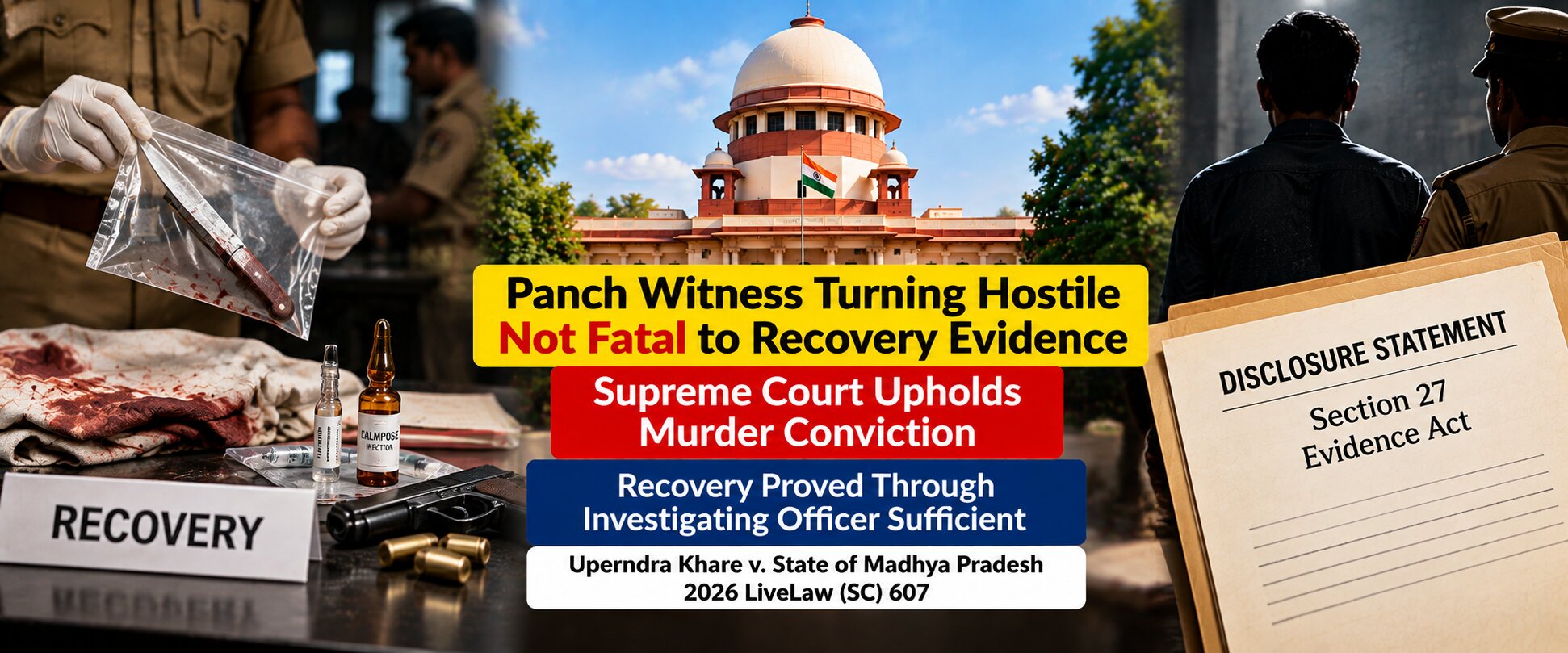
Panch witnesses turning hostile does not automatically invalidate recovery evidence.
Judgement Details
Court
Supreme Court of India
Date of Decision
2 September 2026
Judges
Justice Pankaj Mithal and Justice Prasanna B. Varale
Citation
Acts / Provisions
Facts of the Case
-
The prosecution case arose from a murder in which the appellant, along with other persons, allegedly entered the house of the deceased.
-
The accused were allegedly armed with country-made pistols, cartridges and guptis, a sharp-edged weapon.
-
According to the prosecution, the accused administered Calmpose injections to the victims before attacking them.
-
The victims subsequently died as a result of the injuries inflicted upon them.
-
Several articles were recovered from the scene of occurrence, including blood-stained clothes, a bedsheet and empty Calmpose injection phials found from the toilet seats.
-
The seized articles were sealed during the investigation.
-
The post-mortem examination attributed the cause of death to excessive haemorrhage resulting from injuries caused by a sharp object or weapon.
-
The medical evidence also detected the remains of Calmpose injection in the body.
-
During the investigation, certain articles were allegedly recovered at the instance of the appellant pursuant to his disclosure statement.
-
The prosecution relied upon the recovery evidence under Section 27 of the Evidence Act.
-
The panch witnesses associated with the recovery proceedings subsequently turned hostile.
-
The appellant argued that the recovery evidence should consequently be discarded because the independent panch witnesses did not support the prosecution.
-
The Sessions Court nevertheless relied upon the recovery evidence and convicted the appellant for murder.
-
The Madhya Pradesh High Court affirmed the conviction.
-
The appellant approached the Supreme Court challenging the concurrent findings of the courts below.
Issues
-
Whether recovery of material objects pursuant to the accused's disclosure statement can be relied upon when the panch witnesses to the recovery panchnama subsequently turn hostile?
-
Whether the testimony of the Investigating Officer alone can sufficiently prove a recovery made pursuant to the accused's disclosure statement under Section 27 of the Evidence Act?
-
Whether the hostility of panch witnesses, by itself, creates sufficient doubt to discard otherwise corroborated recovery evidence?
-
Whether the prosecution evidence, including the recovery, medical evidence and testimony of the Investigating Officer, was sufficient to sustain the appellant's conviction for murder?
Judgement
-
The Supreme Court dismissed the appeal and upheld the appellant's conviction for murder.
-
The Court rejected the argument that the recovery evidence automatically became unreliable merely because the panch witnesses had turned hostile.
-
The Court reiterated that the testimony of the Investigating Officer can be relied upon to prove a recovery when the surrounding evidence supports the prosecution case.
-
The Court relied upon the principle laid down in Rameshbhai Mohanbhai Koli v. State of Gujarat, (2011) 11 SCC 111.
-
The Court also relied upon Mallikarjun v. State of Karnataka, (2019) 8 SCC 359, where it was held that the recovery of a weapon does not become invalid merely because the panch witnesses have turned hostile.
-
The Supreme Court therefore held that the hostility of the panch witnesses was not, by itself, sufficient to discard the recovery proved through the Investigating Officer.
-
The Court found that the prosecution had sufficiently established the recovery evidence despite the hostile panch witnesses.
-
The medical evidence provided additional support to the prosecution case by establishing that the deceased suffered injuries caused by a sharp weapon and that Calmpose had been administered.
-
The Court consequently found no reason to interfere with the concurrent findings of the Sessions Court and the Madhya Pradesh High Court.
-
The criminal appeal was accordingly dismissed.
Held
-
Recovery pursuant to an accused's disclosure statement can be proved through the Investigating Officer's testimony.
-
The evidence of the Investigating Officer cannot be rejected merely because independent panch witnesses fail to support the prosecution.
-
The court must examine the overall reliability of the recovery evidence and its corroboration from other material on record.
-
A hostile panch witness does not necessarily destroy the prosecution case.
-
The recovery of an article pursuant to a disclosure statement remains capable of being relied upon when the legal requirements of Section 27 of the Evidence Act are satisfied.
-
Medical evidence and other surrounding circumstances may provide additional corroboration to the recovery evidence.
-
In the present case, the Supreme Court found sufficient material to sustain the appellant's murder conviction.
Analysis
-
Hostile panch witness is not fatal: The central principle of the judgment is that a panch witness turning hostile does not automatically erase the evidentiary value of a recovery. The court must examine whether the recovery has otherwise been satisfactorily established.
-
Investigating Officer's evidence: The Supreme Court reaffirmed that the Investigating Officer is a competent witness to prove recovery proceedings. His testimony cannot be discarded merely because the panch witnesses do not support the prosecution.
-
Section 27 operates as an exception: The evidentiary value of information supplied by an accused in custody is limited by Section 27. Only that portion of the information which distinctly relates to the fact discovered is admissible. The recovery must therefore satisfy the statutory requirements.
-
Independent corroboration remains relevant: Although the Investigating Officer's testimony may prove recovery, the court must still scrutinise it carefully. The reliability of the recovery is strengthened when it fits with medical evidence and other circumstances.
-
Medical evidence: In this case, the post-mortem evidence showing excessive haemorrhage from sharp-force injuries supported the prosecution version concerning the use of a sharp weapon.
-
Calmpose evidence: The presence of Calmpose remains in the body also supported the prosecution allegation that the victims had been administered the drug before the fatal assault.
-
Hostility does not equal falsity: A hostile witness does not necessarily mean that the underlying event did not occur. The court may rely upon the portion of evidence that remains trustworthy and is supported by other evidence.
-
Earlier Supreme Court precedent: By relying upon Rameshbhai Mohanbhai Koli and Mallikarjun, the Court reaffirmed an established evidentiary principle rather than creating an entirely new rule.
-
Cumulative assessment of evidence: The Court considered the recovery in the context of the broader prosecution case rather than treating the panch witnesses' hostility as an isolated circumstance automatically creating reasonable doubt.
-
Important limitation: The judgment does not mean that every recovery proved only through a police officer must automatically be accepted. The court must still assess the credibility of the Investigating Officer, the legality of the disclosure and recovery, the connection between the information and the discovered fact, and the corroborating circumstances.