
U.P. Public Service Commission Through Its Chairman & Anr. v. Sunil Kumar Singh & Ors., 2026
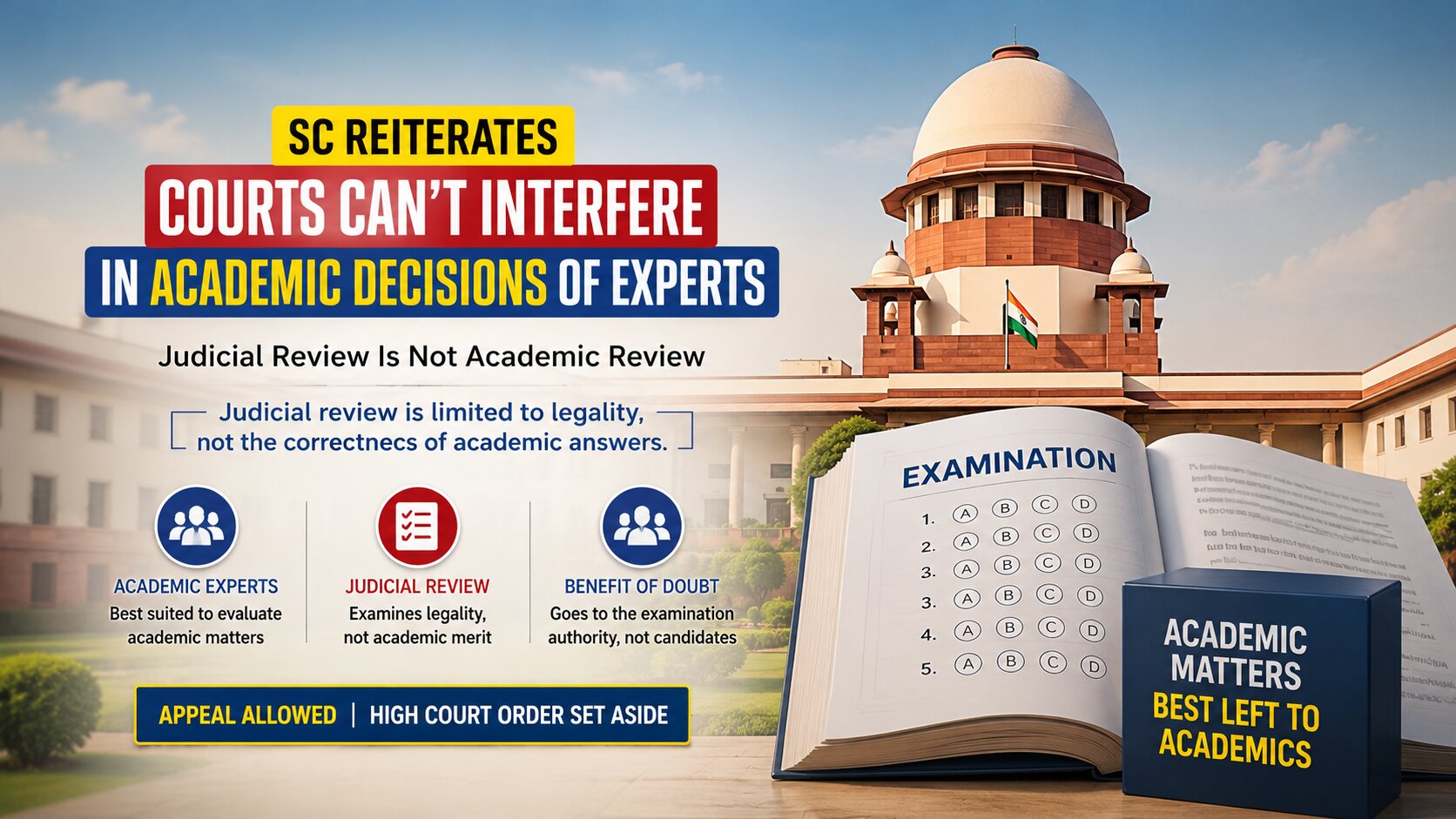
The High Court cannot ordinarily substitute its own academic assessment for the assessment of subject-matter experts in examination matters.
Judgement Details
Court
Supreme Court of India
Date of Decision
13 August 2026
Judges
Justice Dipankar Datta and Justice Sheel Nagu
Citation
Acts / Provisions
Facts of the Case
-
The dispute arose in connection with an examination conducted by the Uttar Pradesh Public Service Commission (UPPSC).
-
Certain candidates challenged aspects of the examination, including the correctness or validity of particular questions and the answers adopted by the examination authority.
-
The controversy involved questions belonging to different academic disciplines, in respect of which the examination authority had relied upon the assessment of subject-matter experts.
-
The matter reached the Allahabad High Court, which undertook an examination of the disputed questions and the answers provided in the examination.
-
The High Court interfered with the examination authority's assessment and issued directions concerning the treatment of disputed questions.
-
Among other directions, the High Court directed the UPPSC to undertake re-evaluation of answer scripts, delete certain questions and award full marks for certain questions.
-
The High Court's approach effectively required the examination authority to alter aspects of the examination on the basis of the High Court's own assessment of the disputed academic questions.
-
The UPPSC challenged the High Court's directions before the Supreme Court.
-
The Supreme Court examined whether the High Court had exceeded the permissible limits of judicial review by entering into the merits of academic questions and substituting its assessment for that of the experts.
-
The Supreme Court relied substantially upon the principles established in Ran Vijay Singh v. State of Uttar Pradesh, which cautions courts against undertaking their own scrutiny or re-evaluation of examination answer scripts because courts ordinarily lack the necessary academic expertise.
-
The Supreme Court ultimately found that the High Court had exceeded the jurisdiction ordinarily available to a judicial-review court in academic examination matters.
-
The official Supreme Court case listing confirms the matter as U.P. Public Service Commission through its Chairman & Anr. v. Sunil Kumar Singh & Ors., C.A. No. 4970/2017.
Issues
-
Whether the High Court was justified in exercising judicial review to examine and determine the correctness of disputed examination questions despite the examination authority having relied upon academic experts?
-
Whether the High Court could direct re-evaluation of answer scripts in circumstances where the governing examination framework did not confer an unrestricted right of re-evaluation upon candidates?
-
Whether the High Court could direct deletion of disputed questions and award full marks to candidates by substituting its own assessment for that of the academic experts?
-
Whether the High Court's examination of disputed questions from different academic disciplines amounted to an impermissible exercise of academic expertise under the guise of judicial review?
-
Whether the principles laid down in Ran Vijay Singh v. State of Uttar Pradesh required the High Court to exercise exceptional restraint in interfering with answer keys and evaluation of examination scripts?
-
Whether judicial review in examination matters is confined principally to examining the legality of the decision-making process rather than reassessing the academic correctness of answers determined by competent experts?
Judgement
-
The Supreme Court allowed the appeal filed by the Uttar Pradesh Public Service Commission and set aside the directions issued by the Allahabad High Court concerning the disputed examination questions and answer scripts.
-
The Court held that the High Court had exceeded the permissible limits of judicial review by interfering with the decision of experts in an academic field.
-
The Supreme Court strongly disapproved of the High Court's detailed examination of questions belonging to different academic disciplines.
-
The Court observed that the High Court had effectively approached the disputed questions as though it were an expert body itself, rather than confining itself to the legality of the examination authority's decision-making process.
-
The Court found that directing re-evaluation, deleting questions and awarding full marks in the manner ordered by the High Court was inconsistent with the principles governing judicial interference in examination matters.
-
The Supreme Court reiterated that academic matters are ordinarily best left to academic experts, particularly where the examination authority has obtained or relied upon expert opinion.
-
The Court relied upon the principles laid down in Ran Vijay Singh, under which courts should ordinarily presume the correctness of answer keys and should interfere only in rare and exceptional circumstances where a material error is demonstrated clearly and without resort to inferential reasoning.
-
The Court emphasized that the benefit of doubt should ordinarily go to the examination authority rather than to an individual candidate where uncertainty exists concerning an answer key.
-
The Court consequently restored the position that examination authorities and academic experts should be permitted to perform their specialised functions without unnecessary judicial substitution of opinion.
-
The appeal was accordingly allowed.
Held
-
Judicial review is concerned primarily with the legality and fairness of the decision-making process, and not with undertaking a fresh academic evaluation of examination questions or answers.
-
Re-evaluation or scrutiny of answer scripts is not a matter that courts should routinely order in the absence of a clear legal or regulatory basis.
-
Where the applicable examination rules permit re-evaluation, it may be undertaken in accordance with those rules.
-
Where the rules do not provide for re-evaluation, judicial intervention may be justified only in rare or exceptional circumstances where a material error is demonstrated clearly and without an inferential process of reasoning.
-
Courts should generally presume the correctness of the official answer key prepared or accepted by the competent examination authority.
-
Where genuine doubt exists regarding an answer key, the benefit ordinarily goes to the examination authority, rather than automatically to the candidate.
-
Academic questions involving specialised knowledge should ordinarily be resolved by qualified academic experts, not by courts lacking the requisite subject-matter expertise.
-
The High Court's directions concerning re-evaluation, deletion of questions and award of full marks were therefore unsustainable.
Analysis
-
Court's reasoning: The Supreme Court's central reasoning was based on the institutional limits of judicial review. A court exercising judicial review is not ordinarily equipped to determine whether an answer to a specialised academic question is scientifically, technically or academically correct. Such questions are ordinarily within the competence of subject experts.
-
Judicial review versus appellate academic assessment: The judgment reinforces the distinction between reviewing a decision and replacing that decision. Judicial review permits a court to examine whether an authority acted lawfully, fairly and within its jurisdiction. It does not ordinarily permit the court to become an appellate academic authority and determine which answer should have been treated as correct.
-
Importance of expert opinion: Examination authorities depend upon subject experts to formulate questions, prepare answer keys and determine academically acceptable answers. Excessive judicial interference can undermine this specialised process because a court may reach a different conclusion without possessing the same academic expertise.
-
Application of Ran Vijay Singh: The decision reinforces the principles established in Ran Vijay Singh v. State of Uttar Pradesh, (2018) 2 SCC 357. That judgment established a high threshold for judicial intervention in examination evaluation and emphasized that courts should not routinely re-evaluate answer scripts or independently scrutinise answer keys.
-
Exceptional nature of re-evaluation: The judgment does not mean that judicial review is completely unavailable in examination matters. Rather, intervention is exceptional. A candidate must establish a clear and material error, and the error must not depend upon speculative reasoning, extensive interpretation or competing academic opinions.
-
Institutional competence: An important principle emerging from the judgment is that institutional competence matters in judicial review. Courts possess constitutional expertise in questions of law, while academic experts possess specialised knowledge concerning technical and subject-specific questions. Respect for this division of institutional competence prevents judicial review from becoming an exercise in academic re-evaluation.
-
Protection of examination finality: Competitive examinations involve large numbers of candidates. If individual candidates can routinely obtain judicial orders requiring re-evaluation or alteration of answer keys, the finality and administrative efficiency of the examination process can be seriously affected. The judgment therefore supports certainty and uniformity in public examinations.
-
Equal treatment of candidates: The restraint imposed by the Court also protects other candidates who participated in the same examination under the original rules. Altering an answer key or deleting questions after the examination may affect rankings and selection outcomes for candidates who were not parties to the litigation.
-
Limits of judicial review: The judgment does not eliminate judicial review. Courts can still intervene where there is illegality, arbitrariness, procedural unfairness, violation of statutory rules or another recognised ground of judicial review. What courts should ordinarily avoid is replacing the academic judgment of competent experts with their own assessment.
-
Impact on existing law: The decision strengthens and reiterates the established judicial approach that academic decisions relating to examination questions and answer keys should receive considerable judicial restraint. It therefore operates as a reaffirmation of the principle that examination disputes are not ordinarily an invitation for courts to conduct a fresh evaluation.
-
Practical significance: For candidates challenging an answer key or examination result, the judgment makes clear that merely showing that another answer may also appear plausible is generally insufficient. The challenge must satisfy the stringent standard required for exceptional judicial intervention.
-
Broader constitutional significance: The case illustrates the difference between the existence of judicial review and the manner in which that power should be exercised. The constitutional power of review is broad, but its exercise must respect the specialised functions entrusted to administrative and expert bodies.