
Union Territory through Police Station Mattan v. Ghulam Nabi Mir, 2026
Challenge to an order making interim bail absolute in an NDPS case concerning alleged cultivation of opium poppy.
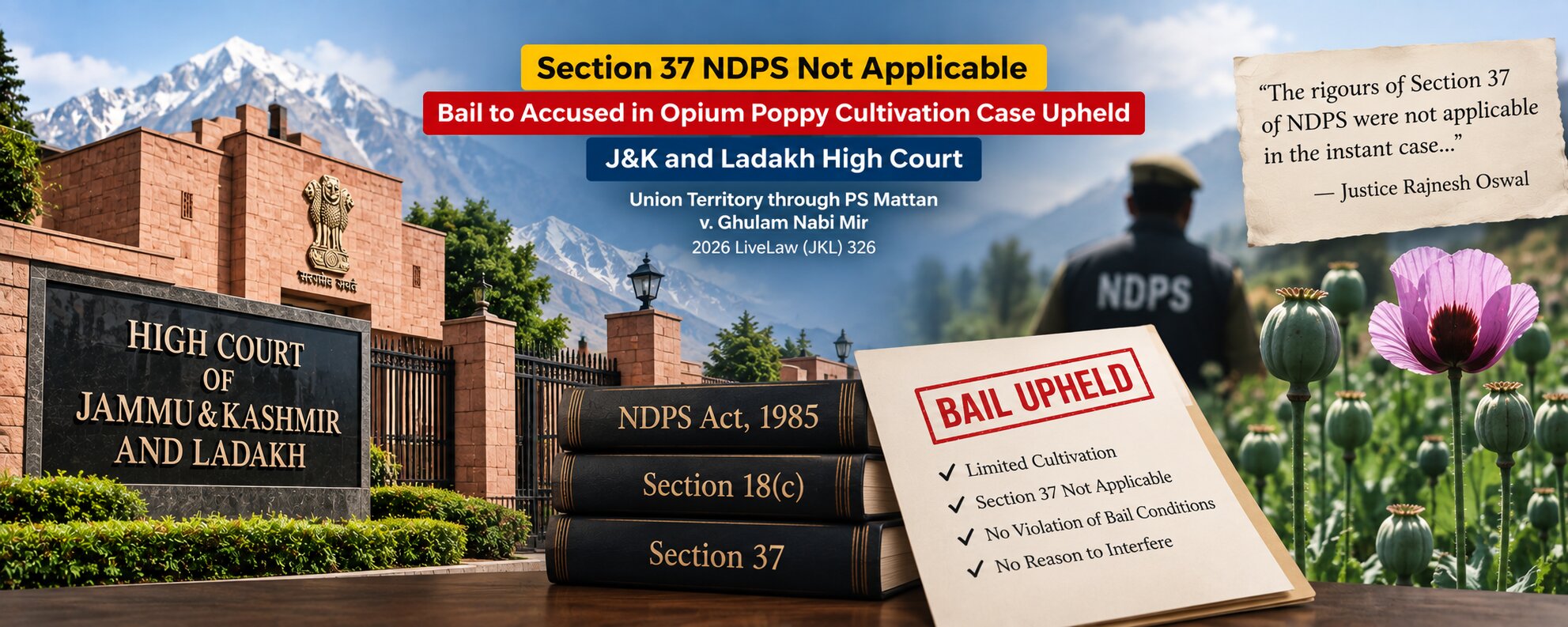
Judgement Details
Court
High Court of Jammu & Kashmir and Ladakh
Date of Decision
16 September 2026
Judges
Justice Rajnesh Oswal
Citation
Acts / Provisions
Facts of the Case
-
The respondent, Ghulam Nabi Mir, was arrested in connection with allegations relating to the cultivation of opium poppy.
-
The prosecution alleged that the respondent had cultivated an opium poppy crop on land measuring approximately 01 marla.
-
The case was registered in connection with the alleged offence under the NDPS Act.
-
The respondent approached the Special Judge, NDPS, Anantnag, seeking bail.
-
The Special Judge initially granted the respondent interim bail by order dated 29 May 2026.
-
The interim bail was subsequently made absolute by the Special Judge.
-
The Union Territory challenged the order before the High Court of Jammu & Kashmir and Ladakh.
-
The Union Territory argued that the Special Judge had granted bail while observing that the allegation concerned limited cultivation and did not involve recovery of a commercial quantity of contraband.
-
The Union Territory further contended that the Special Judge had not assigned adequate reasons for making the interim bail absolute.
-
The prosecution sought interference with the bail order on the ground that the allegations concerned an offence under the stringent NDPS legislation.
-
The High Court examined the record and noted that the respondent had already been enlarged on interim bail.
-
The High Court specifically noted that there was no allegation that the respondent had violated any of the conditions imposed while granting interim bail.
-
The Special Judge, while making the interim bail absolute, had also taken note of the Supreme Court's direction in Anna Waman Bahalerao v. State of Maharashtra concerning the timely disposal of bail applications.
-
The Special Judge had further observed that there was nothing on record showing that the respondent had violated the conditions of bail.
-
The High Court considered the applicability of the stringent requirements contained in Section 37 of the NDPS Act.
-
The High Court concluded that the rigours of Section 37 were not applicable to the case.
-
According to the High Court, the bail application therefore had to be considered primarily with reference to Section 18(c) of the NDPS Act.
Issues
-
Whether the stringent conditions prescribed under Section 37 of the Narcotic Drugs and Psychotropic Substances Act, 1985 were applicable to the case concerning the alleged cultivation of opium poppy?
-
Whether the bail application of the respondent was required to be considered primarily with reference to Section 18(c) of the NDPS Act in the circumstances of the case?
-
Whether the absence of any allegation that the respondent had violated the conditions of interim bail constituted a relevant circumstance against interference with the order making such bail absolute?
-
Whether the order of the Special Judge, NDPS, Anantnag, making the interim bail granted to the respondent absolute warranted interference by the High Court?
-
Whether the Union Territory had established sufficient grounds for setting aside the bail order in the peculiar facts and circumstances of the case?
Judgement
-
The High Court of Jammu & Kashmir and Ladakh dismissed the petition filed by the Union Territory challenging the bail granted to Ghulam Nabi Mir.
-
The Court held that the rigours of Section 37 of the NDPS Act were not applicable to the case.
-
The Court observed that the bail application therefore had to be considered in accordance with the applicable provisions, particularly Section 18(c) of the NDPS Act.
-
The Court examined the circumstances in which the respondent had initially been granted interim bail.
-
The Court noted that the respondent had been enlarged on interim bail on 29 May 2026.
-
The Court found that there was no allegation whatsoever that the respondent had violated the terms and conditions of the interim bail.
-
The Court also considered the fact that the Special Judge had made the interim bail absolute after considering the circumstances of the case.
-
The High Court noted that the Special Judge had referred to the Supreme Court's direction in Anna Waman Bahalerao v. State of Maharashtra concerning timely consideration of bail applications.
-
The High Court found no sufficient basis to interfere with the order passed by the Special Judge.
-
The Court therefore concluded that, in the peculiar facts and circumstances of the case, there was no reason to disturb the bail granted to the respondent.
-
The petition filed by the Union Territory was consequently found to be without merit and dismissed.
Held
-
The High Court held that the rigours of Section 37 of the NDPS Act were not applicable in the present case.
-
The bail application was therefore required to be considered primarily with reference to Section 18(c) of the NDPS Act.
-
The Court considered the absence of any allegation that the respondent had violated the conditions of bail as an important circumstance.
-
The mere fact that the prosecution disagreed with the grant of bail was not sufficient, in the circumstances of the case, to warrant interference by the High Court.
-
The High Court found no adequate ground to interfere with the order of the Special Judge, NDPS, Anantnag, making the interim bail absolute.
-
The petition filed by the Union Territory was dismissed.
Analysis
-
The judgment reinforces that Section 37 of the NDPS Act is not applicable to every offence prosecuted under the NDPS Act.
-
Courts must first determine whether the alleged offence falls within the statutory scope attracting the stringent requirements of Section 37.
-
Where Section 37 is not applicable, the court must consider bail under the relevant substantive provision and ordinary principles governing bail.
-
The decision also demonstrates the importance of the accused's conduct after the grant of interim bail.
-
The absence of any allegation concerning violation of bail conditions or misuse of bail was relevant to the High Court's refusal to interfere.
-
The judgment illustrates that an appellate or revisional court will examine the specific statutory framework applicable to the alleged offence, rather than mechanically applying the strictest NDPS bail requirements.
-
The decision is particularly relevant to cases involving cultivation of opium poppy, where the applicability of Section 37 must be assessed according to the precise statutory offence and circumstances involved.
-
The ruling also demonstrates judicial restraint where the lower court has exercised its discretion in granting bail and there is insufficient material demonstrating a legal basis for interference.