
Union of India v. Preeti Vaid & Anr., 2026
The judgment reinforces the beneficial and welfare-oriented nature of the RPWD Act by adopting a purposive interpretation.
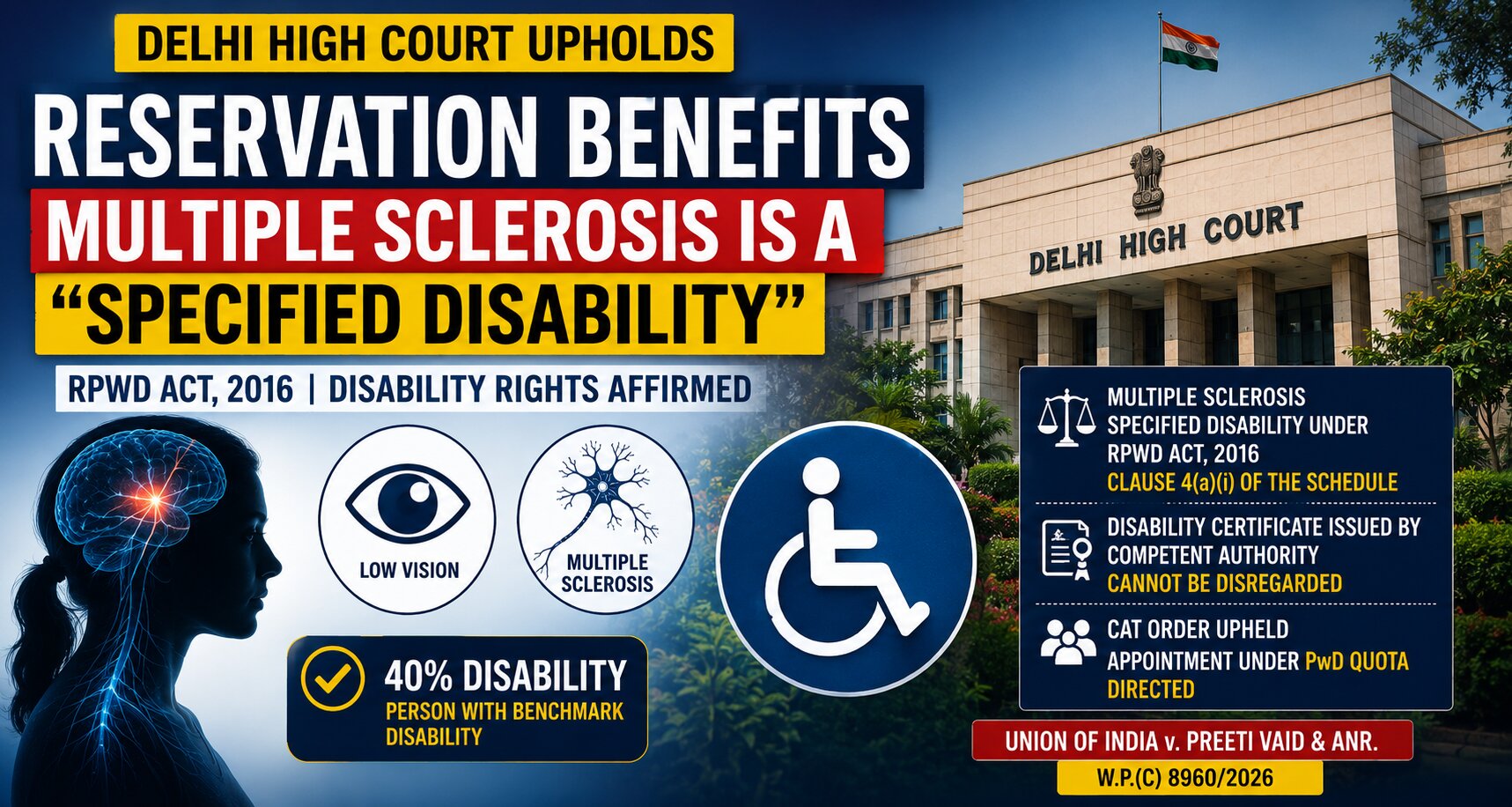
Judgement Details
Court
High Court of Delhi
Date of Decision
15 July 2026
Judges
Justice C. Hari Shankar and Justice Vinod Kumar
Citation
Acts / Provisions
Facts of the Case
-
The respondent suffered from Multiple Sclerosis (MS) and low vision in both eyes.
-
She possessed a disability certificate issued by the competent authority under the RPWD Act, certifying:
-
15% disability due to low vision.
-
30% disability due to multiple sclerosis.
-
Overall disability of 40%, qualifying her as a person with benchmark disability.
-
-
She applied for the Combined Graduate Level Examination (CGLE) 2021 conducted by the Staff Selection Commission (SSC) under the Persons with Disabilities (PwD) reservation category.
-
The respondent successfully cleared all stages of the recruitment process and was called for document verification.
-
SSC rejected her candidature stating that "Multiple Sclerosis Disease not admissible for reservation."
-
She challenged the rejection before the Central Administrative Tribunal (CAT).
-
The CAT directed SSC to appoint her under the PwD quota.
-
SSC challenged the CAT's order before the Delhi High Court, contending that multiple sclerosis was not covered under Section 34 of the RPWD Act for reservation purposes.
Issues
-
Whether Multiple Sclerosis is a "specified disability" under the Rights of Persons with Disabilities Act, 2016?
-
Whether a person suffering from Multiple Sclerosis with 40% benchmark disability is entitled to reservation under Section 34 of the RPWD Act?
-
Whether Section 34(1) of the RPWD Act can be interpreted to exclude persons suffering from Multiple Sclerosis from reservation in public employment?
-
Whether the Staff Selection Commission could disregard the disability certificate issued by the competent authority under the RPWD Act?
-
Whether the Central Administrative Tribunal rightly directed the appointment of the respondent under the PwD reservation quota?
Judgement
-
The Delhi High Court dismissed the writ petition filed by the Union of India and SSC.
-
The Court upheld the order of the Central Administrative Tribunal directing appointment of the respondent under the PwD quota.
-
It held that Multiple Sclerosis is expressly recognized under Clause 4(a)(i) of the Schedule to the RPWD Act as a chronic neurological condition.
-
Consequently, Multiple Sclerosis is a "specified disability" under Section 2(z)(c) of the RPWD Act.
-
Since the respondent had an overall disability of 40%, she qualified as a person with benchmark disability under Section 2(r).
-
The Court held that the first part of Section 34(1) creates a statutory obligation to reserve at least 4% vacancies for persons with benchmark disabilities, while the second part merely distributes that reservation among different categories.
-
It ruled that the latter part of Section 34(1) cannot be interpreted in a manner that narrows or defeats the broader right created by the first part.
-
The Court observed that the RPWD Act is a beneficial legislation and must receive a liberal and purposive interpretation.
-
The Court further held that SSC could not ignore or question a disability certificate validly issued by the competent authority under the RPWD Act.
-
It also noted that SSC's own recruitment notification specifically recognized Multiple Sclerosis as an eligible disability for reservation.
-
Accordingly, the writ petition was dismissed.
Held
-
Multiple Sclerosis is a specified disability under the RPWD Act.
-
A person suffering from Multiple Sclerosis with 40% benchmark disability is entitled to reservation under Section 34 of the RPWD Act.
-
Section 34 must be interpreted liberally to further the object of the RPWD Act.
-
SSC cannot disregard a disability certificate issued by the competent authority.
-
The CAT's direction granting appointment under the PwD quota was upheld.
Analysis
- It clarifies the distinction between "specified disability" under Section 2(z)(c) and "person with benchmark disability" under Section 2(r), thereby removing ambiguity regarding eligibility for reservation.
-
The Court emphasized that Section 34 should not be interpreted narrowly, as doing so would undermine the legislative objective of promoting equal opportunities for persons with disabilities.
-
The decision strengthens the legal sanctity of disability certificates issued by competent statutory authorities by holding that recruiting agencies cannot independently question or disregard such certificates.
-
By relying upon Vikash Kumar, Ravinder Kumar Dhariwal, and In Re: Recruitment of Visually Impaired in Judicial Services, the Court reaffirmed that disability rights legislation must be interpreted expansively in favour of inclusion rather than exclusion.
-
The judgment also highlights the principle that government authorities must act consistently with their own recruitment notifications and cannot subsequently deny benefits expressly promised therein.
-
The ruling significantly strengthens employment rights of persons suffering from chronic neurological disorders such as Multiple Sclerosis and advances the constitutional principles of equality, dignity, and non-discrimination.