
Union of India & Ors. v. Ramdhani Prasad, 2026
Article 311(1) is attracted only when the authority passing the dismissal or removal order is subordinate in rank to the authority that actually appointed the employee.
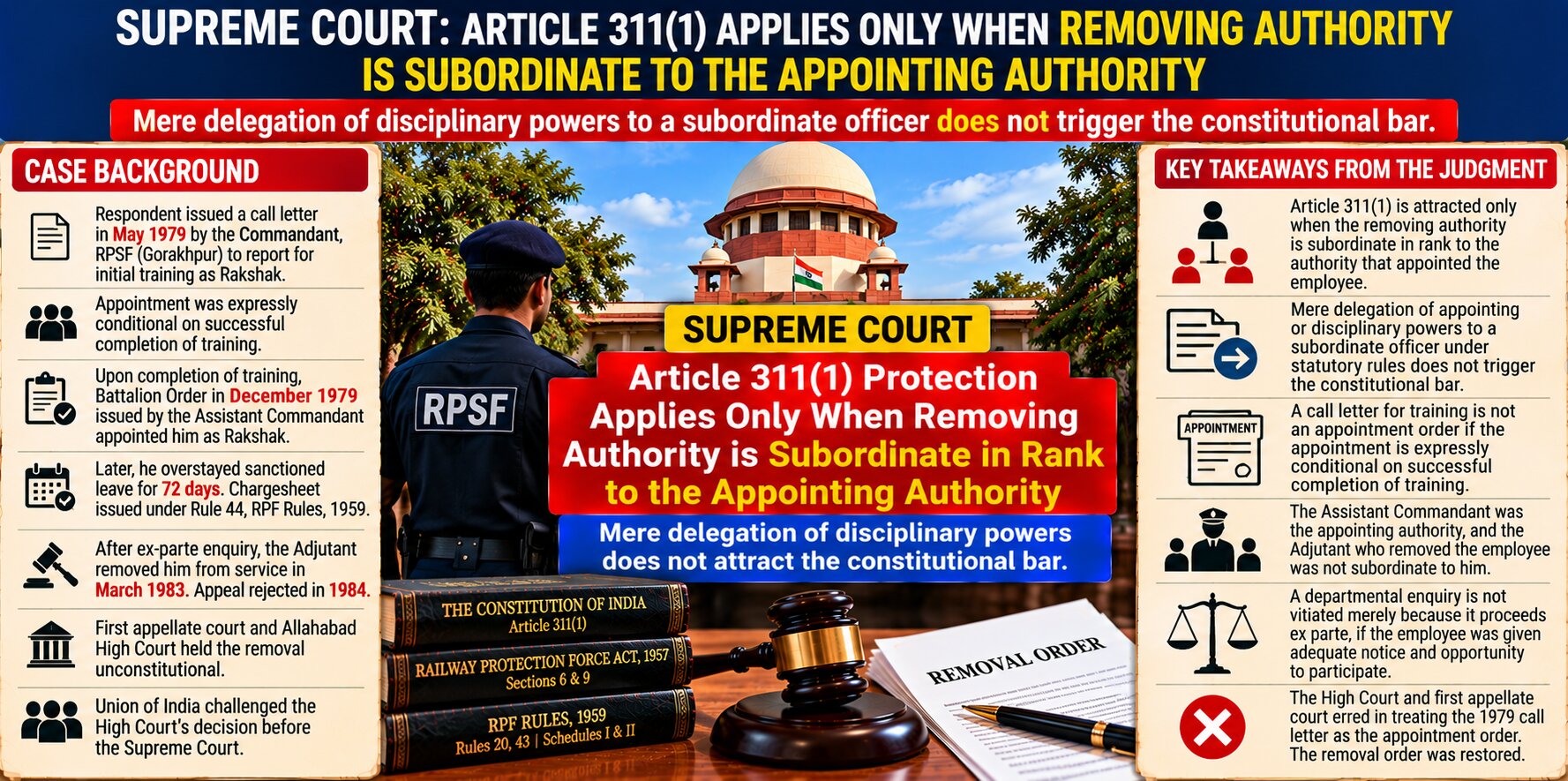
Judgement Details
Court
Supreme Court of India
Date of Decision
24 September 2026
Judges
Justice Aravind Kumar and Justice Vipul M. Pancholi
Citation
Acts / Provisions
Facts of the Case
-
The respondent, Ramdhani Prasad, was selected for appointment as a Rakshak in the Railway Protection Special Force (RPSF).
-
In May 1979, the Commandant, RPSF, Gorakhpur, issued a call letter requiring him to report for initial training for the post of Rakshak.
-
The call letter expressly made the proposed appointment conditional upon the recruit's successful completion of initial training.
-
After the respondent successfully completed his training, a Battalion Order was issued by the Assistant Commandant in December 1979 appointing him and the other recruits as Rakshaks and posting them to their respective battalions.
-
A subsequent Battalion Order in February 1980 reaffirmed the appointment and posting.
-
The respondent subsequently overstayed his sanctioned leave by approximately 72 days.
-
Disciplinary proceedings were initiated against him under Rule 44 of the Railway Protection Force Rules, 1959.
-
A charge-sheet was served upon him and a departmental enquiry was initiated.
-
The enquiry ultimately proceeded ex parte after the respondent, despite being informed of the proceedings, did not appear.
-
The Adjutant thereafter passed an order in March 1983 removing the respondent from service.
-
The respondent preferred a departmental appeal, which was rejected in 1984.
-
He then instituted a civil suit challenging the removal.
-
His principal contention was that the 1979 call letter issued by the Commandant/Chief Security Officer constituted his appointment order.
-
On that basis, he argued that his removal by the Adjutant violated Article 311(1) because the Adjutant was allegedly subordinate to the authority that had appointed him.
-
The trial court rejected the suit and upheld the removal.
-
The first appellate court reversed that finding and held that the removal was unconstitutional.
-
The Allahabad High Court, in second appeal, affirmed the first appellate court's decision.
-
The Union of India challenged the High Court's decision before the Supreme Court.
-
The Union argued that the call letter merely required the respondent to report for training and did not constitute an unconditional appointment.
-
According to the Union, the actual appointment took place through the December 1979 Battalion Order issued by the Assistant Commandant, who was statutorily competent to appoint Rakshaks.
-
The respondent also argued that the departmental enquiry was invalid because it proceeded ex parte while he was undergoing medical treatment.
-
The Supreme Court therefore had to determine both who had actually appointed the respondent and whether the authority that removed him was subordinate in rank to that appointing authority.
Issues
-
Whether the May 1979 call letter issued by the Commandant constituted the respondent's appointment order as a regular Rakshak?
-
Whether the December 1979 Battalion Order issued by the Assistant Commandant constituted the respondent's operative order of appointment?
-
Whether Article 311(1) of the Constitution is attracted when the authority removing a civil servant is not subordinate in rank to the authority that actually appointed him?
-
Whether the statutory delegation of appointment and disciplinary powers under the Railway Protection Force Act and Rules alters the constitutional requirement concerning the relative rank of the appointing and removing authorities?
-
Whether the Adjutant was competent under the Railway Protection Force Rules to impose the penalty of removal upon the respondent?
-
Whether the departmental enquiry was vitiated merely because it proceeded ex parte after the respondent had been served with the charge-sheet and notice of the enquiry?
-
Whether the judgments of the first appellate court and the Allahabad High Court holding the respondent's removal unconstitutional were legally sustainable?
Judgement
-
The Supreme Court allowed the Union of India's appeal and set aside the judgments of the Allahabad High Court and the first appellate court.
-
The Court held that the May 1979 call letter was not the operative appointment order because it did not contain an unconditional declaration that the respondent had already been appointed as a regular Rakshak.
-
The call letter expressly made the proposed appointment conditional upon the successful completion of initial training.
-
The Court considered the December 1979 Battalion Order materially different because it specifically recorded that the recruits, having successfully completed training, were appointed as Rakshaks.
-
The Supreme Court rejected the argument that the Battalion Order was merely a posting order, holding that an order can simultaneously operate as an appointment order and a posting order.
-
On the statutory framework, the Court examined Sections 6 and 9 of the Railway Protection Force Act, 1957, Rule 20, Rule 43 and Schedules I and II of the RPF Rules, 1959.
-
The Court held that Section 6's reference to control resting with the Chief Security Officer did not mean that the Chief Security Officer alone possessed the exclusive power of appointment.
-
The proviso to Section 6 permits appointment powers to be exercised by other superior officers in accordance with the statutory framework.
-
The relevant Rules specifically empowered the Assistant Security Officer/Assistant Commandant to appoint Rakshaks and Senior Rakshaks.
-
The Court relied on Union of India v. Chandra Pal Pandey, explaining that the expression concerning control “shall rest” with the Chief Security Officer signifies overall control, rather than exclusive exercise of every appointment power by that officer.
-
The Court then applied the principle in Krishna Kumar, namely that delegation of statutory appointing power does not alter the hierarchical status of the officer exercising that delegated power.
-
Since the respondent was actually appointed through the December 1979 order issued by the Assistant Commandant, the constitutional comparison under Article 311(1) had to be made with that authority.
-
The Court found that the Adjutant was not subordinate in rank to the Assistant Commandant and was independently competent under the applicable Rules to impose the penalty of removal.
-
Consequently, the essential condition for attracting Article 311(1) was absent.
-
The Court held that the respondent's removal therefore did not violate Article 311(1).
-
The Supreme Court separately considered the challenge to the ex parte departmental enquiry.
-
It noted that the respondent had acknowledged the charge-sheet, submitted a response and was informed of the date of the enquiry.
-
Despite notice, he did not participate, following which the enquiry proceeded ex parte and the necessary show-cause process was undertaken before the removal order.
-
The Court therefore rejected the contention that the departmental enquiry was invalid merely because it proceeded ex parte.
-
The Supreme Court restored the trial court's dismissal of the respondent's suit and consequently restored the order removing him from service.
Held
-
The identity of the appointing authority must be determined from the actual statutory appointment order, and not merely from an earlier communication connected with recruitment or training.
-
A call letter requiring a candidate to undergo training does not necessarily constitute an appointment order where the proposed appointment is expressly conditional upon successful completion of training.
-
An order can validly function as both an appointment order and a posting order.
-
The December 1979 Battalion Order was the operative appointment order because it recorded the respondent's appointment as a Rakshak after successful completion of training.
-
The Assistant Commandant was competent under the applicable RPF statutory framework to appoint Rakshaks.
-
The Adjutant's competence to impose the penalty of removal was also recognised under the relevant disciplinary rules.
-
Delegation of statutory power does not alter the rank or status of the officer exercising that power for purposes of Article 311(1).
-
Because the Adjutant was not subordinate in rank to the actual appointing authority, the constitutional prohibition in Article 311(1) was not attracted.
-
A departmental enquiry is not rendered invalid merely because it proceeds ex parte, provided the employee was given adequate notice and a reasonable opportunity to participate.
-
The respondent's removal from service was therefore legally sustainable.
-
The judgments of the first appellate court and the Allahabad High Court were set aside, and the trial court's dismissal of the suit was restored.
Analysis
-
The most significant aspect of the judgment is the Court's emphasis on identifying the actual appointing authority before applying Article 311(1). The constitutional protection is not determined simply by identifying the highest authority involved in the recruitment process.
-
The Court carefully distinguished between a recruitment/training communication and a formal appointment order. Because the May 1979 call letter expressly conditioned appointment upon successful completion of training, it could not be treated as an unconditional appointment.
-
The December 1979 Battalion Order was decisive because it expressly recorded the appointment of the trained recruits as Rakshaks.
-
This approach reinforces the principle that the substance and legal effect of the relevant administrative order, rather than its label alone, determine whether it constitutes an appointment order.
-
The decision also clarifies the relationship between statutory delegation and Article 311(1). Delegation of appointment power does not transform the rank of the officer exercising the delegated power.
-
Therefore, an officer exercising delegated statutory authority does not automatically become constitutionally subordinate to the authority from whom the statutory framework derives overall control.
-
The Court's reliance on Chandra Pal Pandey is important because it distinguishes overall administrative control from the exclusive exercise of every statutory power. The fact that overall control rests with a superior authority does not necessarily mean that every appointment must personally be made by that authority.
-
The judgment accordingly places considerable importance on the specific statutory rules and schedules governing the Railway Protection Force rather than on a broad assumption about administrative hierarchy.
-
The Article 311(1) protection is therefore not a general rule that removal must always be ordered by the same officer who signed the appointment order. The constitutional requirement is specifically concerned with whether the removing authority is subordinate in rank to the appointing authority.
-
The judgment also illustrates why the constitutional protection under Article 311(1) must be distinguished from the broader requirement that disciplinary proceedings comply with natural justice.
-
Even where Article 311(1) is not violated, disciplinary proceedings must still provide the employee with the legally required opportunity to defend himself.
-
In the present case, the Court found that the respondent had received the charge-sheet, responded to it and received notice of the enquiry, but failed to participate. The ex parte character of the enquiry therefore did not, by itself, establish denial of natural justice.
-
The ruling does not establish that every ex parte departmental enquiry is automatically valid. Its conclusion rests on the particular procedural history and the opportunity admittedly provided to the respondent.
-
The judgment has broader significance for service jurisprudence, particularly in organisations governed by specialised statutory service rules. Courts must examine the relevant appointment and disciplinary schedules before determining whether an officer possessed the necessary authority.
-
It also demonstrates that an employee cannot establish an Article 311(1) violation merely by showing that a higher-ranking officer was involved at an earlier stage of recruitment. The crucial question is who legally made the appointment.
-
The decision ultimately restored the removal because both the constitutional objection and the natural-justice objection failed on the facts found by the Supreme Court.
-
The judgment therefore reinforces three connected principles: identify the true appointing authority, compare the rank of the removing authority with that appointing authority, and separately examine whether the disciplinary process complied with natural justice.