
Union of India & Ors. v. Hariom Projects Pvt. Ltd., 2026
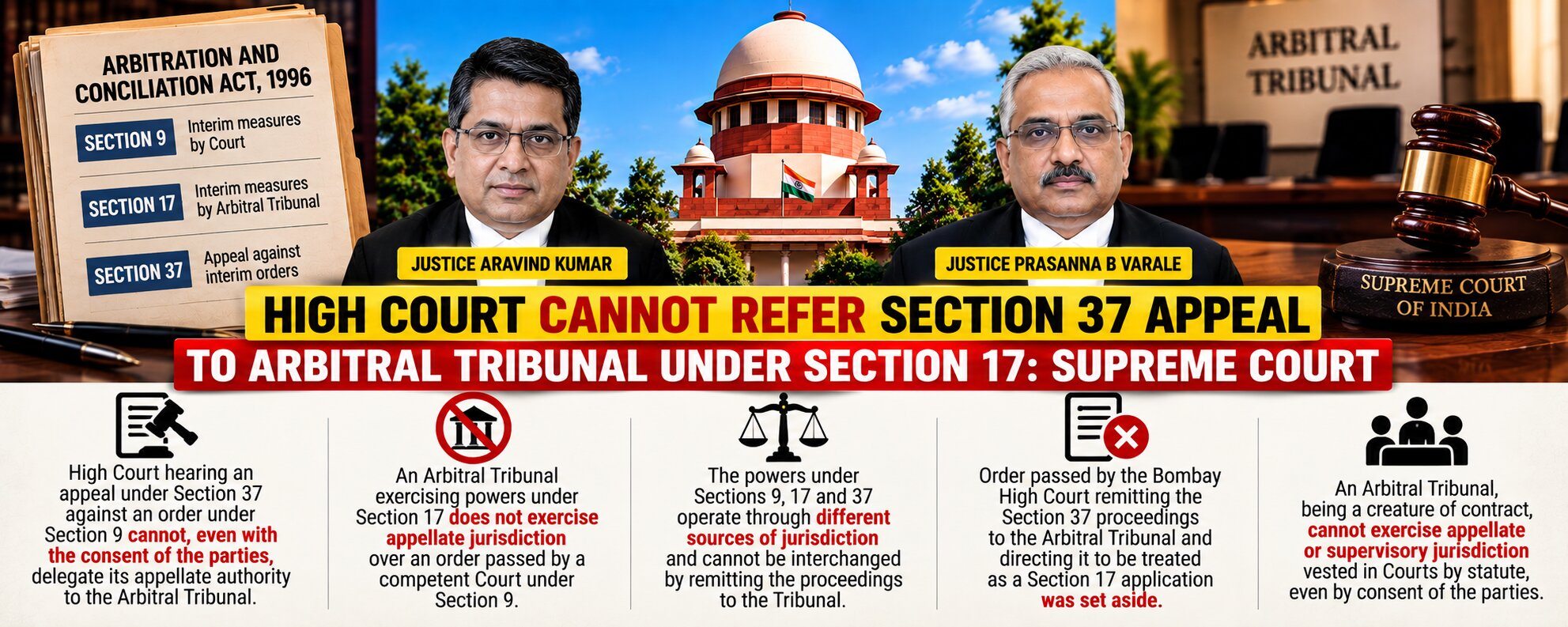
An Arbitral Tribunal exercising powers under Section 17 does not exercise appellate jurisdiction over an order passed by a Court under Section 9.
Judgement Details
Court
Supreme Court of India
Date of Decision
30 September 2026
Judges
Justice Aravind Kumar and Justice Prasanna B. Varale
Citation
Acts / Provisions
Facts of the Case
-
The dispute arose from a contract awarded by the Union of India to Hariom Projects Pvt. Ltd.
-
The contract related to providing Administrative and Training Infrastructure (Phase-I) at NDA Khadakwasla.
-
Disputes subsequently arose between the parties concerning various contractual matters, including adjustments, payment calculations and design-related issues.
-
Hariom Projects invoked the arbitration clause contained in the contract.
-
The respondent also approached the District Judge, Pune, under Section 9 of the Arbitration and Conciliation Act, 1996, seeking interim protection.
-
Among other reliefs, the respondent sought protection against cancellation or termination of the contract.
-
The Section 9 application was dismissed by the competent Court.
-
Aggrieved by the dismissal, Hariom Projects filed an appeal under Section 37 of the Arbitration Act before the Bombay High Court.
-
During the pendency of the Section 37 appeal, the Union of India terminated the work order.
-
The Bombay High Court granted interim protection against the termination.
-
Subsequently, with the consent of the parties, the High Court appointed a Sole Arbitrator.
-
While appointing the Arbitrator, however, the High Court directed that the proceedings pending before it under Section 37 should be remitted to the Arbitral Tribunal.
-
The High Court further directed the Arbitral Tribunal to treat those proceedings as an application under Section 17.
-
The Union of India challenged this portion of the High Court's order before the Supreme Court.
-
The principal question before the Supreme Court was whether a statutory appeal under Section 37 could be transferred to an Arbitral Tribunal and converted into a Section 17 application merely because the parties had consented to arbitration.
Issues
-
Whether a High Court exercising appellate jurisdiction under Section 37 of the Arbitration and Conciliation Act can delegate or transfer that statutory appellate jurisdiction to an Arbitral Tribunal exercising powers under Section 17?
-
Whether an Arbitral Tribunal exercising jurisdiction under Section 17 can examine or adjudicate a challenge to an order passed by a Court under Section 9 as though it were exercising appellate jurisdiction?
-
Whether the consent of the parties can authorise an Arbitral Tribunal to exercise appellate or supervisory jurisdiction statutorily vested in a Court under Section 37?
-
Whether proceedings pending before a High Court under Section 37 can be remitted to an Arbitral Tribunal and directed to be treated as an application under Section 17?
-
Whether the jurisdiction exercised under Sections 9, 17 and 37 of the Arbitration and Conciliation Act arises from distinct statutory sources and therefore cannot be interchanged merely by transmitting the proceedings from the Court to the Arbitral Tribunal?
Judgement
-
The Supreme Court allowed the appeal to the limited extent challenged by the Union of India.
-
The Court set aside the Bombay High Court's direction requiring the Section 37 proceedings to be remitted to the Arbitral Tribunal.
-
The Supreme Court held that an Arbitral Tribunal exercising powers under Section 17 does not exercise appellate jurisdiction over an order passed by a competent Court under Section 9.
-
The Court emphasised that the powers under Sections 9, 17 and 37 have different sources and operate in different legal fields.
-
Section 9 empowers a Court to grant interim measures.
-
Section 17 empowers an Arbitral Tribunal to grant interim measures after the arbitral proceedings are before the Tribunal.
-
Section 37 provides a statutory appellate remedy against specified orders, including certain orders passed under Section 9.
-
The Court held that the statutory appellate jurisdiction under Section 37 cannot simply be transferred to the Arbitral Tribunal.
-
The fact that the parties consented to the appointment of an Arbitrator did not permit the parties or the Court to confer appellate jurisdiction on the Tribunal.
-
The Court also rejected the proposition that proceedings under Section 37 could be transformed into proceedings under Section 17 merely by transmitting the record to the Tribunal.
-
The Supreme Court observed that an Arbitral Tribunal is a creature of the arbitration agreement and the governing statute and cannot assume appellate or supervisory jurisdiction that the statute has vested in the Courts.
-
The High Court's order was therefore set aside only to the extent that it remitted the Section 37 proceedings to the Arbitral Tribunal and directed their treatment as a Section 17 application.
-
The remainder of the High Court's order was not disturbed by the Supreme Court.
Held
-
Section 37 appellate jurisdiction is distinct from the interim-relief jurisdiction of an Arbitral Tribunal under Section 17.
-
The jurisdiction under Sections 9, 17 and 37 cannot be treated as interchangeable.
-
A High Court cannot delegate its statutory appellate jurisdiction under Section 37 to an Arbitral Tribunal.
-
Party consent cannot confer appellate or supervisory jurisdiction upon an Arbitral Tribunal where the statute does not provide for such jurisdiction.
-
Proceedings pending under Section 37 cannot be converted into a Section 17 application merely by remitting them to the Arbitral Tribunal.
-
The Bombay High Court's direction remitting the Section 37 proceedings to the Arbitral Tribunal was set aside to that limited extent.
Analysis
-
Different sources of jurisdiction: The central principle is that Sections 9, 17 and 37 create different forms of jurisdiction. The Court focused on the source of power, rather than merely the similarity of the interim relief that may be sought.
-
Section 9 jurisdiction: Section 9 permits a Court to grant interim measures in appropriate circumstances. The resulting judicial order is an order of a competent Court.
-
Section 17 jurisdiction: Section 17 empowers the Arbitral Tribunal to grant interim measures during the arbitral process. The Tribunal's power is not an appellate power over judicial orders.
-
Section 37 jurisdiction: Section 37 creates a statutory appellate remedy against specified orders under the Arbitration Act. When a High Court exercises Section 37 jurisdiction, it acts as an appellate Court.
-
No appellate power under Section 17: An Arbitral Tribunal cannot sit in appeal over an order passed by a Court merely because the subject matter concerns interim protection.
-
Consent cannot create statutory jurisdiction: The judgment reinforces the principle that jurisdiction cannot ordinarily be created merely through consent of the parties. Parties can agree to arbitration within the limits permitted by law, but they cannot confer a statutory appellate power on an Arbitral Tribunal that the legislation has not granted to it.
-
Arbitral Tribunal as a creature of statute and agreement: The Tribunal derives its authority from the arbitration agreement and the Arbitration Act. Its powers therefore remain within the boundaries established by the statutory framework.
-
Delegation by the High Court: A Court possessing statutory appellate jurisdiction cannot simply transfer that jurisdiction to another adjudicatory body when the statute does not authorise such delegation.
-
Section 17 cannot replace Section 37: Treating a Section 37 appeal as a Section 17 application would fundamentally change the legal character of the proceeding. The parties would move from an appellate proceeding before a Court to an interim-relief proceeding before an Arbitral Tribunal.
-
Nature of proceedings matters: Even if both proceedings concern interim protection, the legal nature of the two proceedings remains different. The similarity of the relief sought does not make the jurisdiction identical.
-
Protection of statutory appellate structure: The judgment preserves the statutory hierarchy created by the Arbitration Act. Courts exercising appellate jurisdiction and Arbitral Tribunals exercising arbitral jurisdiction perform different institutional functions.
-
Effect of party consent: Consent was sufficient for the appointment of the Sole Arbitrator, but it could not validate the transfer of the pending statutory appeal.
-
Limited interference by the Supreme Court: The Supreme Court did not invalidate the entire High Court order. It interfered specifically with the portion that transferred the Section 37 proceedings to the Arbitral Tribunal and converted them into a Section 17 application.
-
Practical significance: Parties involved in arbitration cannot assume that every dispute concerning interim relief can be shifted between Court and Tribunal merely for convenience. The appropriate statutory source of jurisdiction must be identified.
-
Importance for arbitration practice: The judgment provides clarity where a Section 9 application has already resulted in a judicial order and an appeal under Section 37 is pending when arbitration proceedings commence.
-
Core procedural lesson: A Section 37 appeal remains a statutory appellate proceeding. Appointment of an Arbitral Tribunal does not automatically transform that appeal into a Section 17 application.