
Umesh Mali v. State of U.P. through Principal Secretary, Home, Lucknow & 3 Others, 2026
In the present case, the applicant's age, lack of criminal antecedents, period of custody and completion of investigation were relevant circumstances in considering bail.
Judgement Details
Court
Allahabad High Court
Date of Decision
3 September 2026
Judges
Justice Subhash Vidyarthi
Citation
Acts / Provisions
Facts of the Case
-
The applicant, Umesh Mali, was a young man aged approximately 20 years.
-
An FIR was registered against him and another accused in relation to an alleged sexual assault upon a 14-year-old girl.
-
The prosecution alleged that the two accused persons forcibly took the victim to a field at approximately 7:00 p.m.
-
According to the FIR, one accused allegedly held the victim's mouth while the applicant allegedly committed rape upon her.
-
The applicant was booked under Section 70(2) BNS, relating to gang rape, along with Section 351(3) BNS, Sections 5/6 POCSO Act, and Section 3(2)(v) of the SC/ST Act.
-
The applicant sought bail before the High Court.
-
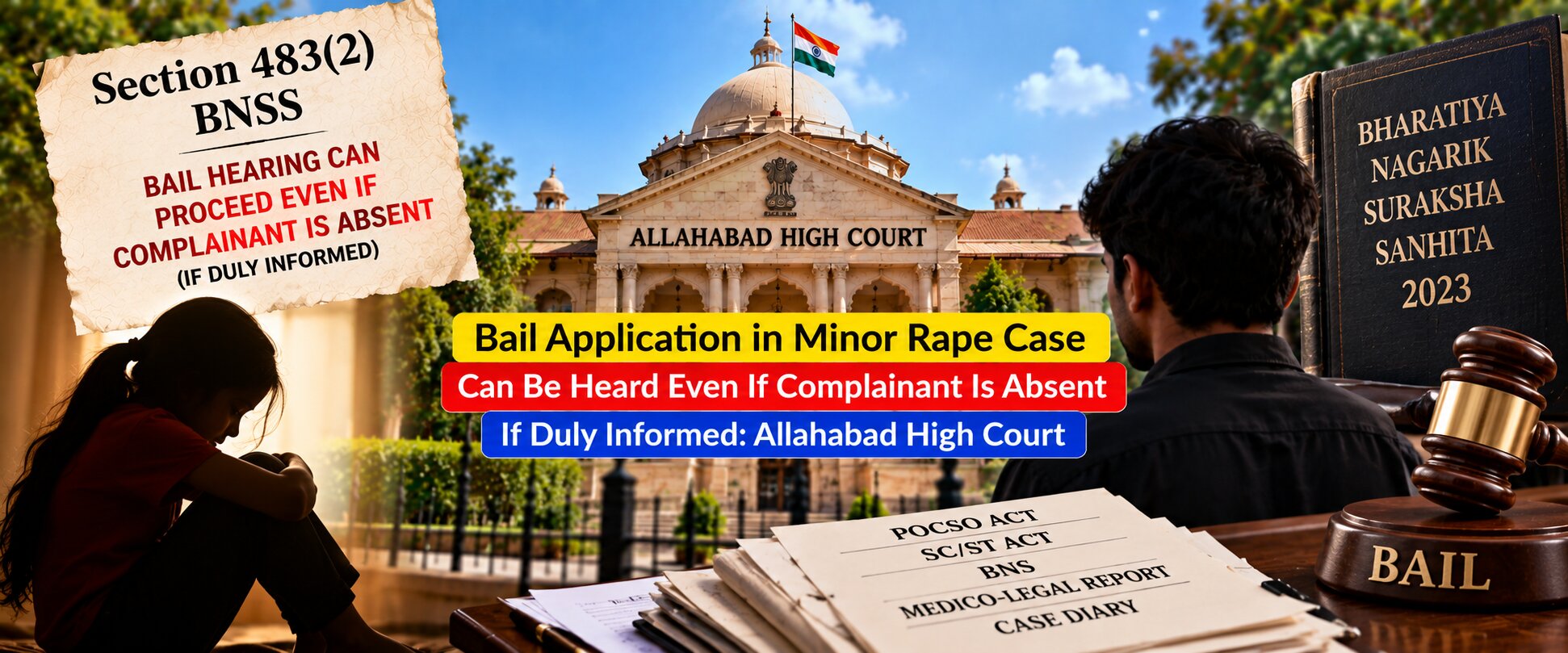
During the bail hearing, the State raised a preliminary objection based on Section 483(2) BNSS.
-
The State contended that the informant or an authorised person was required to be present at the time of hearing of the bail application in cases covered by the statutory provision.
-
The State informed the Court that the police had delivered information concerning the bail hearing to the complainant on 26 May 2026.
-
Despite receiving the information, neither the complainant nor a representative appeared before the Court.
-
The State therefore argued that the bail application could not proceed in the absence of the informant.
-
The High Court rejected this preliminary objection.
-
The Court examined Rule 4 of the POCSO Rules, 2020, which requires the police or Special Juvenile Police Unit to inform the child and local guardian about the schedule of court proceedings.
-
The Court also considered the earlier decision in Rohit v. State of U.P.
-
The Court held that the statutory requirement is to ensure that the complainant or victim is given an opportunity of hearing, rather than to make the complainant's physical presence an absolute condition for the Court's jurisdiction to hear bail.
-
The Court then considered the bail application on its merits.
-
The victim had herself lodged the FIR.
-
However, in her statement recorded before the Magistrate under Section 183 BNSS, she stated that she did not know who the other person involved in the incident was.
-
The medical examination of the victim did not disclose any injury marks on her body.
-
The medical report also recorded that the hymen was intact.
-
The doctor noted that the victim's clothes had been collected and were neither torn nor stained.
-
The State informed the Court that the investigation had been completed.
-
However, the pathological examination reports relating to the samples taken during the medical examination were not available in the case diary.
-
The applicant had no previous criminal history.
-
He had remained in custody since February 2026.
-
Taking the totality of the circumstances into account, the High Court granted the applicant bail.
Issues
-
Whether Section 483(2) BNSS requires the physical presence of the informant or complainant at the time of hearing a bail application in cases involving rape of a minor?
-
Whether a bail application under Section 483(2) BNSS can be heard when the informant or complainant has been duly informed about the hearing but chooses not to appear?
-
Whether the requirement of providing the informant or victim an opportunity of hearing is satisfied when the police or competent authority has duly informed them about the bail proceedings?
-
Whether the absence of the informant, despite due notice of the bail hearing, prevents the High Court from exercising its jurisdiction to consider the accused's bail application?
-
Whether the medical and other circumstances available on record justified grant of bail to the applicant after completion of investigation?
-
Whether the applicant was entitled to bail considering his age, absence of criminal antecedents, period of custody and completion of investigation?
Judgement
-
The Allahabad High Court allowed the bail application filed by Umesh Mali.
-
The Court first considered the State's preliminary objection concerning the absence of the informant.
-
Section 483(2) BNSS was examined in light of the requirement concerning the presence of the informant or authorised person in specified sexual-offence cases.
-
The Court held that the purpose of the provision is to ensure that the complainant or victim receives an effective opportunity to oppose the bail application.
-
The Court referred to Rule 4 of the POCSO Rules, 2020.
-
Under the Rules, the police or Special Juvenile Police Unit is required to inform the child and local guardian about the schedule of court proceedings.
-
The Court found that this requirement had been complied with because the police had informed the complainant about the bail hearing.
-
The complainant nevertheless chose not to appear before the Court.
-
The Court held that once the complainant has been duly informed, the decision whether to personally appear and oppose the bail application remains with the complainant.
-
The Court observed that the complainant may repose confidence in the Public Prosecutor or Additional Government Advocate, who is present to oppose the bail application on behalf of the State.
-
Therefore, the absence of the complainant after due notice does not prevent the Court from hearing the bail application.
-
The Court consequently rejected the State's preliminary objection.
-
On the merits, the Court considered the allegations in the FIR and the victim's subsequent statement recorded before the Magistrate.
-
The Court noticed an inconsistency concerning the identity of the second alleged participant.
-
The medical examination did not reveal injuries on the victim's body.
-
The medical report recorded that the hymen was intact and that the clothes collected during examination were not torn or stained.
-
The Court also noted that the investigation had already been completed.
-
The pathological examination reports of the samples collected during the medical examination were, however, not available in the case diary.
-
The applicant was approximately 20 years old, had no criminal antecedents and had been in custody since February 2026.
-
Considering these circumstances, the Court found it appropriate to grant bail.
-
The applicant was directed to be released on bail subject to the conditions imposed by the Court.
Held
-
Section 483(2) BNSS does not make the physical presence of the informant or complainant an absolute precondition for hearing a bail application when the complainant has been duly informed of the proceedings.
-
The statutory requirement is substantially concerned with providing the complainant or victim an opportunity of hearing.
-
If the complainant has been duly informed but chooses not to appear, the bail application can still be heard.
Analysis
- The absence of the complainant after due notice does not deprive the Court of jurisdiction to consider the bail application.
-
The Public Prosecutor or Additional Government Advocate may represent the State's opposition to bail where the complainant chooses not to personally appear.
-
The Court may consider the bail application on its merits after satisfying itself that the statutory opportunity of hearing has been provided.
-
The bail application was accordingly allowed.