
UJ v. State of Madhya Pradesh, 2026
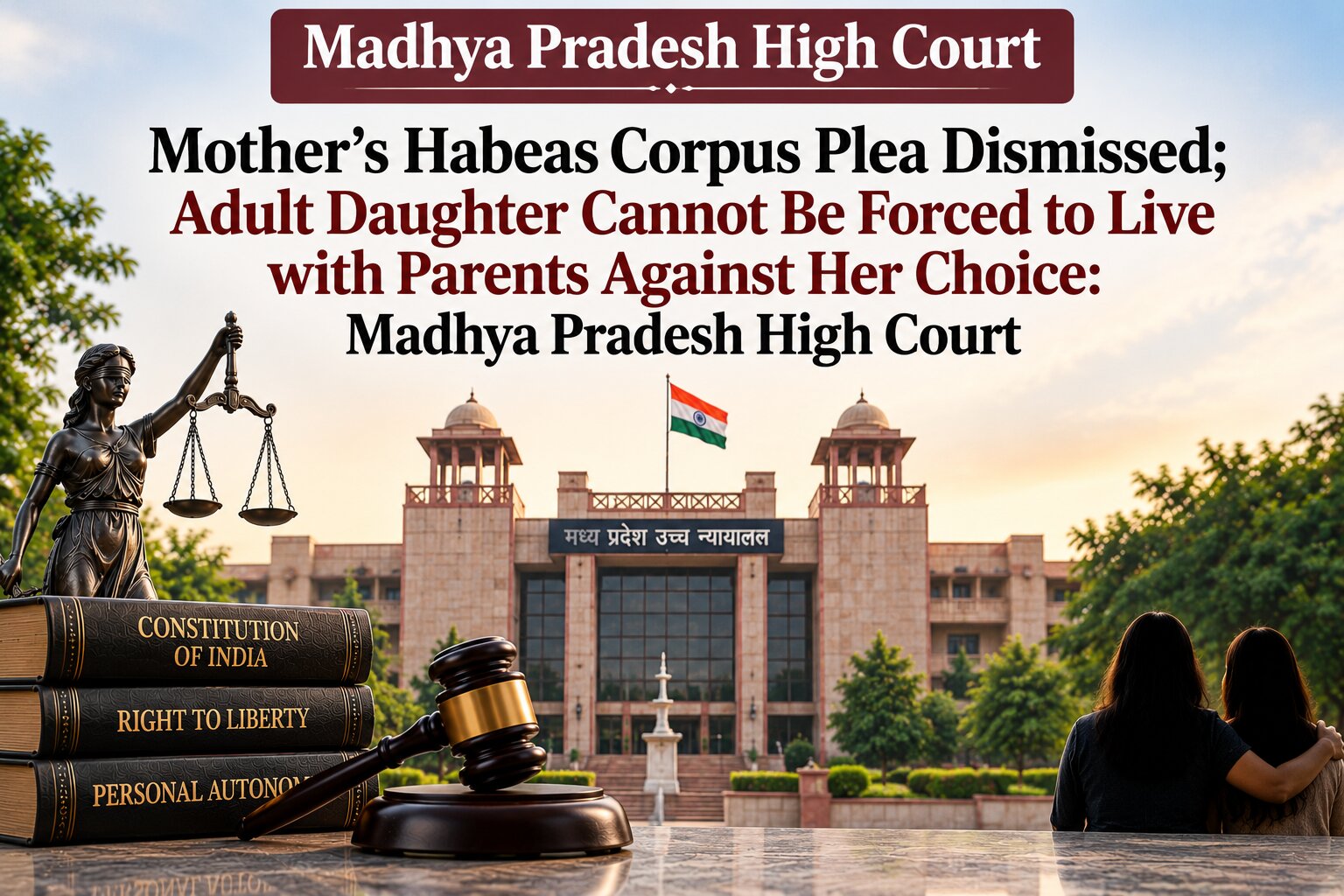
An adult woman is entitled to decide where she wishes to live and with whom she wishes to reside.
Judgement Details
Court
Madhya Pradesh High Court
Date of Decision
20 August 2026
Judges
Chief Justice Vivek Rusia and Justice Pradeep Mittal
Citation
Acts / Provisions
Facts of the Case
-
The petitioner-mother approached the Madhya Pradesh High Court through a habeas corpus petition, seeking that her daughter be traced and produced before the Court.
-
The Court directed the police to produce the daughter before it.
-
When produced, the daughter categorically stated that she was a major and was residing with her partner of her own free will.
-
She expressed her desire to continue living with her partner rather than return to her parents.
-
The mother was aggrieved by her daughter's choice of partner and sought her custody.
-
The Court therefore examined whether any illegal or unlawful detention existed.
Issues
-
Whether a habeas corpus petition is maintainable when an adult woman is residing voluntarily with a person of her choice?
-
Whether a major daughter can be compelled to return to her parents merely because they disagree with her choice of partner?
-
Whether a Constitutional Court can direct the custody of an adult woman to her parents against her expressed wishes?
-
Whether the Court can assume the role of a superguardian over a major individual exercising her personal liberty?
Judgement
-
The High Court dismissed the habeas corpus petition.
-
The Court found that the daughter was a major adult woman and had voluntarily chosen where and with whom she wished to reside.
-
There was no material indicating that she was under any illegal restraint or unlawful custody.
-
The Court held that habeas corpus jurisdiction cannot be used merely to secure custody of an adult against her will.
-
The Court relied upon the Supreme Court's decision in Soni Gerry v. Gerry Douglas concerning the autonomy and freedom of an adult daughter.
-
The Court observed that it should not become a “superguardian” merely because parents are emotionally aggrieved by the choices of their adult child.
-
Consequently, no direction was issued to hand over the woman to her mother.
Held
-
Habeas corpus requires the existence of illegal or unlawful detention.
-
Parents cannot claim custody of a major daughter merely because they disapprove of her partner.
-
Courts cannot compel an adult woman to reside with her parents against her free will.
-
Constitutional courts must respect the adult woman's personal liberty and autonomy.
-
The Court cannot assume the role of a superguardian based solely on parental sentiments.
Analysis
-
The judgment strongly reinforces the principle of individual autonomy after attaining majority. Once a person becomes an adult, parental authority does not extend to controlling fundamental personal decisions such as residence and companionship.
-
The Court correctly distinguished a genuine habeas corpus situation from a family disagreement. The writ protects a person from unlawful detention; it is not a mechanism for parents to recover an adult child who has voluntarily left home.
-
The daughter's personal statement before the Court was particularly significant. Her categorical assertion that she was major and living with her partner voluntarily removed the essential element of illegal detention.
-
The ruling also protects the constitutional values of personal liberty, dignity and decisional autonomy. A person's freedom cannot disappear merely because family members disapprove of the person's choices.
-
The reference to Soni Gerry v. Gerry Douglas strengthens the proposition that courts should not substitute their own assessment—or parental preferences—for the wishes of a competent adult.
-
The Court's warning against becoming a “superguardian” is important because constitutional jurisdiction must remain focused on legality rather than parental emotions or social expectations.
-
Overall, the decision establishes a clear principle: once an adult woman voluntarily chooses her place of residence and there is no unlawful restraint, the Court cannot compel her to return to her parents against her wishes.