
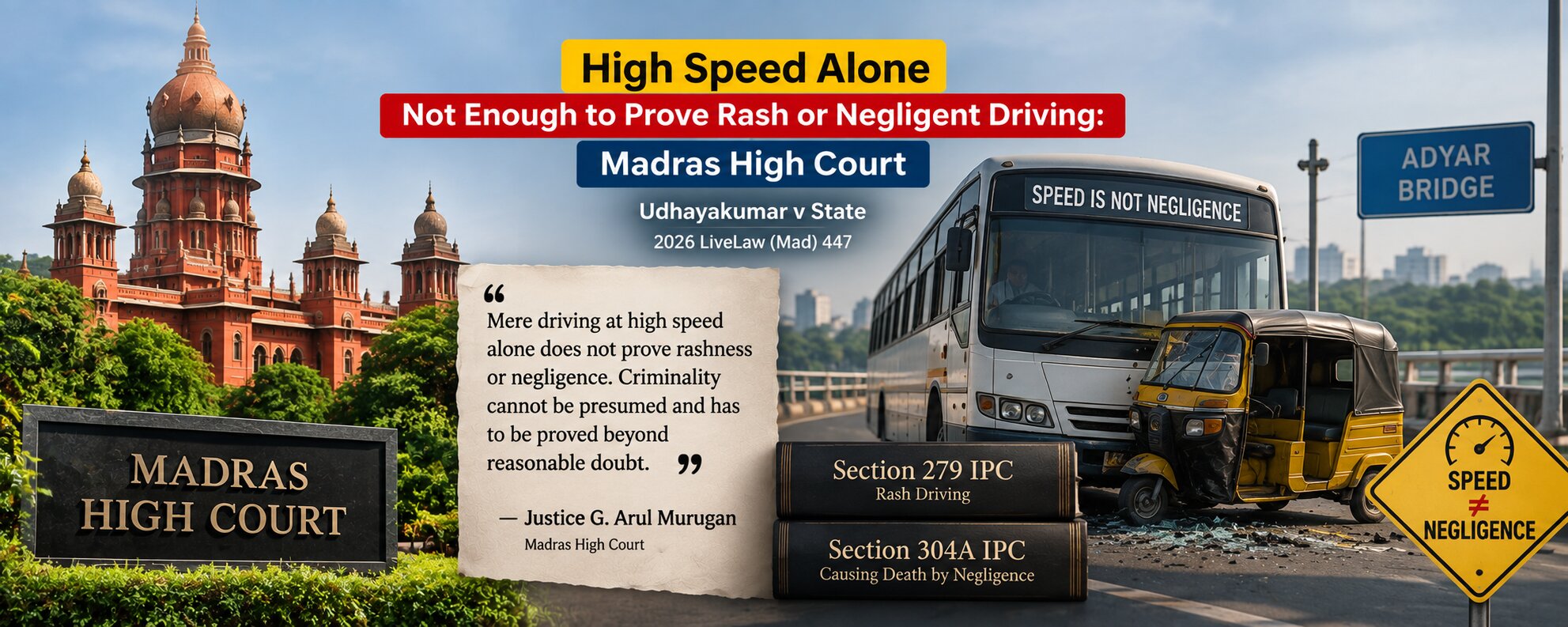
Udhayakumar v. State, 2026
High speed alone does not establish rash or negligent driving.
Judgement Details
Court
Madras High Court
Date of Decision
15 September 2026
Judges
Justice G. Arul Murugan
Citation
Acts / Provisions
Facts of the Case
-
The appellant, Udhayakumar, was driving a bus on 3 November 2014.
-
The prosecution alleged that he was driving the bus in a rash and negligent manner and that he was also under the influence of alcohol.
-
While the vehicles were crossing the Adyar Bridge, the bus collided with an auto-rickshaw.
-
The auto-rickshaw driver sustained injuries in the accident.
-
The injured auto-rickshaw driver was taken to the hospital but subsequently died on the same day.
-
Following a complaint lodged by an eyewitness, a criminal case was registered against the appellant.
-
After completing the investigation, the prosecution filed its final report alleging offences under Sections 279 and 304(ii) IPC and Section 185 of the Motor Vehicles Act.
-
The matter proceeded to trial before the competent court.
-
During the trial, the court found that the prosecution had failed to establish the offence under Section 304(ii) IPC.
-
The court also found that the prosecution had failed to prove the allegation under Section 185 of the Motor Vehicles Act.
-
However, the trial court concluded that the prosecution had established the offences under Sections 279 and 304A IPC.
-
The appellant was accordingly convicted and sentenced to six months' imprisonment under Section 279 IPC.
-
He was further sentenced to one year's imprisonment under Section 304A IPC.
-
Aggrieved by the conviction and sentence, Udhayakumar preferred an appeal before the Madras High Court.
-
The appellant argued that mere high speed does not automatically establish rashness or negligence.
-
It was contended that the prosecution was required to establish the specific manner in which the appellant drove the vehicle and demonstrate that such conduct amounted to rash or negligent driving.
-
The appellant further argued that the evidence presented by the prosecution was insufficient to establish the required criminal standard of proof.
-
The State opposed the appeal and argued that two witnesses had supported the prosecution's case regarding the manner in which the bus was driven.
-
The State contended that the absence of any mechanical defect in the bus, coupled with the absence of an adequate explanation from the defence, supported the inference that the accident resulted from the appellant's rash and negligent driving.
Issues
-
Whether mere high-speed driving, without independent evidence establishing the manner of driving, is sufficient to constitute rash or negligent driving under Section 279 of the Indian Penal Code?
-
Whether the prosecution had proved beyond reasonable doubt that the appellant drove the bus in a rash or negligent manner resulting in the accident and death of the auto-rickshaw driver so as to attract Section 304A of the Indian Penal Code?
-
Whether the testimony of the prosecution witnesses was sufficient to establish the specific acts of rashness or negligence attributable to the appellant?
-
Whether the conviction and sentence imposed upon the appellant under Sections 279 and 304A of the Indian Penal Code could be sustained in the absence of cogent evidence establishing rash or negligent driving beyond reasonable doubt?
Judgement
-
The Madras High Court allowed the criminal appeal filed by Udhayakumar.
-
The Court held that mere high-speed driving is not, by itself, sufficient to establish rashness or negligence for the purposes of Sections 279 and 304A IPC.
-
The Court emphasised that the prosecution was required to establish the accused's rash or negligent conduct beyond reasonable doubt.
-
The Court examined the testimony of the prosecution witnesses to determine whether they had actually observed the manner in which the accident occurred.
-
With respect to one witness, the Court noted that he had been driving a car behind the bus, while the auto-rickshaw was ahead of the bus.
-
The Court observed that the position of this witness raised a question as to whether he could actually have seen the auto-rickshaw and properly observed how it was being driven immediately before the collision.
-
The Court also considered whether the witness could have observed any negligent act on the part of the auto-rickshaw driver that might have contributed to the accident.
-
With respect to the second witness, the Court noted that he had been riding a motorcycle and that the bus had overtaken him before colliding with the auto-rickshaw.
-
However, the second witness had essentially stated that the bus was being driven at high speed.
-
The Court found that this testimony did not sufficiently establish that the bus was being driven in a rash or negligent manner.
-
The Court held that high speed, without more, cannot automatically be equated with criminal rashness or negligence.
-
The Court reiterated that criminal liability cannot be presumed and that the prosecution bears the burden of proving the essential ingredients of the offence.
-
Since the prosecution failed to establish rash and negligent driving beyond reasonable doubt, the conviction under Sections 279 and 304A IPC could not be sustained.
-
The High Court consequently set aside the conviction and sentence imposed upon the appellant.
-
The appeal was accordingly allowed.
Held
-
For a conviction under Section 279 IPC, the prosecution must establish that the accused's manner of driving was rash or negligent and endangered human life or was likely to cause hurt or injury.
-
For a conviction under Section 304A IPC, the prosecution must establish a causal connection between the accused's rash or negligent act and the resulting death.
-
The prosecution must prove the necessary elements of the offence beyond reasonable doubt.
-
A witness merely stating that a vehicle was travelling at high speed is not necessarily sufficient to establish criminal rashness or negligence.
-
The Court found that the prosecution evidence did not adequately establish the specific rash or negligent act committed by the appellant.
-
Consequently, the conviction and sentence under Sections 279 and 304A IPC were set aside.
Analysis
-
The Court's reasoning focused on the distinction between speed and criminal negligence.
-
Driving at a high speed may be relevant evidence in a particular case, but speed by itself does not establish that the manner of driving was legally rash or negligent.
-
The Court required the prosecution to demonstrate how the accused was driving, rather than merely establishing how fast the vehicle was travelling.
-
The evidence of the first witness was considered problematic because of his position behind the bus. The Court questioned whether he could have adequately observed the auto-rickshaw or its manner of movement.
-
The evidence of the second witness established that the bus had been travelling at high speed and had overtaken the witness's motorcycle, but the witness did not provide sufficient details demonstrating the specific rash or negligent conduct of the appellant.
-
The Court therefore found a gap between the evidence of high speed and the legal requirement of proving rashness or negligence.
-
The Court also emphasised the fundamental criminal-law principle that criminality cannot be presumed.
-
The prosecution therefore had to establish the essential ingredients of the offences through reliable evidence rather than relying on inference alone.