
Uddagiri Srirama Murthy & Another v. State of Andhra Pradesh & Others, 2026
The Court adopted a strict interpretation of Section 23(1), holding that all statutory conditions must be satisfied before the extraordinary power to invalidate a property transaction can be exercised.
Judgement Details
Court
Andhra Pradesh High Court
Date of Decision
14 July 2026
Judges
Justice Venkateswarlu Nimmagadda
Citation
Acts / Provisions
Facts of the Case
-
The petitioners, namely the son and his wife, challenged an order passed by the Appellate Tribunal under the Maintenance and Welfare of Parents and Senior Citizens Act, 2007.
-
The dispute related to a registered partition deed dated 30 March 2018 executed between the son and his mother concerning their joint family properties.
-
According to the petitioners, both the son and the mother had pre-existing rights in the joint family properties, and the partition deed merely separated and defined their respective shares.
-
Subsequently, the mother approached the Tribunal seeking cancellation of the partition deed under Section 23(1) of the Maintenance and Welfare of Parents and Senior Citizens Act, 2007, alleging that she was not being maintained by her son.
-
The Tribunal dismissed the mother's application.
-
Aggrieved by the dismissal, the mother preferred an appeal before the Appellate Tribunal.
-
The Appellate Tribunal allowed the appeal and directed cancellation of the registered partition deed.
-
The petitioners challenged the Appellate Tribunal's order before the High Court, contending that a partition is not a transfer of property and that the deed contained no condition obligating the son to maintain his mother.
-
They further argued that the continued maintenance dispute could not confer jurisdiction upon the Tribunal to invalidate a partition deed that merely recognized existing proprietary rights.
Issues
-
Whether a registered partition deed executed between members of a joint family amounts to a "transfer of property" within the meaning of Section 23(1) of the Maintenance and Welfare of Parents and Senior Citizens Act, 2007?
-
Whether the expression "gift or otherwise" occurring in Section 23(1) includes a partition of joint family property?
-
Whether Section 23(1) can be invoked in the absence of any condition in the partition deed requiring the transferee to provide maintenance or basic amenities to the senior citizen?
-
Whether the Appellate Tribunal acted within its jurisdiction in directing cancellation of the registered partition deed?
Judgement
-
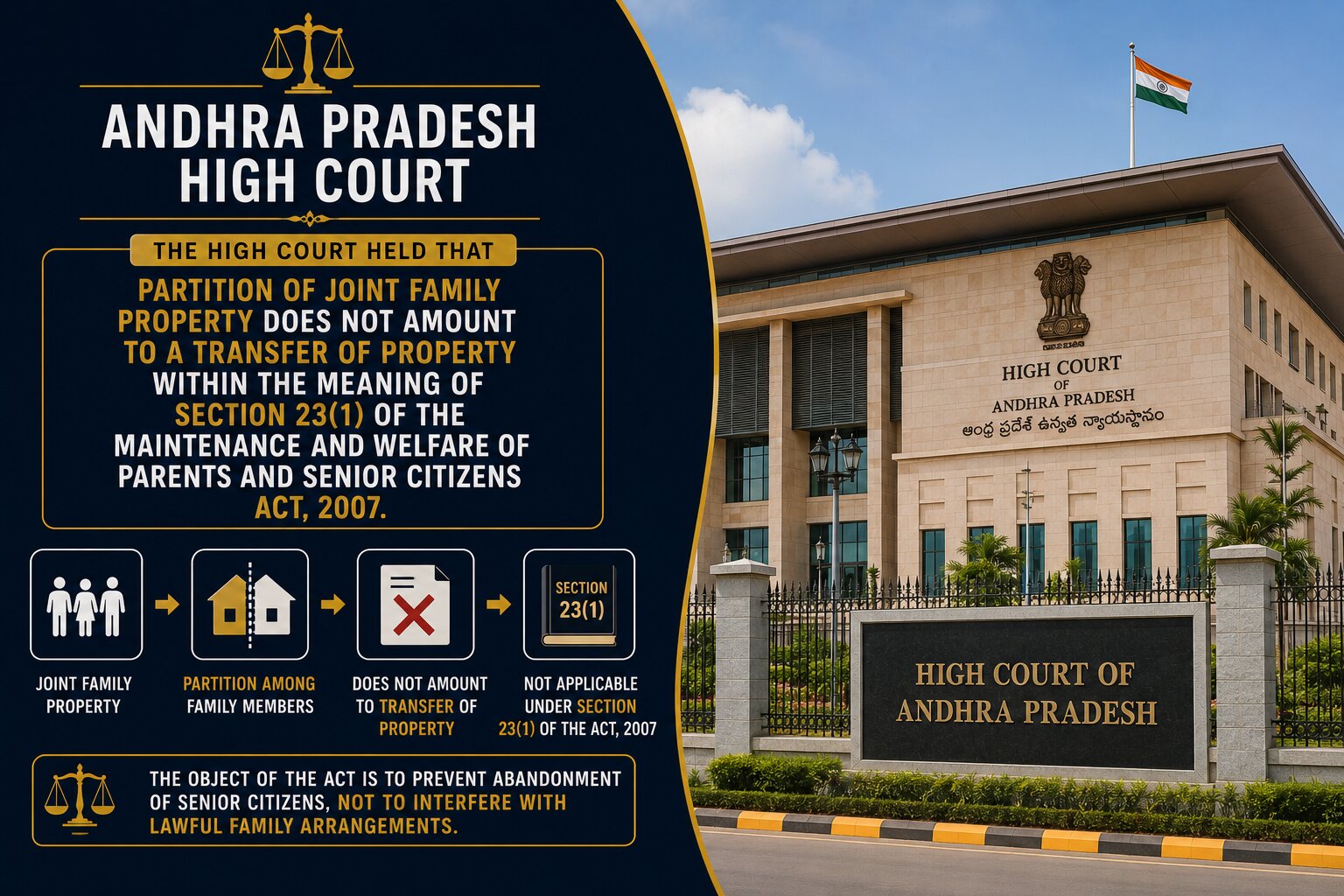
The High Court held that partition of joint family property does not amount to a transfer of property within the meaning of Section 23(1) of the Maintenance and Welfare of Parents and Senior Citizens Act, 2007.
-
The Court observed that while a transfer involves passing of an interest in property from one person to another, a partition merely separates and crystallizes pre-existing proprietary rights already vested in the parties.
-
The Court held that the very foundation for invoking Section 23(1) was absent because there was no transfer by the senior citizen in favour of the petitioner.
-
The Court further observed that the registered partition deed did not contain any clause requiring the son to provide maintenance, basic amenities, or physical needs to his mother.
-
The Court held that the statutory requirements of Section 23(1) were therefore not satisfied.
-
The Court rejected the contention that the words "gift or otherwise" in Section 23(1) could be interpreted to include a partition, holding that such an interpretation would be contrary to the nature of a partition under property law.
-
The Court clarified that although disputes regarding maintenance may entitle the senior citizen to seek maintenance or other relief under the Act, such disputes cannot by themselves justify cancellation of a partition deed.
-
The Court found that the Appellate Tribunal exceeded its jurisdiction by cancelling a transaction that did not satisfy the statutory requirements of Section 23(1).
-
Accordingly, the High Court allowed the writ petition, set aside the order of the Appellate Tribunal, restored the registered partition deed, and clarified that the mother was at liberty to pursue any other remedy available in law.
Held
-
A partition of joint family property is not a transfer of property for the purposes of Section 23(1) of the Maintenance and Welfare of Parents and Senior Citizens Act, 2007.
-
The expression "gift or otherwise" under Section 23(1) does not include a partition deed.
-
Section 23(1) can be invoked only where there is a transfer of property by a senior citizen subject to a condition requiring maintenance or provision of basic amenities.
-
In the absence of such a transfer and such a condition, the Tribunal has no jurisdiction to cancel a registered partition deed.
-
The Appellate Tribunal's order cancelling the partition deed was set aside, and the partition deed was restored.
Analysis
-
The judgment clearly distinguishes partition from transfer of property, reaffirming the settled principle that partition merely separates existing rights rather than creating or transferring new rights.
-
The decision limits the jurisdiction of Maintenance Tribunals by preventing them from cancelling transactions that fall outside the scope of Section 23(1).
-
By refusing to treat a partition as a transfer, the Court protected the legal certainty of bona fide family arrangements involving joint family property.
-
The judgment emphasizes that maintenance disputes and property disputes are distinct causes of action, and one cannot automatically be used to invalidate the other.
-
The Court clarified that while senior citizens remain entitled to claim maintenance and other statutory reliefs, those remedies cannot be expanded to annul transactions that do not satisfy the statutory prerequisites.
-
The ruling provides important guidance on interpreting the expression "gift or otherwise", ensuring that it is not construed so broadly as to include transactions fundamentally different from transfers.
-
Overall, the judgment strengthens the principle that statutory powers affecting property rights must be exercised strictly within the limits prescribed by the legislature.