
T.K.A. Padmanabhan v. Abhiyan Cooperative Group Housing Society Ltd., 2026
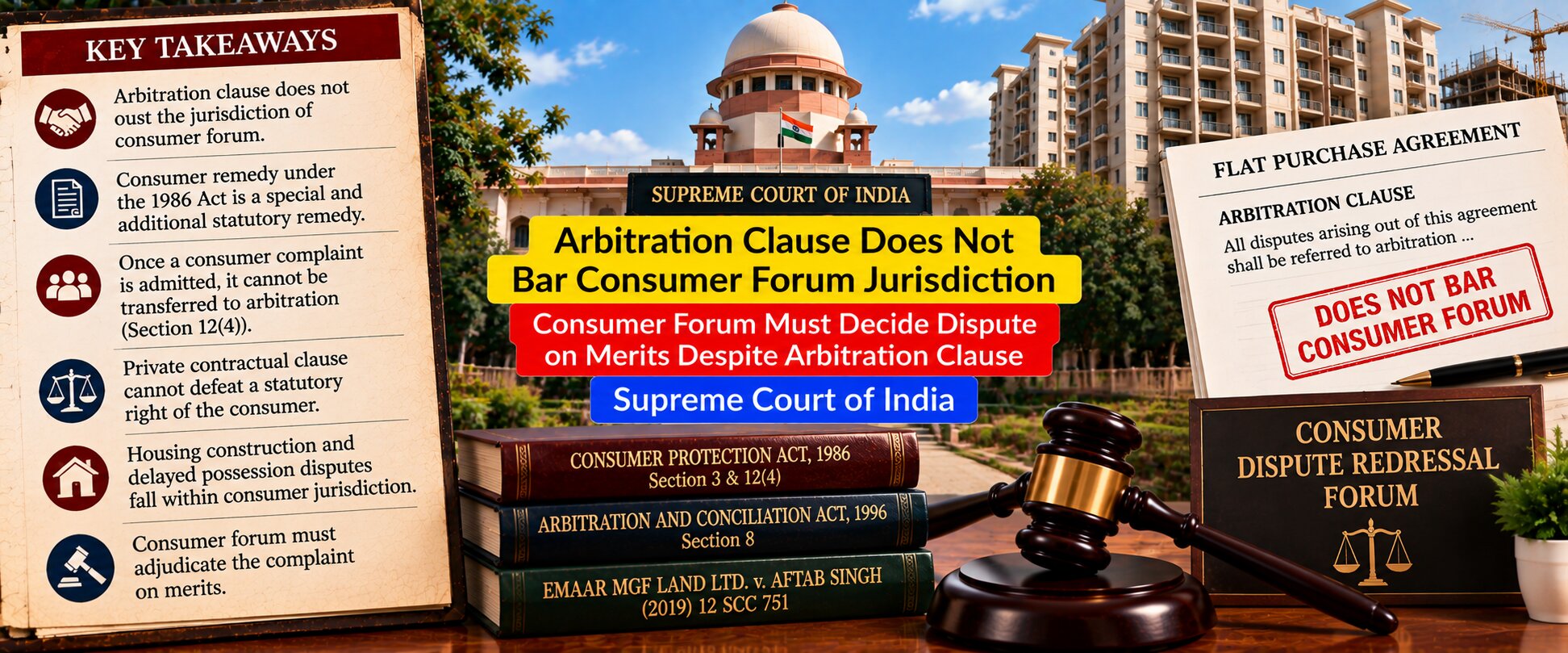
An arbitration clause does not, by itself, oust the jurisdiction of a consumer forum.
Judgement Details
Court
Supreme Court of India
Date of Decision
4 September 2026
Judges
Justice Vikram Nath and Justice V. Mohana
Citation
Acts / Provisions
Facts of the Case
-
The appellant, T.K.A. Padmanabhan, became a member of the respondent cooperative group housing society in January 2003.
-
He claimed to have paid the full amount required for allotment of a residential flat.
-
Flat No. 232 was allotted to him.
-
The parties entered into an agreement dated 27 February 2004 concerning the allotment of the flat.
-
The appellant alleged that there was a delay in handing over possession of the residential flat.
-
Treating the delay as deficiency in service, he filed Consumer Complaint No. 579 of 2005 before the District Consumer Forum-VII, New Delhi.
-
The complaint was admitted and notice was issued to the respondent society.
-
The respondent thereafter filed an application under Section 8 of the Arbitration and Conciliation Act, 1996, seeking reference of the dispute to arbitration.
-
The respondent relied upon the arbitration clause contained in the flat purchase agreement.
-
The District Forum accepted the objection and referred the parties to arbitration.
-
The appellant challenged that order before the Delhi State Consumer Disputes Redressal Commission.
-
The State Commission affirmed the District Forum's decision.
-
The appellant thereafter approached the National Consumer Disputes Redressal Commission (NCDRC).
-
The NCDRC dismissed his revision petition by order dated 4 January 2016.
-
The appellant consequently approached the Supreme Court.
-
Before the Supreme Court, the principal question was whether an arbitration clause in the agreement could prevent the consumer forum from deciding an already-admitted consumer complaint on merits.
-
The Supreme Court also considered the statutory scheme of the Consumer Protection Act, 1986, particularly Sections 3 and 12(4).
-
The Court noted that the consumer remedy under the 1986 Act was expressly intended to be additional to other remedies available under law.
-
The Court therefore examined whether a private arbitration agreement could override that statutory consumer remedy.
Issues
-
Whether the mere existence of an arbitration clause in an agreement excludes the jurisdiction of a consumer forum under the Consumer Protection Act, 1986?
-
Whether a consumer complaint alleging deficiency in service can be referred to arbitration merely because the underlying agreement contains an arbitration clause?
-
Whether an admitted consumer complaint can subsequently be transferred to an arbitral tribunal in view of the proviso to Section 12(4) of the Consumer Protection Act, 1986?
-
Whether the statutory consumer remedy under Section 3 of the Consumer Protection Act can be defeated by a private contractual arbitration clause?
-
Whether the District Forum, State Commission and NCDRC were justified in refusing to adjudicate the appellant's complaint on merits?
Judgement
-
The Supreme Court allowed the appeal filed by T.K.A. Padmanabhan.
-
The Court set aside the orders passed by the District Forum, State Commission and NCDRC which had diverted the dispute to arbitration.
-
The Court held that the mere existence of an arbitration clause does not oust the jurisdiction of a consumer forum.
-
The Consumer Protection Act, 1986 creates a special statutory remedy for consumers.
-
Section 3 expressly provides that the remedy under the Consumer Protection Act is in addition to and not in derogation of other remedies available under law.
-
Therefore, the existence of another adjudicatory mechanism, including arbitration, does not automatically extinguish the consumer forum's jurisdiction.
-
The Court relied upon its earlier decision in Emaar MGF Land Ltd. v. Aftab Singh, which had conclusively recognised that an arbitration clause does not prevent a consumer from pursuing a statutory consumer remedy.
-
The Court further found that the present complaint had already been admitted by the District Forum.
-
Once the complaint had been admitted, the proviso to Section 12(4) of the 1986 Act imposed a clear restriction against transferring the complaint to another court, tribunal or authority established under another law.
-
Consequently, the District Forum was required to proceed with the consumer complaint in accordance with the Consumer Protection Act.
-
A private contractual arbitration clause could not override that statutory restriction.
-
The Court therefore held that the arbitration clause could not be treated as sufficient reason to non-suit the appellant before the consumer forum.
-
The Court also restored the appellant's consumer complaint for adjudication on merits.
-
The complaint was directed to be placed before the District Consumer Disputes Redressal Commission, Dwarka.
-
Both parties were to be given an appropriate opportunity of hearing and of leading evidence.
-
Since the complaint had originally been filed in 2005, the Supreme Court directed the District Commission to endeavour to decide it preferably within one year from receipt of the order.
Held
-
The Consumer Protection Act, 1986 provides a special and additional statutory remedy.
-
The existence of an alternative remedy or arbitration mechanism does not automatically bar a consumer complaint.
-
A consumer cannot be compelled to abandon the statutory consumer remedy merely because the underlying agreement contains an arbitration clause.
-
Section 3 of the 1986 Act makes the consumer remedy additional to other remedies.
Analysis
- Once a consumer complaint has been admitted, the proviso to Section 12(4) prevents its transfer to another court, tribunal or authority established under another law.
-
A private contractual clause cannot override the statutory protection contained in Section 12(4).
-
The District Forum was therefore required to adjudicate the complaint on merits instead of referring it to arbitration.
-
The orders of the District Forum, State Commission and NCDRC were consequently set aside.
-
The consumer complaint was restored for determination on its merits.