
Tirumanuyam Srinivasulu Reddy @ Srunivasulu & Another v. State of Andhra Pradesh, 2026
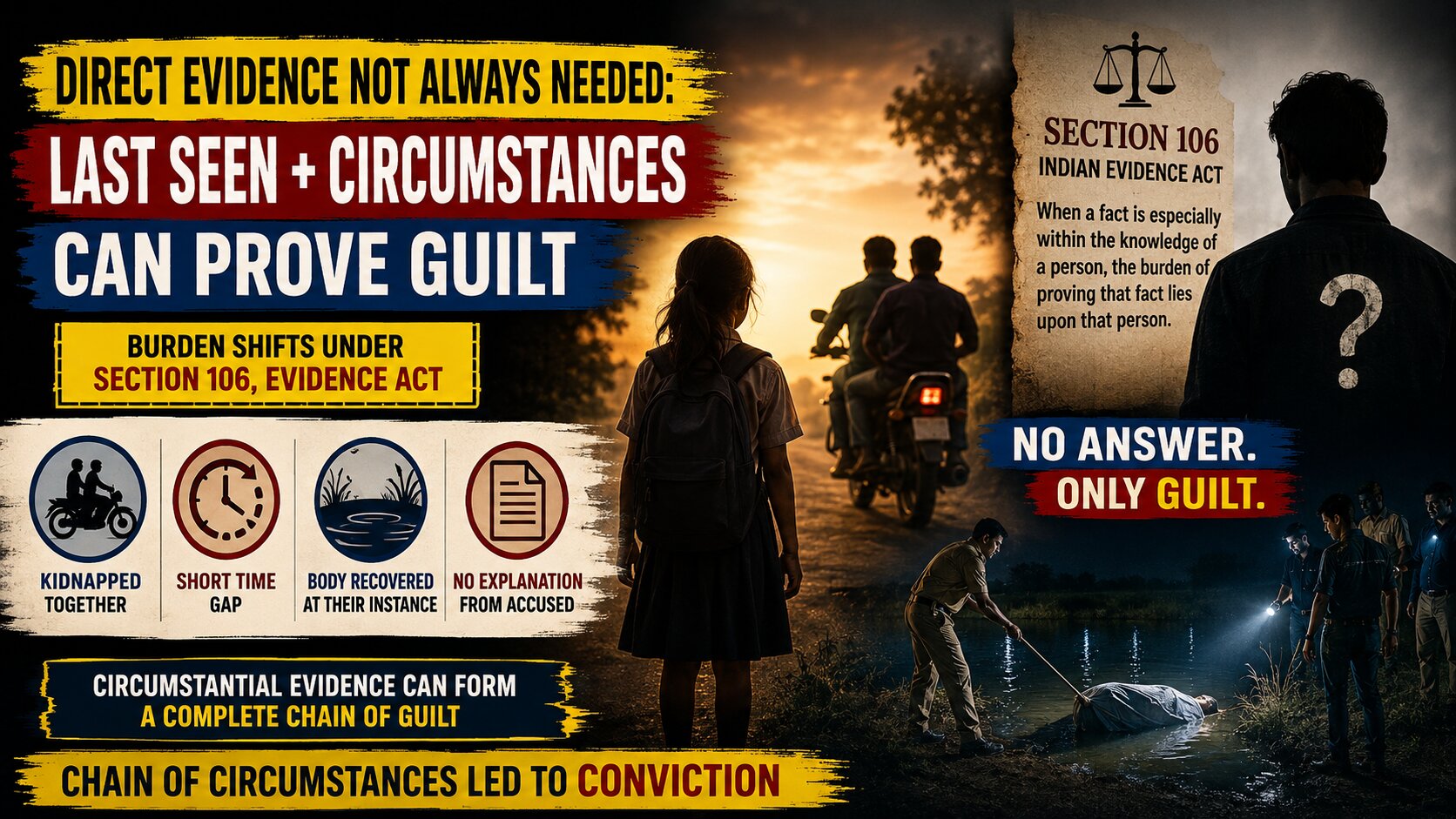
Direct eyewitness evidence of the actual murder is not indispensable where a complete and reliable chain of circumstantial evidence establishes guilt.
Judgement Details
Court
High Court of Andhra Pradesh
Date of Decision
25 August 2026
Judges
Justice K. Suresh Reddy and Justice Challa Gunarajan
Citation
Acts / Provisions
Facts of the Case
-
The case concerned the kidnapping and subsequent death of a minor girl in Andhra Pradesh.
-
The prosecution case arose from an incident in December 2014 in which the minor girl was allegedly taken away from near her school-bus stop.
-
According to the prosecution, Accused No. 1 approached the minor girl and took her towards a motorcycle.
-
The motorcycle belonged to Accused No. 2 and was being driven by him. Accused No. 1 was allegedly travelling as the pillion rider, with the deceased minor seated between the two accused.
-
The prosecution alleged that the deceased's mother raised an alarm, but both accused nevertheless left the place with the girl.
-
Independent witnesses subsequently supported the prosecution's last-seen theory, stating that the minor was seen travelling with both accused shortly after the kidnapping.
-
The prosecution alleged that the girl was taken to Vikruthamala tank in Yerpedu Mandal, where Accused No. 1 caused her death by drowning.
-
It was further alleged that the accused subsequently attempted to conceal the body and other incriminating material near the tank.
-
The prosecution alleged that the motive arose from a monetary dispute of approximately ₹3 lakh between Accused No. 1 and the deceased's father. Earlier demands for repayment had allegedly resulted in an altercation and threats.
-
The prosecution relied upon the evidence of witnesses who had seen the deceased with the accused, the recovery of the body and incriminating articles, identification evidence and the absence of any satisfactory explanation from the accused.
-
The dead body and other material objects were recovered pursuant to disclosure statements attributed to the accused.
-
A Test Identification Parade was also relied upon by the prosecution to establish the identity of the accused.
-
Following investigation, the accused were prosecuted for offences relating to kidnapping, murder and disappearance of evidence.
-
Accused No. 1 was charged under Sections 364, 302 and 201 IPC, while Accused No. 2 faced the relevant charges with the aid of Section 34 IPC concerning common intention.
-
The trial court convicted both accused and imposed life imprisonment for the murder conviction, along with the sentences imposed for the other offences.
-
The accused challenged their convictions before the Andhra Pradesh High Court through Criminal Appeal No. 474 of 2018.
Issues
-
Whether the prosecution was required to produce direct eyewitness evidence of the actual commission of murder in circumstances where the minor was kidnapped, was last seen alive in the exclusive company of the accused and her dead body was recovered shortly thereafter?
-
Whether the last-seen theory, when corroborated by independent witnesses and other incriminating circumstances, could establish the involvement of the accused in the kidnapping and subsequent murder?
-
Whether the circumstances proved by the prosecution formed a complete and unbroken chain pointing towards the guilt of both accused and excluding every reasonable hypothesis consistent with their innocence?
-
Whether Section 106 of the Indian Evidence Act placed an evidentiary burden upon the accused to explain what happened to the deceased after she was last seen alive in their exclusive company?
-
Whether the recovery of the dead body and incriminating material pursuant to the disclosure statements of the accused constituted a circumstance supporting the prosecution case?
-
Whether the prosecution had established the common intention of both accused so as to sustain the conviction of Accused No. 2 with the aid of Section 34 of the Indian Penal Code?
-
Whether the absence of direct evidence establishing the precise manner in which the deceased was murdered was sufficient to create a reasonable doubt when the remaining circumstantial evidence formed a complete chain?
-
Whether the trial court's conviction and sentences suffered from any perversity, illegality or material infirmity warranting interference by the High Court?
Judgement
-
The Andhra Pradesh High Court dismissed the criminal appeal filed by the accused and confirmed the conviction and sentences imposed by the trial court.
-
The Court accepted the prosecution's case that the minor girl had been kidnapped and was subsequently found dead after being last seen in the exclusive company of the accused.
-
The Court relied significantly upon the evidence of independent witnesses supporting the last-seen theory.
-
The Court found that the deceased had been seen alive with both accused shortly before her death.
-
The Court considered the recovery of the dead body and incriminating articles pursuant to the accused's disclosure statements as an important circumstance supporting the prosecution case.
-
The Court also relied upon the identification evidence establishing the identity of the accused.
-
The Court held that the circumstances established by the prosecution could not be examined in isolation and had to be considered conjointly as a complete chain of circumstances.
-
The Court found that the chain of circumstances was consistent with the guilt of the accused and inconsistent with their innocence.
-
The Court applied Section 106 of the Indian Evidence Act, observing that once the prosecution established that the deceased was last seen alive in the exclusive company of the accused, the accused were required to explain what happened to her thereafter because those circumstances were especially within their knowledge.
-
The Court noted that neither accused furnished a satisfactory explanation regarding the fate of the deceased after she was last seen with them.
-
The Court rejected the argument that the absence of a direct witness to the murder necessarily weakened the prosecution case.
-
Considering the short interval between the kidnapping and recovery of the dead body, the Court held that the prosecution could not reasonably be expected to produce direct evidence of the actual act of murder.
-
The Court concluded that the prosecution had established the guilt of both accused beyond reasonable doubt.
-
The High Court found no perversity, illegality or infirmity in the trial court's judgment warranting appellate interference.
-
Accordingly, the Criminal Appeal was dismissed, and the convictions and sentences were confirmed.
Held
-
The last-seen theory can constitute an important link in a circumstantial-evidence case when supported by credible independent evidence and other corroborating circumstances.
-
Once the prosecution establishes that the deceased was last seen alive in the exclusive company of the accused, the circumstances surrounding her subsequent disappearance or death may fall particularly within the accused's knowledge for purposes of Section 106 of the Indian Evidence Act.
-
The accused's failure to provide a satisfactory explanation concerning the fate of the deceased can operate as an additional incriminating circumstance when the prosecution has already established the foundational facts.
-
Recovery of the dead body and incriminating articles pursuant to disclosure statements can provide significant corroboration to the prosecution's circumstantial case.
-
A court must examine circumstantial evidence collectively, rather than treating each circumstance as an isolated piece of evidence.
-
The circumstances must form a complete chain pointing towards the guilt of the accused and excluding reasonable alternative hypotheses consistent with innocence.
-
The absence of a direct eyewitness to the murder does not by itself entitle an accused to acquittal.
-
The conviction and life sentences imposed upon both accused were therefore upheld, and the criminal appeal was dismissed.
Analysis
-
Court's reasoning: The High Court approached the case as one based primarily on circumstantial evidence. Instead of requiring the prosecution to establish the murder through an eyewitness, the Court examined whether the individual circumstances, taken together, established a continuous chain leading to the accused.
-
Last-seen theory: The last-seen circumstance was particularly important because independent witnesses placed the deceased in the company of both accused shortly before her disappearance and death. The earlier 2021 proceedings in the same appeal also record evidence from P.Ws. 4 and 5 concerning the deceased being taken away with the accused.
-
Section 106 Evidence Act: Section 106 does not ordinarily relieve the prosecution of its primary burden of proving guilt beyond reasonable doubt. Its significance here was that, after the prosecution established foundational circumstances concerning the deceased being last seen with the accused, the circumstances concerning what happened immediately thereafter were particularly within the accused's knowledge.
-
No reversal of the presumption of innocence: The application of Section 106 should not be understood as creating a general rule that an accused must prove innocence. Rather, the prosecution first established the circumstances connecting the accused to the deceased, after which the accused's unexplained conduct became an additional circumstance in the evidentiary chain.
-
Circumstantial evidence: The judgment reinforces the established principle that circumstantial evidence can sustain a conviction if the circumstances are firmly proved, form a complete chain and point to the accused's guilt while excluding reasonable alternatives.
-
Direct evidence: The Court's reasoning is particularly significant because the defence relied upon the absence of direct evidence of the murder. The Court held that the practical circumstances of the case did not make direct evidence reasonably expected, especially given the short interval between the kidnapping and recovery of the body.
-
Recovery evidence: The recovery of the dead body and incriminating material pursuant to the accused's disclosure statements supplied an additional link in the chain. This circumstance was considered alongside, rather than independently of, the last-seen evidence.
-
Common intention: The prosecution case did not merely place the two accused at the same location. The evidence concerning the motorcycle, the manner in which the minor was taken away, subsequent events and recovery was considered in determining their participation and the applicability of Section 34 IPC.
-
Importance of corroboration: The decision demonstrates that the last-seen theory becomes substantially stronger when accompanied by independent witnesses, identification evidence, recovery of the body and other incriminating circumstances.
-
Standard of proof: The Court ultimately applied the criminal-law standard of proof beyond reasonable doubt. The prosecution was required to establish a chain strong enough to exclude reasonable hypotheses of innocence.
-
Appellate review: Since the High Court found no perversity, illegality or material infirmity in the trial court's appreciation of evidence, it declined to interfere with the conviction.
-
Earlier proceedings: The appeal had remained pending for several years. In a 2021 bail proceeding, the High Court had already considered evidence from P.Ws. 4 and 5 and declined to grant bail to Accused No. 1. A 2024 application seeking relief on medical grounds was also dismissed, with directions concerning necessary medical treatment. These proceedings were interlocutory and distinct from the final adjudication of the criminal appeal.
-
Impact on criminal jurisprudence: The judgment illustrates the continuing importance of circumstantial evidence in murder prosecutions and clarifies how last-seen evidence, recovery evidence and Section 106 can operate together without requiring an eyewitness to the actual killing.