
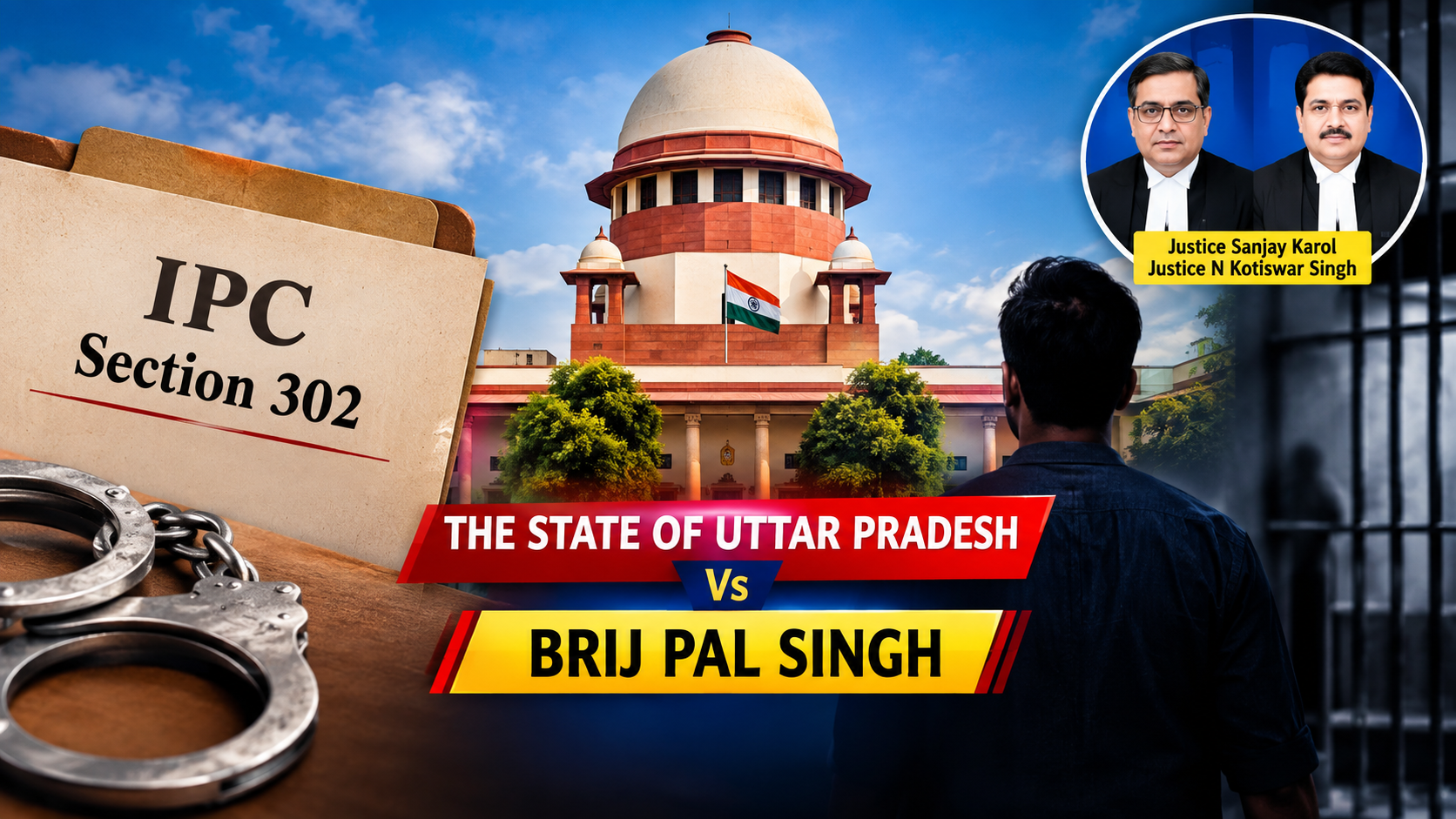
The State of Uttar Pradesh & Anr. v. Brij Pal Singh & Anr., 2026
PC & PNDT Act — Police Cannot Independently Investigate; Appropriate Authority Has Primary Investigative Role
Judgement Details
Court
Supreme Court of India
Date of Decision
15 September 2026
Judges
Justice Sanjay Karol and Justice Nongmeikapam Kotiswar Singh
Citation
Acts / Provisions
Facts of the Case
-
The matter arose from FIR No. 628 of 2017 concerning alleged illegal sex determination of a foetus in violation of the PC & PNDT Act.
-
The District Magistrate, Bulandshahar, who was the Appropriate Authority (AA) under the Act, received secret information regarding alleged illegal sex-determination activities involving Dr. Brij Pal Singh and others. A Tehsildar of Khurja District was deputed to conduct a decoy operation. Following the operation, a raid was conducted at the hospital and criminal proceedings were initiated.
-
A chargesheet was subsequently filed invoking Sections 315 and 511 IPC as well as Sections 4, 5(2), 6(a), 23 and 25 of the PC & PNDT Act.
-
Dr. Brij Pal Singh approached the Allahabad High Court under Section 482 CrPC, seeking quashing of the proceedings. The High Court accepted the quashing petition and, because different High Courts had taken divergent views concerning the power of police to register FIRs and investigate PC & PNDT offences, issued a certificate for appeal to the Supreme Court under Articles 134-A and 134(1)(c).
Issues
-
Whether an FIR can be registered by the police for offences under the PC & PNDT Act merely because such offences are classified as cognizable and non-bailable under Section 27?
-
Whether the police can investigate offences under the PC & PNDT Act, and who is competent to investigate complaints under the Act?
-
Whether a Magistrate can take cognizance of a PC & PNDT offence on the basis of a chargesheet submitted by the police?
Judgement
-
The Supreme Court examined the statutory scheme of the PC & PNDT Act, particularly the interaction between Sections 17(4), 27 and 28, along with Rule 18A(3)(iv).
-
The Court held that the fact that offences under Section 27 are classified as cognizable, non-bailable and non-compoundable does not by itself confer investigative jurisdiction upon the police under the special statute.
-
The Court emphasized that Section 17(4) places responsibility for investigating complaints upon the Appropriate Authority. Further, Rule 18A(3)(iv) directs that police involvement should be avoided “as far as possible.”
-
The Court also harmonised Sections 27 and 28. Section 27 describes the nature of the offences, whereas Section 28 establishes the specific statutory mechanism through which a court may take cognizance. Consequently, a police chargesheet cannot independently become the basis for cognizance of a PC & PNDT offence.
-
The Court nevertheless clarified that this restriction is confined to offences under the PC & PNDT Act. Where the same transaction discloses an independent offence under the IPC/BNS or another general penal law, the police retain their ordinary investigative powers in relation to that independent offence.
Held
The Supreme Court answered the reference as follows:
-
Police are not the investigating authority for offences under the PC & PNDT Act.
-
The Appropriate Authority is responsible for investigating complaints under the Act.
-
Police may provide a supplementary role, when required by the Appropriate Authority and under its supervision.
-
Merely because the offences are cognizable and non-bailable under Section 27 does not permit the police to investigate them under the general criminal procedure.
-
A Magistrate cannot take cognizance of a PC & PNDT offence merely on the basis of a police chargesheet.
-
The restriction does not prevent police investigation of independent IPC/BNS offences arising from the same transaction.
-
The reference was answered accordingly and the matter was remanded to the High Court for a decision consistent with the Supreme Court's ruling.
Analysis
-
The judgment is significant because it resolves the apparent tension between the general criminal procedure and the special enforcement mechanism created by the PC & PNDT Act.
-
First, the Court rejected the argument that the expression “cognizable” in Section 27 automatically gives the police unrestricted authority to investigate every offence under the Act. The Court treated Section 27 and Section 28 as provisions that must be read together rather than in isolation.
-
Second, the Court gave importance to Section 17(4), which specifically assigns investigative responsibility to the Appropriate Authority. The specialised nature of PC & PNDT enforcement—including medical and technical issues—was relevant to the Court's interpretation.
-
Third, Section 28 was treated as creating a specific statutory mechanism for cognizance. The Court therefore held that a police chargesheet cannot bypass the complaint procedure prescribed by the special Act.
-
Fourth, the Court relied on the principle that where a special statute prescribes a specific procedure, the general criminal procedure applies only to the extent that it is not inconsistent with the special legislation. The Court drew support from decisions concerning other specialised statutes, including the Transplantation of Human Organs and Tissues Act and the Drugs and Cosmetics Act.
-
Fifth, the ruling does not create complete immunity from police action. The Court expressly distinguished offences under the PC & PNDT Act from independent offences under general criminal law. Thus, if the same factual transaction also constitutes an IPC/BNS offence, police investigation of that separate offence remains permissible.
-
The practical effect is that enforcement under the PC & PNDT Act must follow the special statutory framework, with the Appropriate Authority at the centre of investigation and prosecution, while preserving ordinary police powers for distinct offences under general criminal law.