
The State of Telangana & Others v. M.A. Garden Function Hall & Others Etc., 2026
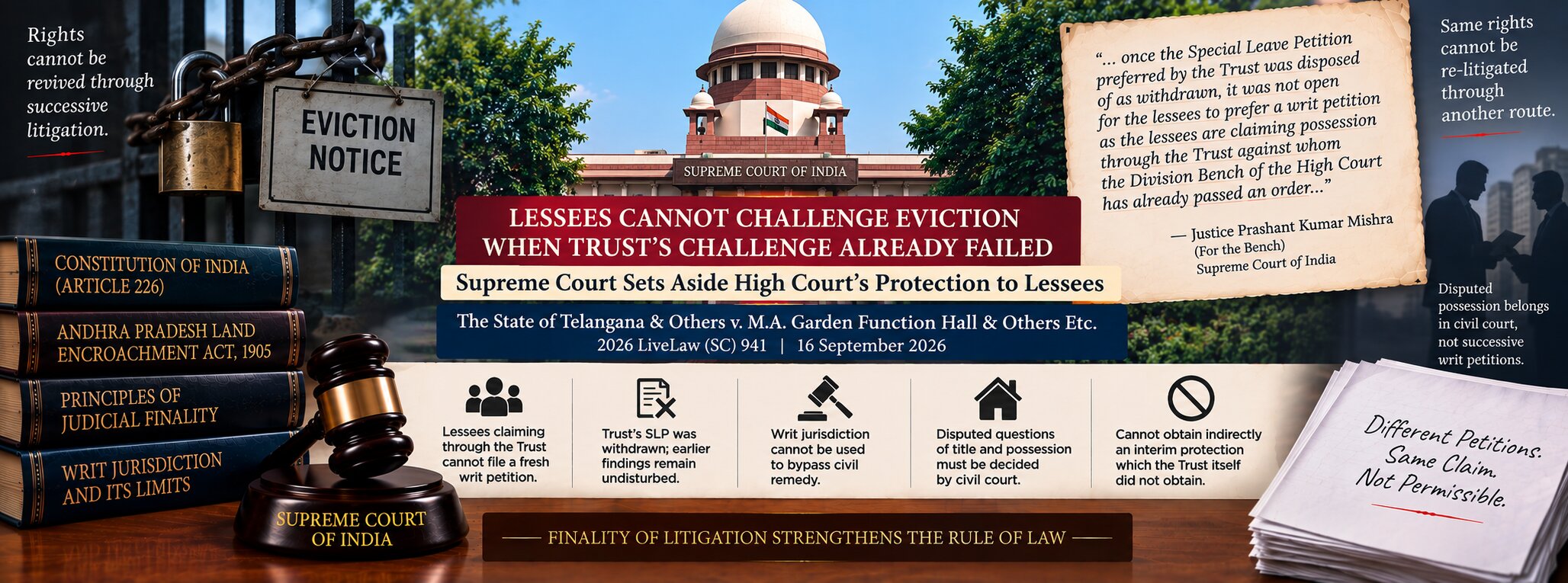
Lessees claiming possession through a Trust cannot circumvent an earlier adverse order against that Trust by filing a fresh writ petition.
Judgement Details
Court
Supreme Court of India
Date of Decision
16 September 2026
Judges
Justice Prashant Kumar Mishra and Justice Shree Chandrashekhar
Citation
Acts / Provisions
Facts of the Case
-
M/s. Kishan Chand Foundation Trust claimed ownership over approximately 4,678 sq. metres of land at Gaganmahal Village, Hyderabad, on the basis of a registered sale deed executed in 1968.
-
The Trust received an eviction notice under Section 7 of the Andhra Pradesh Land Encroachment Act, 1905.
-
Proceedings under Section 6 were subsequently initiated by the State authorities for delivery of possession of the property.
-
The Trust challenged the eviction proceedings before the High Court through a writ petition.
-
Initially, the Single Judge of the High Court allowed the Trust's petition and quashed the eviction proceedings.
-
The Division Bench, however, reversed the Single Judge's decision on 7 September 2022.
-
The Division Bench held that a writ court under Article 226 is not the appropriate forum for determining possession or title when serious factual disputes exist.
-
The Trust challenged the Division Bench judgment before the Supreme Court through an SLP.
-
The Supreme Court initially directed the parties to maintain status quo concerning the property.
-
On 9 September 2025, the Trust's SLP was permitted to be withdrawn, with liberty to the Trust to institute a fresh civil suit.
-
Importantly, the Supreme Court did not grant further interim protection to the Trust after permitting withdrawal of the SLP.
-
Shortly thereafter, persons claiming to be lessees of the Trust, including M.A. Garden Function Hall, filed fresh writ petitions before the Telangana High Court challenging the State's action concerning possession.
-
The High Court's Single Judge directed the State not to dispossess the lessees and also directed the authorities to unlock the function hall.
-
The State challenged this order before the Division Bench, but the Division Bench dismissed the State's appeals and upheld the protection granted to the lessees.
-
The State therefore approached the Supreme Court.
-
The Supreme Court examined whether the lessees could initiate a fresh writ proceeding when the Trust through which they claimed possession had already unsuccessfully challenged the eviction.
-
The Court noted that the fresh writ petitions by the lessees were filed immediately after the Trust's SLP had been withdrawn.
-
A civil suit had subsequently been filed, but the trial court had not granted interim protection within the stipulated period.
Issues
-
Whether the lessees claiming possession through the Trust could maintain a fresh writ petition against eviction after the Trust's own challenge to the eviction had already failed before the High Court and its SLP was withdrawn?
-
Whether the High Court could grant interim protection to the lessees when the earlier Division Bench judgment concerning the Trust's possession remained undisturbed by the Supreme Court?
-
Whether the lessees could invoke writ jurisdiction to obtain indirectly an interim protection which the Trust itself had not obtained after withdrawal of its SLP?
-
Whether the High Court could entertain a second writ proceeding for protection of possession when the earlier proceedings had indicated that disputed questions of possession and title should be determined through the appropriate civil remedy?
Judgement
-
The Supreme Court allowed the State of Telangana's appeals.
-
The Court set aside the Single Judge's order dated 12 September 2025 and the Division Bench judgment dated 30 December 2025.
-
The Court held that the lessees were claiming possession through the Trust, against which the Division Bench had already passed an adverse order.
-
The Trust's SLP against that judgment had been withdrawn without the Supreme Court interfering with the Division Bench's findings.
-
Therefore, the lessees could not use a fresh writ petition to reopen or circumvent the consequences of the earlier proceedings.
-
The Court emphasized that the earlier Division Bench had already held that a writ court cannot determine possession or title in the presence of serious factual disputes.
-
The subsequent writ petitions filed by the lessees essentially sought protection of possession in circumstances where such protection had not been granted to the Trust.
-
The Court observed that such interim protection could appropriately be considered by the civil court in the civil suit.
-
The Supreme Court did not interfere with the State's action of locking the premises.
-
The pending civil suit was directed to be decided on its own merits.
Held
-
Once the Trust's SLP was withdrawn without disturbing the Division Bench judgment, the earlier findings continued to operate.
-
The lessees could not obtain through a fresh writ petition relief which the Trust itself could not secure.
-
A second writ petition seeking protection of possession was impermissible where the earlier proceedings had already dealt with the same underlying dispute.
-
Article 226 writ jurisdiction cannot be used to bypass the appropriate civil remedy for disputed questions of title and possession.
-
The High Court should not have granted interim protection to the lessees in the circumstances of the case.
-
The appropriate forum for interim relief concerning the disputed possession was the civil court.
Analysis
-
The judgment reinforces the principle of finality of judicial proceedings.
-
The Court focused on the fact that the lessees derived their claimed possession through the Trust and therefore could not use their derivative status to circumvent the earlier proceedings involving the Trust.
-
The judgment prevents parties from obtaining indirect relief through successive litigation after an earlier proceeding concerning the same subject matter has reached an adverse conclusion.
-
The Court maintained the distinction between writ jurisdiction and ordinary civil remedies.
-
Article 226 is a discretionary constitutional remedy and is not ordinarily intended for adjudicating complicated disputes concerning title and possession requiring detailed evidence.
-
The Supreme Court also considered the timing of the subsequent writ petitions significant because they were filed shortly after the Trust withdrew its SLP.
-
The Court indicated that the lessees' proceedings effectively sought interim protection of possession, which could be considered by the civil court.
-
The decision demonstrates that a party cannot obtain indirectly, through another person claiming derivative rights, an order that would effectively undermine an earlier judicial determination.
-
The judgment is particularly relevant to landlord–lessee disputes, government eviction proceedings, and the limits of Article 226 jurisdiction.
-
The decision also emphasizes that where a court grants liberty to pursue a fresh civil suit, parties should ordinarily pursue that remedy rather than attempting to revive the dispute through another writ proceeding.
-
The Supreme Court ultimately restored the position that the underlying possession dispute must be dealt with through the appropriate civil proceedings, rather than through successive writ petitions.