
The State of Punjab v. Avtar Singh & Ors., 2026
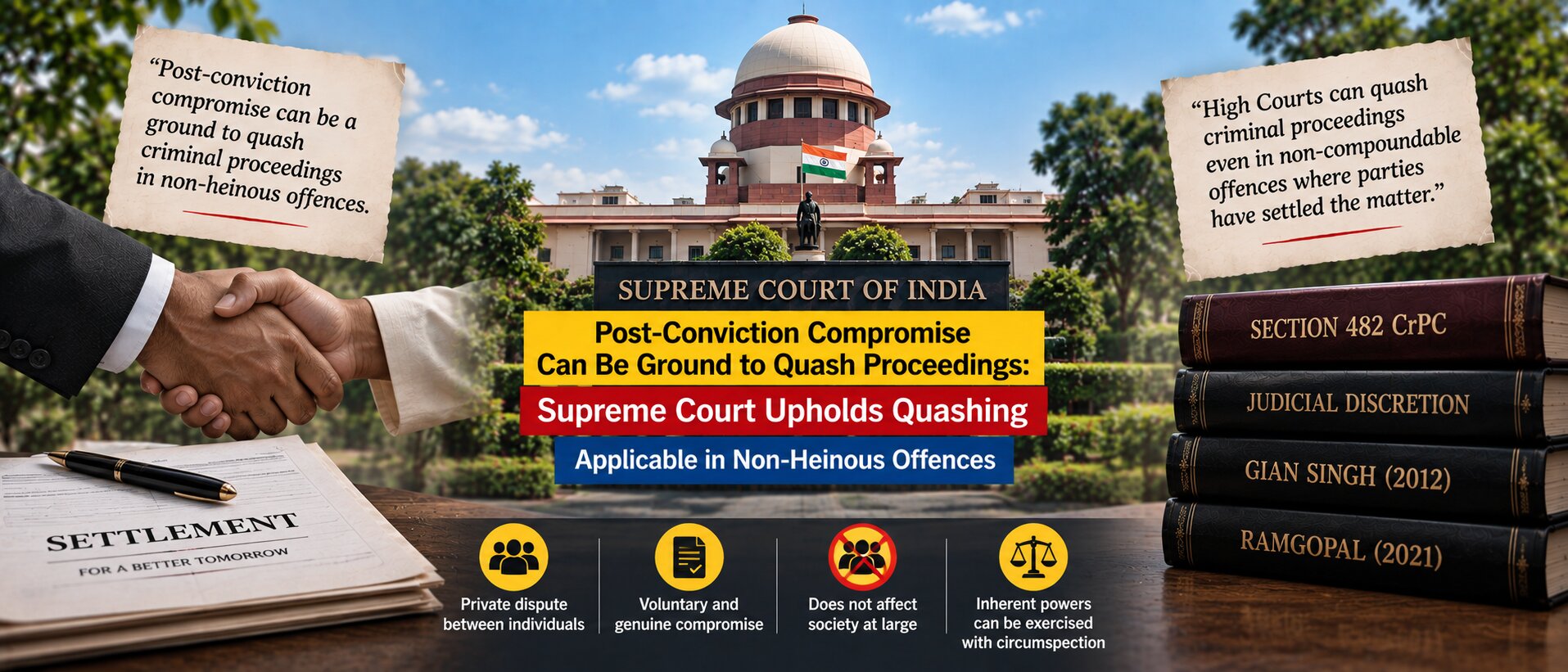
A High Court can exercise its inherent jurisdiction to quash criminal proceedings on the basis of a genuine compromise even where the offence is non-compoundable.
Judgement Details
Court
Supreme Court of India
Date of Decision
2 September 2026
Judges
Justice Prashant Kumar Mishra and Justice Shree Chandrashekhar
Citation
Acts / Provisions
Facts of the Case
-
The respondent-accused was prosecuted for offences including unlawful assembly, kidnapping/abduction and use of dangerous weapons.
-
The accused was convicted by the trial court.
-
After the conviction, the accused and the complainant/victim entered into a compromise.
-
The complainant/victim appeared before the trial court and stated that the compromise had been entered into with the intervention of respectable persons and relatives.
-
The complainant/victim also stated that the compromise was genuine, voluntary and without pressure or undue influence.
-
On the basis of the settlement, the Punjab and Haryana High Court exercised its inherent jurisdiction and quashed the criminal proceedings against the accused.
-
The State of Punjab challenged the High Court's decision before the Supreme Court.
-
The Supreme Court considered whether a criminal proceeding could be quashed on the basis of a compromise after conviction, particularly where the offences were not compoundable.
-
The Court relied upon the principles laid down in Gian Singh v. State of Punjab and subsequently reaffirmed in Ramgopal and Another v. State of Madhya Pradesh.
-
The Court considered the nature of the offences, the effect of the incident on society, the genuineness of the compromise and the conduct of the accused.
-
The Supreme Court found that the incident was essentially private in nature and did not involve a heinous offence affecting society at large.
-
The Court also noted that the case did not involve an economic offence, an NDPS offence or a large-scale scam affecting the public.
-
The Supreme Court therefore declined to interfere with the High Court's decision.
Issues
-
Whether criminal proceedings can be quashed on the basis of compromise between the accused and the complainant or victim after conviction?
-
Whether the High Court can exercise its inherent powers to quash proceedings relating to non-compoundable offences when the parties have voluntarily settled their dispute?
-
Whether the nature and seriousness of the offences and their impact on society should be considered before quashing criminal proceedings on the basis of settlement?
-
Whether the compromise between the accused and the victim was voluntary and genuine and free from pressure or undue influence?
-
Whether the High Court was justified in quashing the proceedings considering that the offences were not heinous and did not affect society at large?
Judgement
-
The Supreme Court dismissed the State's appeal.
-
The Court upheld the Punjab and Haryana High Court's decision to quash the criminal proceedings against the respondent-accused.
-
The Court relied upon Gian Singh v. State of Punjab and Ramgopal and Another v. State of Madhya Pradesh.
-
The Court recognised that High Courts possess inherent powers to quash criminal proceedings even in cases involving non-compoundable offences, where the parties have genuinely settled their dispute.
-
The Court emphasised that such power must be exercised with caution and circumspection.
-
The Court considered the nature and effect of the offences and found that the incident was essentially between individuals.
-
The Court found that the offences did not have a significant impact on the public at large.
-
The Court also noted that the case did not involve a heinous offence, economic offence, NDPS contraband or a large-scale financial scam.
-
The compromise was found to have been entered into voluntarily and without pressure or undue influence.
-
In view of these circumstances, the Court found no reason to interfere with the High Court's exercise of its inherent jurisdiction.
-
The appeal filed by the State of Punjab was accordingly dismissed.
Held
-
Such power may be exercised even in appropriate cases where the compromise occurs after conviction.
-
The power must be exercised sparingly and with circumspection.
-
The Court must consider the nature and effect of the offence, seriousness of injury, voluntariness of the compromise and conduct of the accused.
-
Where the dispute is essentially private in nature and does not seriously affect society at large, quashing may be justified.
-
The compromise in the present case was considered genuine and voluntary.
-
The Supreme Court therefore upheld the quashing of the criminal proceedings and dismissed the State's appeal.
Analysis
-
Post-conviction compromise: The important aspect of the decision is that the settlement occurred after the accused had already been convicted. The Court nevertheless accepted that, in an appropriate case, the High Court's inherent jurisdiction can be exercised.
-
Non-compoundable offences: The judgment reinforces the distinction between statutory compounding and judicial quashing. Even where an offence cannot ordinarily be compounded under the CrPC, the High Court may, in appropriate circumstances, quash proceedings using its inherent powers.
-
Gian Singh principle: The decision follows the Supreme Court's established approach that criminal proceedings arising predominantly from private disputes may be quashed where continuation of the prosecution would serve little meaningful purpose after a genuine settlement.
-
Ramgopal safeguards: The Court reiterated that the power cannot be exercised mechanically. The nature of the offence, its social impact, the seriousness of the injury and the genuineness of the settlement must be carefully considered.
-
Public interest remains important: Courts must distinguish between offences that are essentially private disputes and offences having serious consequences for society. Serious offences affecting public interest cannot ordinarily be wiped out merely because the parties have reached a settlement.
-
Voluntary compromise: The victim's statement before the trial court that the settlement was voluntary and free from pressure or undue influence was significant in assessing the genuineness of the compromise.
-
Nature of the present offences: Although the accused had faced serious allegations, the Supreme Court found that the particular incident was essentially an individual dispute rather than conduct affecting society at large.
-
Limits of the principle: The judgment does not establish that every conviction can be erased through a compromise. The Court specifically relied upon the circumstances of the case and the absence of a heinous, economic, NDPS or large-scale public offence.
-
Judicial discretion: The decision confirms that quashing on the basis of settlement remains a matter of judicial discretion, requiring examination of the totality of circumstances.
-
Balance between justice and settlement: The judgment reflects the Court's attempt to balance the criminal justice system's interest in prosecution with the practical reality that some disputes can be genuinely resolved between the affected parties.
-
Significance: The ruling is important for understanding the scope of High Court's inherent powers to quash criminal proceedings following settlement, including in cases where the compromise is reached after conviction.