
The State of Maharashtra v. Gorakh Arjun Marathe, 2026
Microscopic examination is not an analytical or chemical analysis test under the PFA Act.
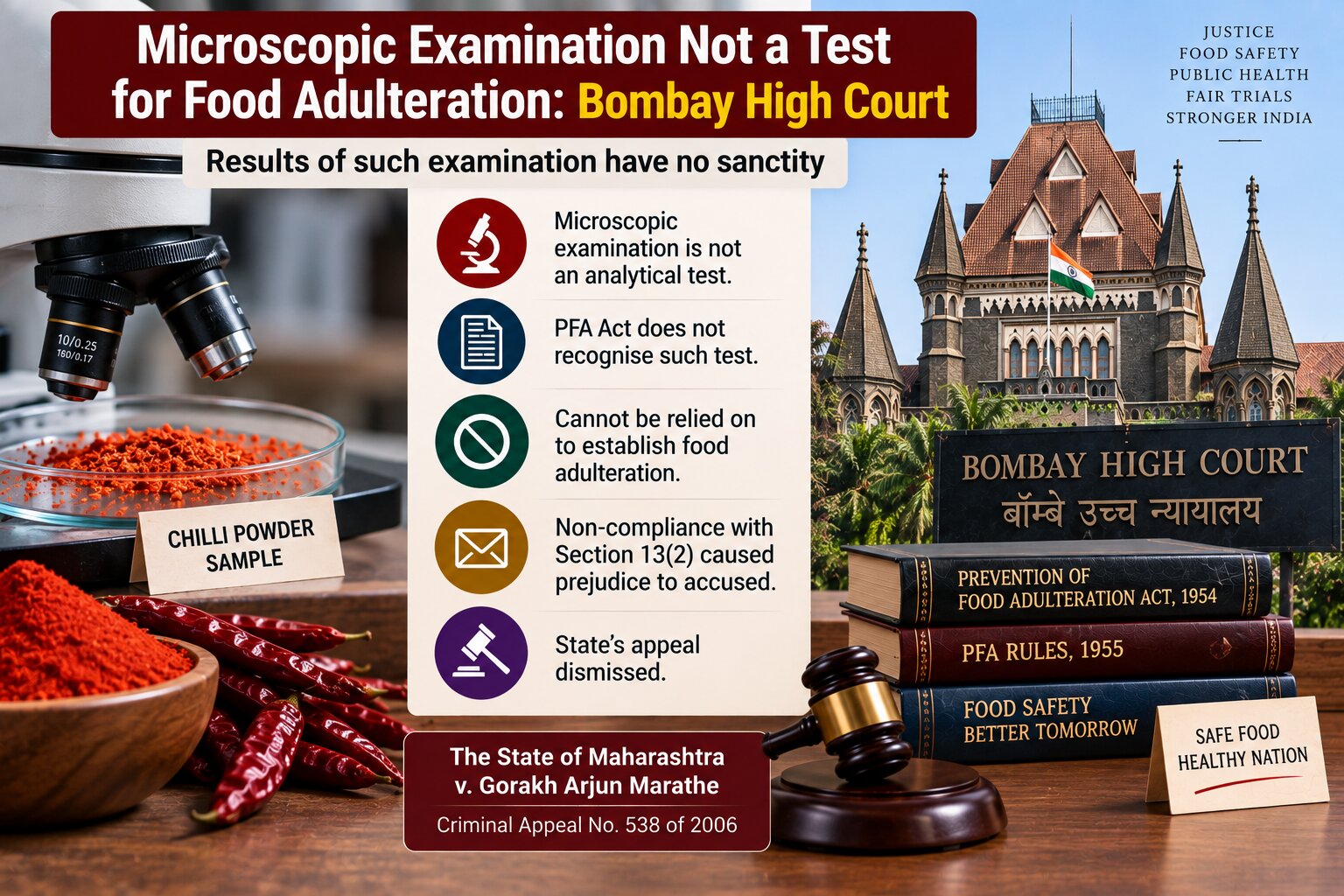
Judgement Details
Court
Bombay High Court
Date of Decision
17 September 2026
Judges
Justice Abhay S. Waghwase
Citation
Acts / Provisions
Facts of the Case
-
The prosecution alleged that the accused were involved in the manufacture and sale of food articles, including chilli powder.
-
A food sample was collected from the accused's premises for examination.
-
According to the prosecution, the sample did not conform to the prescribed standards under the applicable food-adulteration law.
-
Proceedings were initiated against the accused for offences punishable under Section 16 of the Prevention of Food Adulteration Act, 1954.
-
The case was tried before the JMFC, Nandurbar.
-
The trial Court ultimately acquitted the accused.
-
The State challenged the acquittal before the Bombay High Court.
-
The Public Analyst's report recorded that the essential parameters of the sample were within the permissible limits.
-
However, the analyst additionally reported that during microscopic examination of the chilli powder, synthetic red and orange oil-soluble colour appeared to be visible.
-
The prosecution relied upon the provisions of the PFA Rules, 1955, particularly the standards applicable to chillies, which prohibit certain added colouring matter and other substances.
-
The State argued that the trial Court had erred in excluding the microscopic examination findings.
-
The High Court examined whether microscopic examination could constitute a legally recognised analytical or chemical test under the PFA Act.
-
The Court noted that the analyst had not specified the exact percentage of the alleged colouring material.
-
It also noted that no extraneous matter or other material had been specifically detected through a recognised analytical test.
-
The High Court further examined compliance with Section 13(2) of the PFA Act.
-
Although the Chief Officer claimed that the statutory communication had been served upon the accused, the acknowledgement of receipt was not produced before the Court.
-
The postal receipt also contained only a vague address.
-
The Court held that merely producing a copy of the covering letter did not establish compliance with the mandatory statutory procedure.
-
The Court concluded that the deficiencies in the analytical evidence and the non-compliance with Section 13(2) caused prejudice to the accused.
Issues
-
Whether microscopic examination of chilli powder constitutes a legally recognised analytical or chemical test under the Prevention of Food Adulteration Act, 1954?
-
Whether the findings of microscopic examination alone can establish food adulteration when the PFA Act does not recognise such examination as an analytical test?
-
Whether the Public Analyst's report was sufficient to establish adulteration when the recognised parameters were within permissible limits and the alleged colouring material was not quantified?
-
Whether the prosecution had complied with the mandatory requirements of Section 13(2) of the Prevention of Food Adulteration Act, 1954?
-
Whether the alleged non-compliance with Section 13(2) caused prejudice to the accused and affected the sustainability of the prosecution?
-
Whether the trial Court erred in acquitting the accused by excluding the findings based upon microscopic examination?
Judgement
-
The Bombay High Court dismissed the State's appeal against the acquittal of the accused.
-
The Court held that microscopic examination is not an analytical test or chemical analysis test recognised under the Prevention of Food Adulteration Act.
-
The Court observed that neither the Act nor the legislature had provided for or acknowledged microscopic examination as a test upon which food adulteration could be established.
-
Consequently, the microscopic findings recorded by the Public Analyst could not be given legal sanctity for establishing adulteration.
-
The Court found that the essential parameters mentioned in the Public Analyst's report were within permissible limits.
-
The alleged synthetic red and orange oil-soluble colour was reported merely on microscopic examination and was not supported by the required quantitative analytical finding.
-
The Court also noted that the analyst had not specified the percentage of the alleged colouring substance.
-
The Court therefore held that the Trial Court was justified in excluding the microscopic examination results.
-
The High Court additionally found non-compliance with Section 13(2) of the PFA Act.
-
The prosecution failed to produce adequate proof establishing that the accused had actually received the relevant communication.
-
The Court held that merely producing a copy of the covering letter was insufficient to demonstrate compliance with the statutory requirement.
-
The failure to establish proper compliance caused prejudice to the accused.
-
The Court therefore found no reason to interfere with the acquittal and dismissed the State's appeal.
Held
-
Findings based solely on microscopic examination cannot be treated as sufficient proof of food adulteration where such examination is not recognised by the governing statute.
-
The trial Court was justified in excluding the microscopic examination findings from consideration.
-
Where the recognised parameters in the Public Analyst's report are within permissible limits, an unquantified microscopic observation of alleged colouring material cannot by itself establish adulteration.
-
Section 13(2) compliance is mandatory, and the prosecution must establish that the statutory communication was properly served upon the accused.
-
A mere copy of a covering letter, without reliable proof of receipt, does not necessarily establish compliance with Section 13(2).
-
Failure to comply with the statutory procedure, where it causes prejudice to the accused, can affect the sustainability of the prosecution.
-
The acquittal recorded by the Trial Court was therefore upheld and the State's appeal was dismissed.
Analysis
-
Statutory recognition of testing methods: The judgment emphasises that criminal liability for food adulteration must be established through testing methods recognised by the applicable statutory framework.
-
Microscopy versus chemical analysis: The Court drew a clear distinction between observing a substance under a microscope and conducting a legally recognised analytical or chemical test capable of establishing adulteration.
-
Quantification matters: The analyst's failure to state the exact percentage of the alleged synthetic colouring material further weakened the prosecution's case.
-
Recognised parameters were compliant: An important factual circumstance was that the essential parameters reported by the Public Analyst were within permissible limits. The microscopic observation therefore could not independently establish the offence.
-
Section 13(2) safeguards the accused: The statutory procedure gives the accused an important opportunity concerning independent examination of the sample. Proof of proper communication is therefore significant.
-
Proof of service cannot be assumed: The Court rejected the proposition that production of a covering letter alone established compliance. The prosecution needed adequate evidence demonstrating that the accused received the relevant communication.
-
Prejudice caused by procedural non-compliance: The Court treated the Section 13(2) deficiency as material because it affected the accused's statutory rights and caused prejudice.
-
Acquittal upheld: Taken together, the lack of legally sufficient analytical evidence and the procedural defect under Section 13(2) justified maintaining the acquittal.
-
Precedential significance: The ruling reinforces the principle, also reflected in the cited Supreme Court decision in Jagdish Chandra v. State of Uttar Pradesh, that courts cannot substitute an unrecognised testing method for the analytical procedures contemplated by the governing food-adulteration legislation.