
The State of Jharkhand v. Jagdish Lakra, 2026
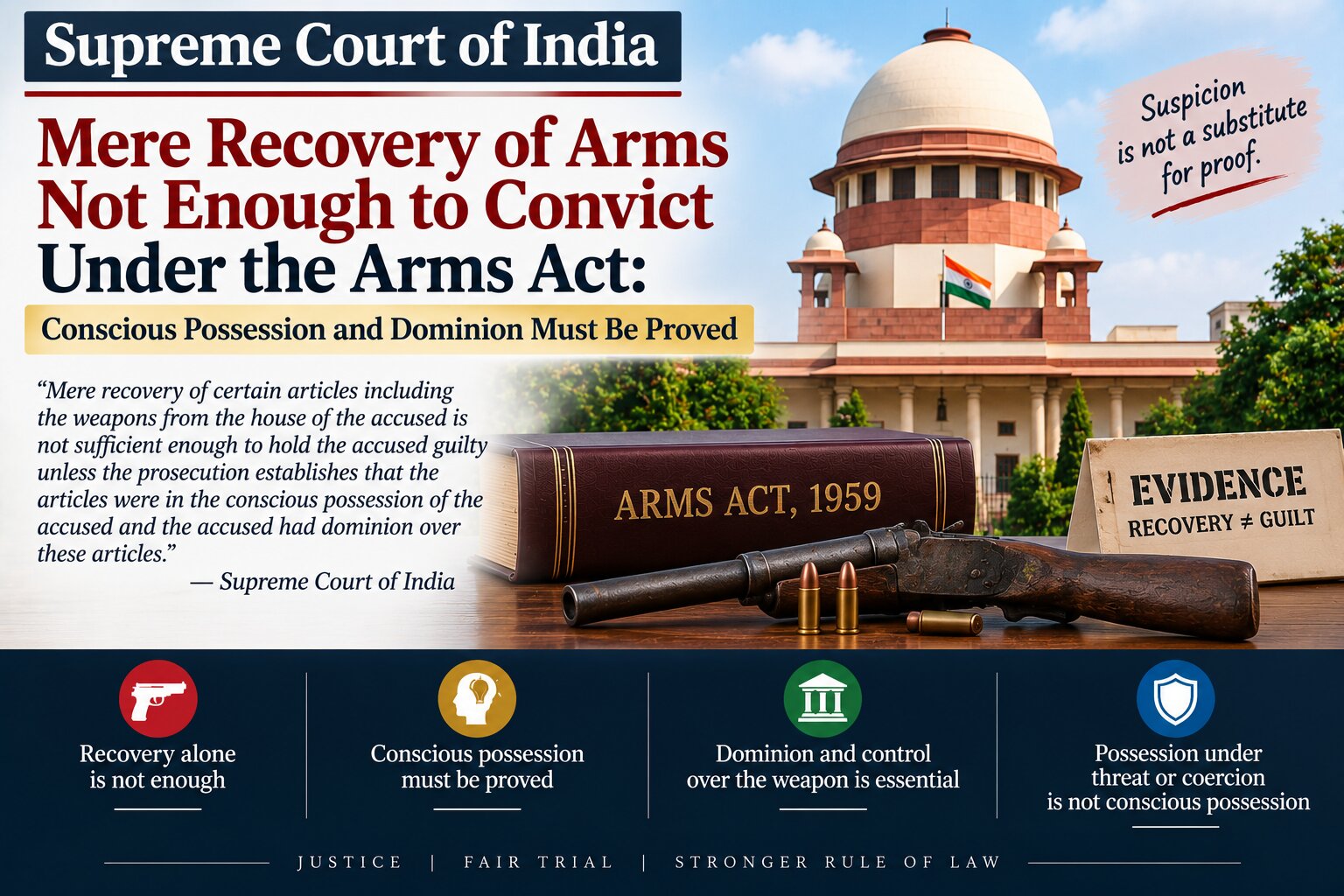
Mere recovery of an illegal firearm from a house is not sufficient to establish guilt under the Arms Act.
Judgement Details
Court
Supreme Court of India
Date of Decision
2 September 2026
Judges
Justice Sanjay Karol and Justice Prasanna B. Varale
Citation
Acts / Provisions
Facts of the Case
- In August 2001, police and CRPF personnel conducted a raid in Village Dora, Jharkhand, after receiving information about the presence of extremists.
-
Four alleged extremists had taken shelter in the house of Jagdish Lakra at around 4:00 a.m.
-
When the police reached the house at around 6:00 a.m., three persons fled while one was apprehended.
-
A search of the house resulted in the recovery of a country-made stein gun, cartridges, medicines and extremist literature.
-
Lakra was prosecuted under the Arms Act on the basis of the recovery.
-
The Trial Court convicted him under Sections 25(1-B)(a) and 26 of the Arms Act.
-
The Appellate Court affirmed the conviction.
-
The Jharkhand High Court reversed the conviction and acquitted Lakra, holding that the prosecution had failed to establish his conscious possession of the recovered weapon.
-
The State challenged the High Court's decision before the Supreme Court.
Issues
-
Whether mere recovery of a firearm from the house of an accused is sufficient to establish an offence under the Arms Act?
-
Whether the prosecution must prove conscious possession and dominion of the accused over the recovered weapon?
-
Whether possession of a weapon under coercion or threat to life can be treated as conscious possession?
-
Whether the High Court was justified in interfering with the conviction when the Trial Court and Appellate Court had concurrently found the accused guilty?
Judgement
-
The Supreme Court dismissed the State's appeal and upheld the acquittal of Jagdish Lakra.
-
The Court held that merely finding a firearm inside the accused's house does not automatically establish his possession of that firearm.
-
For an Arms Act conviction, the prosecution must establish conscious possession, together with the accused's dominion or control over the weapon.
-
The Court found that the extremists had entered Lakra's house only a short time before the police raid and had allegedly left the weapon behind while escaping.
-
The circumstances indicated that the incriminating articles could have been kept in the house because of fear or threat to Lakra's life.
-
Such coercive possession cannot by itself be treated as conscious possession sufficient to establish criminal liability.
-
The Court found that the Trial Court had been substantially influenced by the mere fact of recovery without sufficient legal evidence connecting Lakra to conscious possession of the firearm.
-
The High Court's view was found to be a proper and legally sustainable appreciation of the evidence.
Held
-
The prosecution must prove conscious possession of the weapon.
-
The accused must also have dominion, control or knowledge over the firearm.
-
Where possession is the result of coercion, fear or threat to life, it cannot automatically be regarded as conscious possession.
-
The prosecution failed to establish the essential link between Jagdish Lakra and the recovered firearm.
-
The acquittal ordered by the Jharkhand High Court was therefore upheld.
-
The State's appeal was dismissed.
Analysis
-
The judgment draws an important distinction between recovery and legal possession. The location from which an article is recovered does not, by itself, prove that the occupant consciously possessed it.
-
Under the Arms Act, possession involves more than physical proximity. There must be an element of knowledge, consciousness and control over the weapon.
-
The Supreme Court placed considerable importance on the surrounding circumstances. The extremists allegedly entered Lakra's house shortly before the raid and left the weapon while escaping.
-
The Court therefore refused to apply an automatic presumption that the house owner must have possessed every incriminating article found inside the premises.
-
The concept of conscious possession protects individuals from criminal conviction based solely on circumstances that do not establish their voluntary control over prohibited articles.
-
The Court also recognized the distinction between voluntary possession and coercive possession. If a person permits armed individuals to occupy his premises because of a genuine threat to his life, the resulting presence of weapons cannot automatically be attributed to him.
-
The judgment reinforces the principle that criminal liability must be established through legally admissible and connecting evidence, rather than mere suspicion arising from recovery.
-
The decision is particularly significant in cases involving weapons allegedly recovered from shared houses, premises occupied by several persons, or locations temporarily used by third parties.
-
The Court also demonstrated judicial restraint in an appeal against acquittal. Once the High Court had adopted a plausible view based on the evidence, the Supreme Court found no sufficient ground to disturb that conclusion.
-
The central takeaway is that “recovery” is evidence of location, whereas “conscious possession” requires proof of knowledge and control. The latter must be established before a conviction under the Arms Act can be sustained.