
The State of Himachal Pradesh v. Varinder Verma @ Jatti & Anr., 2026
Judgement Details
Court
Supreme Court of India
Date of Decision
15 September 2026
Judges
Justice Manoj Misra & Justice Vijay Bishnoi
Citation
Acts / Provisions
Facts of the Case
-
The prosecution case concerned the alleged murder of two deceased persons.
-
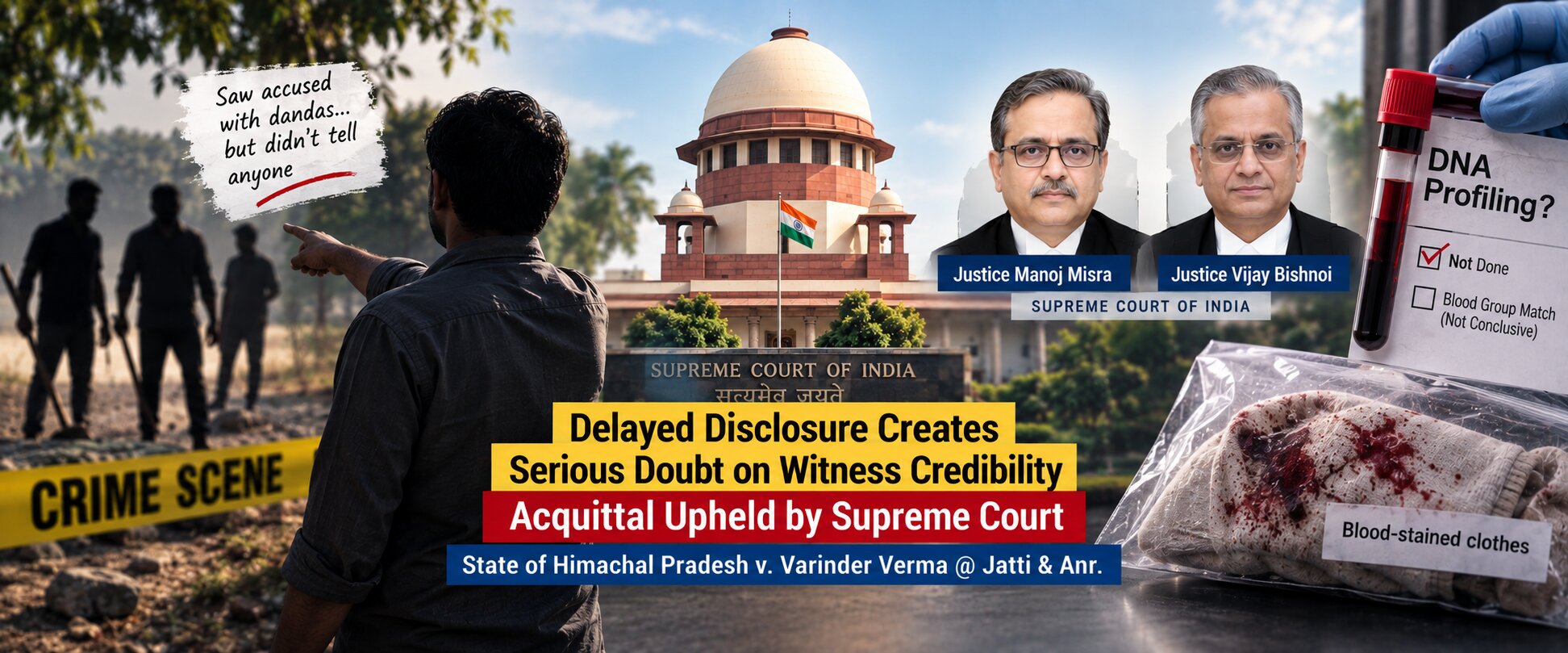
The prosecution relied significantly upon the testimony of PW-3, who claimed to have seen the accused persons armed with dandas and allegedly asking about the whereabouts of the two deceased.
-
PW-3 reached the place of occurrence within approximately two hours of the alleged incident.
-
He saw the deceased persons lying injured and also noticed wooden pieces scattered at the spot.
-
PW-1, who was a close relative of the deceased, was also present at the scene.
-
Despite having allegedly witnessed the incriminating circumstance, PW-3 did not disclose it to PW-1 or the other relatives of the deceased on the day of the incident.
-
PW-3 disclosed the alleged incriminating circumstance only on the following day.
-
His subsequent statement became an important basis for the arrest of the accused persons.
-
The prosecution also relied upon the alleged recovery of blood-stained clothes pursuant to the disclosure statements of the accused.
-
A forensic report indicated that the blood found on the clothes was of the same blood group as that of the deceased.
-
However, the investigating agency did not obtain blood samples from the accused persons to determine whether they also had the same blood group.
-
No DNA profiling was conducted to conclusively establish that the blood stains found on the clothes belonged to the deceased.
-
The High Court had acquitted the accused persons.
-
The State challenged the acquittal before the Supreme Court.
Issues
-
Whether the belated disclosure of an incriminating circumstance by PW-3, despite having an opportunity to disclose it earlier, creates serious doubt regarding the credibility of his testimony?
-
Whether the failure of PW-3 to disclose the alleged incriminating circumstance at the first opportunity materially affects the prosecution case?
-
Whether the alleged recovery of blood-stained clothes establishes the involvement of the accused when the investigation did not determine whether the accused had the same blood group as the deceased?
-
Whether the absence of DNA profiling materially affects the evidentiary value of the blood-stained clothes relied upon by the prosecution?
-
Whether the prosecution established the guilt of the accused beyond reasonable doubt on the basis of the evidence relied upon against them?
-
Whether the High Court was justified in acquitting the accused persons in the circumstances of the case?
Judgement
-
The Supreme Court dismissed the State's appeal against the acquittal of the accused persons.
-
The Court found the testimony of PW-3 to be materially doubtful because of his failure to disclose the alleged incriminating circumstance at the earliest opportunity.
-
The Court noted that PW-3 had reached the scene shortly after the alleged occurrence and was in the presence of PW-1, a close relative of the deceased.
-
Despite this opportunity, PW-3 did not inform PW-1 that the accused persons had allegedly been armed with dandas and were looking for the deceased.
-
The Court held that such unexplained silence created a serious doubt regarding the credibility of PW-3's subsequent testimony.
-
The Court relied upon the principle stated in Kali Ram v. State of Himachal Pradesh (1973) concerning the assessment of evidence and the benefit of reasonable doubt.
-
The Court observed that if the information subsequently disclosed by PW-3 was sufficiently serious to justify the immediate arrest of the accused, the failure to disclose it at the first opportunity required an explanation.
-
The Court also examined the prosecution's reliance upon the recovery of blood-stained clothes.
-
Although the blood group found on the clothes reportedly matched that of the deceased, the investigating agency did not obtain the blood samples of the accused persons.
-
Therefore, the possibility that other persons could have the same blood group could not be ruled out.
-
The absence of DNA profiling meant that the prosecution could not conclusively establish that the blood stains belonged to the deceased.
-
The Court therefore found that the evidence did not conclusively establish the involvement of the accused.
-
The Supreme Court upheld the acquittal and dismissed the State's appeal.
Held
-
The unexplained failure of a witness to disclose a serious incriminating circumstance at the earliest opportunity can substantially affect the credibility of his subsequent testimony.
-
Where a witness claims to have witnessed a grave circumstance connected with a murder but remains silent despite having an immediate opportunity to disclose it, the subsequent disclosure requires a cogent explanation.
-
In the absence of such an explanation, the evidentiary value of the delayed disclosure may be significantly diminished.
-
A matching blood group, by itself, does not conclusively establish that blood stains found on an article originated from the deceased.
-
The absence of DNA profiling may become significant where the prosecution relies upon blood stains as an important link in the chain of circumstances.
-
The prosecution must establish the accused's guilt beyond reasonable doubt.
-
Where the prosecution evidence gives rise to substantial doubt, the accused is entitled to the benefit of that doubt.
-
The High Court's acquittal of the accused persons was upheld.
Analysis
-
Delayed disclosure: The Court treated the unexplained delay by PW-3 as an important circumstance affecting the reliability of his testimony.
-
First opportunity: The judgment emphasizes the significance of what a witness does when the opportunity to disclose an important fact first arises. Failure to mention a supposedly crucial fact at that stage can weaken the subsequent version.
-
Relationship with PW-1: PW-1 was a close relative of the deceased and was present at the crime scene. The Court considered it significant that PW-3 did not disclose the alleged conduct of the accused to him.
-
Credibility of witness testimony: The Court did not treat the testimony of PW-3 in isolation. His conduct before the eventual disclosure was considered while assessing the reliability of his evidence.
-
Case based on suspicion: The Court observed that the circumstances raised a serious possibility that the prosecution case had been developed on the basis of suspicion rather than sufficiently reliable evidence.
-
Blood-group evidence: The matching blood group was not considered conclusive because persons other than the deceased could potentially have the same blood group.
-
DNA evidence: DNA profiling could have provided a stronger scientific link between the blood stains and the deceased. Its absence weakened this particular evidentiary circumstance.
-
Standard of proof: The judgment reinforces that criminal conviction requires proof beyond reasonable doubt and that suspicion, however strong, cannot substitute for legally reliable evidence.
-
Acquittal: Since the prosecution evidence contained significant weaknesses, the Supreme Court found no basis to interfere with the acquittal recorded by the High Court.