
Tara Chand v. Devinder, 2026
A prescriptive easementary right of way must be specifically pleaded and clearly identified.
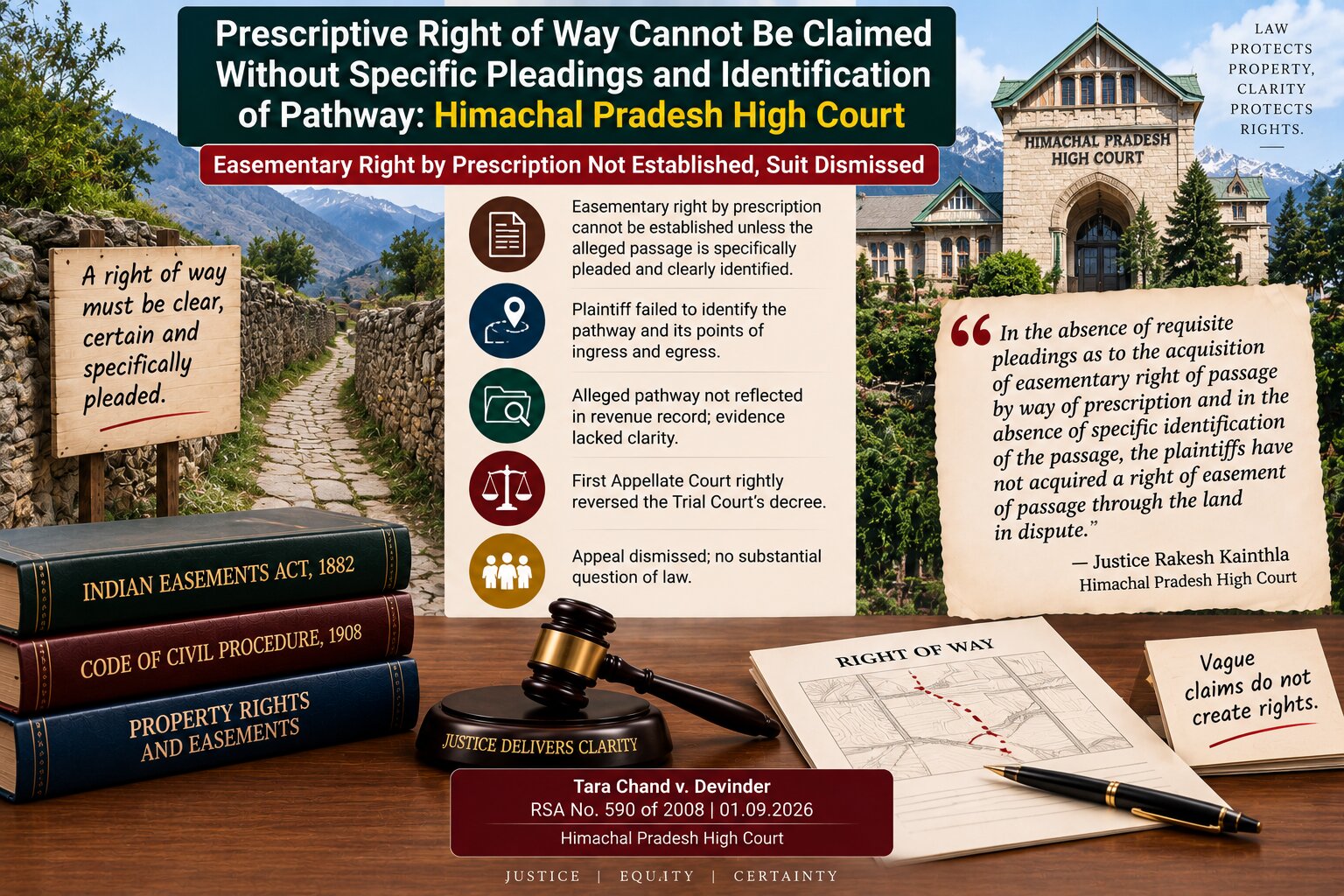
Judgement Details
Court
Himachal Pradesh High Court
Date of Decision
18 September 2026
Judges
Justice Rakesh Kainthla
Citation
Acts / Provisions
Facts of the Case
-
The plaintiff, Tara Chand, instituted a suit seeking a declaration that he had an easementary right of passage through land belonging to the defendants.
-
He claimed that he and his ancestors had been using the alleged pathway continuously and uninterruptedly for more than 20 years.
-
On the basis of such long and uninterrupted use, the plaintiff claimed to have acquired a prescriptive easementary right of way.
-
The plaintiff also sought an injunction restraining the defendants from obstructing the alleged pathway by raising construction.
-
The Trial Court accepted the plaintiff's case and decreed the suit.
-
The Trial Court found that the plaintiff had established use of the pathway for approximately 20–25 years.
-
The defendants challenged the decree before the First Appellate Court.
-
The First Appellate Court reversed the Trial Court's decision.
-
It found that the alleged pathway was not reflected in the revenue record and that the plaintiff had failed to establish the exact passage through the defendants' land.
-
The plaintiff thereafter approached the Himachal Pradesh High Court by way of a Regular Second Appeal.
-
Before the High Court, the plaintiff maintained that long-standing use of the passage had established a prescriptive easement.
-
The High Court examined the pleadings and evidence and found that the plaintiff had not specifically identified the alleged pathway.
-
The pleadings did not clearly specify the points from which the alleged passage commenced and where it ended.
-
The plaintiff's own witnesses also admitted the existence of a common path adjoining the land, creating further uncertainty about the particular passage claimed by the plaintiff.
-
The Court considered the tatima relied upon by the plaintiff but found that its evidentiary value was doubtful because its maker had died and the witness produced by the plaintiff was unaware of the actual spot position.
-
The alleged pathway was also not reflected in the revenue record despite a recent settlement.
-
The High Court consequently upheld the First Appellate Court's finding that the plaintiff had failed to establish the alleged prescriptive right of way.
-
The Court also considered the scope of Order XLI Rules 4 and 33 CPC and held that the First Appellate Court could reverse the Trial Court's decree even though one of the defendants had not independently filed an appeal.
Issues
-
Whether the plaintiff had acquired an easementary right of passage by prescription through the defendants' land on the basis of alleged uninterrupted use for more than 20 years?
-
Whether an easementary right by prescription can be established when the pleadings do not specifically identify the alleged pathway and its points of ingress and egress?
-
Whether the absence of the alleged pathway from the revenue record and deficiencies in the supporting evidence affected the plaintiff's claim of a prescriptive easement?
-
Whether the First Appellate Court could reverse the Trial Court's decree under Order XLI Rules 4 and 33 CPC even though one of the defendants had not filed an appeal?
-
Whether the judgment of the First Appellate Court reversing the Trial Court's decree called for interference in the Regular Second Appeal?
Judgement
-
The Himachal Pradesh High Court dismissed the Regular Second Appeal filed by Tara Chand.
-
The Court held that a claim of easement by prescription requires the alleged passage to be specifically pleaded and clearly identified.
-
The plaintiff had failed to provide sufficient particulars identifying the pathway allegedly running through the defendants' land.
-
The pleadings did not clearly establish the relevant points of ingress and egress.
-
The Court also considered the plaintiff's evidence insufficient to establish the precise passage claimed.
-
The existence of another common path adjoining the land, as admitted by the plaintiff's witnesses, further weakened the identification of the alleged pathway.
-
The Court found the tatima relied upon by the plaintiff to be of insufficient evidentiary value in the circumstances.
-
The alleged pathway was also absent from the relevant revenue record, despite a recent settlement.
-
The Court therefore agreed with the First Appellate Court that the plaintiff had failed to establish acquisition of an easementary right of passage by prescription.
-
The Court also upheld the First Appellate Court's power under Order XLI Rules 4 and 33 CPC to reverse the Trial Court's decree notwithstanding the absence of an appeal by one of the defendants.
-
The First Appellate Court's judgment was consequently upheld and the second appeal was dismissed.
Held
-
Mere assertion of long-standing use of a pathway is insufficient where the precise passage claimed cannot be identified from the pleadings and evidence.
-
The plaintiff must establish the specific pathway over which the claimed easement is asserted.
-
Failure to identify the points of ingress and egress can undermine a claim for a prescriptive right of passage.
-
The absence of the alleged pathway from the revenue record, particularly where the record had been recently prepared or settled, was a relevant circumstance against the plaintiff's claim.
-
Evidence that does not reliably establish the location of the alleged pathway cannot satisfactorily prove the claimed easement.
-
The First Appellate Court was entitled under Order XLI Rules 4 and 33 CPC to reverse the Trial Court's decree even though one defendant had not preferred an appeal.
-
The plaintiff consequently failed to establish the alleged easementary right and the Regular Second Appeal was dismissed.
Analysis
-
Specific pleadings are fundamental: The judgment underscores that an easement by prescription cannot rest on a vague assertion that a pathway has historically been used. The claimant must identify the precise passage over which the right is asserted.
-
Identity of the pathway matters: The absence of clear ingress and egress points created a fundamental evidentiary problem because the Court could not satisfactorily determine which portion of the defendants' land was allegedly burdened by the easement.
-
Long use alone is not enough: Even though the Trial Court had accepted evidence of use for 20–25 years, the High Court upheld the appellate finding because the particular passage itself had not been adequately established.
-
Revenue records as corroborative evidence: The absence of the pathway from the revenue record was treated as a significant circumstance, especially because the land had undergone a recent settlement.
-
Weak documentary evidence: The Court's treatment of the tatima illustrates the importance of proving the authenticity and connection of site-related documents through competent evidence.
-
Conflicting pathway evidence: The plaintiff's own witnesses referring to a common path adjoining the property created uncertainty about whether the path claimed in the litigation was actually the same passage allegedly used for the prescriptive period.
-
Appellate powers under CPC: The ruling also illustrates the broad corrective powers available to an Appellate Court under Order XLI Rules 4 and 33 CPC when determining the legality of the decree under challenge.
-
Significance for easement litigation: A party claiming a prescriptive right of way should clearly plead the location, boundaries, nature and course of the passage, and produce evidence capable of identifying the precise pathway on the ground.
-
Second appellate scrutiny: Since the High Court was exercising second-appellate jurisdiction, interference with the First Appellate Court's factual conclusions required a substantial question of law. The Court found no basis for such interference.