
Tansukhlal Pannalal Jain v. State of Maharashtra, 2026
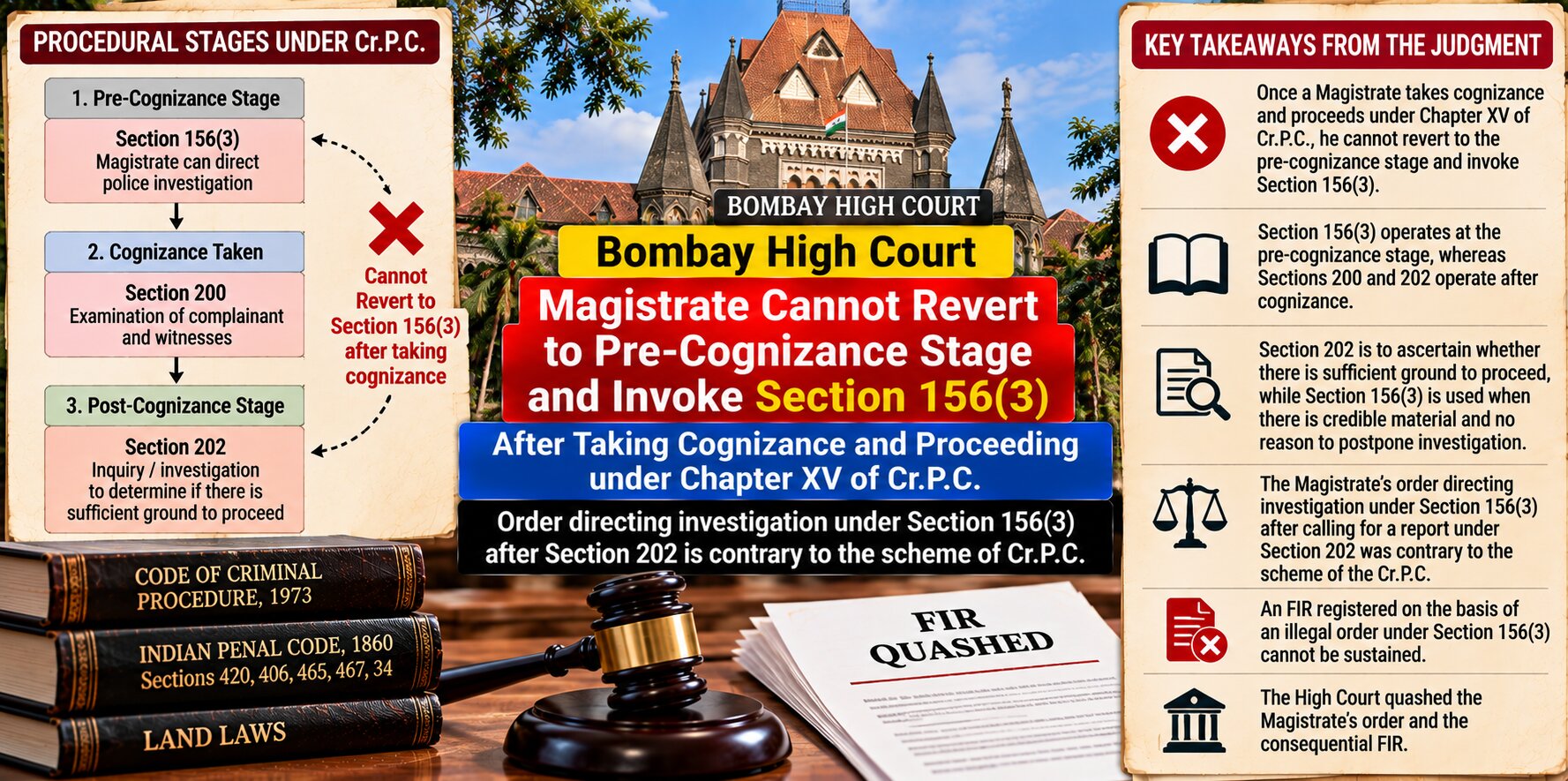
Section 156(3) Cr.P.C. operates at the pre-cognizance stage.
Judgement Details
Court
Bombay High Court
Date of Decision
24 September 2026
Judges
Justice Ranjitsinha Raja Bhonsale
Citation
Acts / Provisions
Facts of the Case
-
The case arose from a complaint alleging that the accused had fabricated and manipulated a Power of Attorney relating to immovable property.
-
It was alleged that the accused relied upon the disputed Power of Attorney to transfer the complainant's land.
-
The complainant alleged commission of offences under Sections 420, 406, 465, 467 and 34 of the IPC.
-
The Judicial Magistrate First Class proceeded with the complaint under the provisions applicable after cognizance.
-
The Magistrate directed the complainant to lead evidence in accordance with Section 200 Cr.P.C.
-
Thereafter, the Magistrate called for a report under Section 202 Cr.P.C.
-
The police submitted a report stating, in substance, that no offence was made out.
-
Instead of proceeding within the Chapter XV framework on the basis of the material before the Magistrate, the Magistrate subsequently passed an order dated 1 October 2016 directing investigation under Section 156(3) Cr.P.C.
-
Pursuant to that order, an FIR was registered against the applicants.
-
The applicants challenged the Magistrate's order and the consequential FIR before the Bombay High Court under Section 482 Cr.P.C.
-
The applicants contended that once the Magistrate had proceeded under Sections 200 and 202 Cr.P.C., it was procedurally impermissible to return to the pre-cognizance stage and invoke Section 156(3).
-
The High Court therefore examined the procedural distinction between Section 156(3) and Section 202 Cr.P.C., as well as the effect of taking cognizance and proceeding under Chapter XV.
Issues
-
Whether a Magistrate who has taken cognizance of a complaint and proceeded under Chapter XV of the Cr.P.C. can subsequently revert to the pre-cognizance stage and invoke Section 156(3) Cr.P.C.?
-
Whether a Magistrate can direct investigation under Section 156(3) after having already directed the complainant to lead evidence under Section 200 and called for an inquiry or investigation under Section 202 Cr.P.C.?
-
Whether an FIR registered pursuant to an order under Section 156(3) that is procedurally illegal can be sustained in law?
-
Whether the High Court should exercise its inherent jurisdiction under Section 482 Cr.P.C. to quash an order directing investigation under Section 156(3) and the consequential FIR?
Judgement
-
The Bombay High Court held that the Magistrate's subsequent direction under Section 156(3) Cr.P.C. was contrary to the procedural scheme of the Code.
-
The Court distinguished the stages at which Section 156(3) and Section 202 operate.
-
Section 156(3) operates at the pre-cognizance stage, where the Magistrate may direct the police to investigate a cognizable offence.
-
Once the Magistrate has taken cognizance and proceeded under Chapter XV, the proceedings enter a different procedural stage.
-
Section 200 provides for examination of the complainant and witnesses after cognizance.
-
Section 202 enables the Magistrate, where appropriate, to postpone issuance of process and conduct or direct an inquiry/investigation for determining whether there is sufficient ground for proceeding.
-
The Court held that these provisions cannot be treated as permitting the Magistrate to move backwards and revive the pre-cognizance procedure under Section 156(3).
-
Once the Magistrate had proceeded under Sections 200 and 202, directing a fresh investigation under Section 156(3) amounted to reverting to an earlier procedural stage.
-
The High Court found clear procedural illegality in the order dated 1 October 2016.
-
The Court consequently held that an FIR could not be registered or sustained on the basis of such an untenable and illegal order.
-
The High Court therefore quashed and set aside the Magistrate's order dated 1 October 2016 and the consequential FIR.
Held
-
Sections 200 and 202 Cr.P.C. operate within the post-cognizance complaint procedure under Chapter XV.
-
Once a Magistrate has taken cognizance and proceeded under Sections 200 and 202, the Magistrate cannot revert to the pre-cognizance stage and invoke Section 156(3).
-
Section 202 is concerned with determining whether there is sufficient ground for proceeding with the complaint, whereas Section 156(3) permits police investigation at the earlier stage.
-
A procedural order that improperly invokes Section 156(3) after the Magistrate has proceeded under Chapter XV cannot validly serve as the foundation for an FIR.
-
The consequential FIR, being founded upon the procedurally illegal order, was also quashed and set aside.
Analysis
-
The central principle of the judgment is the stage-specific operation of Sections 156(3) and 202 Cr.P.C.
-
Section 156(3) is essentially an investigative mechanism available before the Magistrate proceeds to take cognizance of the complaint. It permits the Magistrate to involve the police where police investigation is considered appropriate at that stage.
-
Section 202 serves a different purpose. After cognizance, the Magistrate may postpone issuance of process and undertake or direct an inquiry/investigation to determine whether there is sufficient ground for proceeding against the accused.
-
The Court's reasoning therefore rests upon the procedural progression contemplated by the Cr.P.C. Once the Magistrate moves into Chapter XV, the proceedings are governed by the mechanisms provided in that chapter.
-
The judgment prevents the two provisions from being used interchangeably or sequentially in a manner that allows the Magistrate to move backwards from the post-cognizance stage to the pre-cognizance stage.
-
The Court particularly emphasised that the Magistrate had already directed the complainant to lead evidence under Section 200 and had called for a report under Section 202. That procedural conduct demonstrated that the Magistrate had already proceeded within the Chapter XV framework.
-
In those circumstances, the subsequent invocation of Section 156(3) was found inconsistent with the scheme of the Code.
-
The decision also highlights the importance of procedural legality in criminal proceedings. The registration of an FIR cannot be sustained merely because the underlying allegations are serious; the order that forms its legal foundation must itself be within the jurisdiction and procedure prescribed by law.
-
The High Court's exercise of inherent jurisdiction under Section 482 Cr.P.C. was therefore directed towards preventing continuation of proceedings founded upon an unlawful procedural order.
-
The judgment does not establish that Section 156(3) can never be invoked by a Magistrate in a complaint case. Its significance lies in the timing and procedural stage at which that power is exercised.
-
The ruling is particularly relevant where a Magistrate has already taken cognizance and commenced proceedings under Sections 200 and 202. In such circumstances, the Magistrate must continue within the post-cognizance framework rather than reverting to Section 156(3).
-
The decision also illustrates the distinction between investigation intended to assist the police in collecting evidence before cognizance and inquiry/investigation under Section 202 intended to assist the Magistrate in deciding whether sufficient grounds exist to issue process.
-
The practical consequence is that parties may challenge an FIR where its registration is directly founded upon a Section 156(3) direction that was issued after the Magistrate had already crossed into the post-cognizance stage.
-
The judgment thus reinforces the procedural architecture of the Cr.P.C. and the principle that different statutory stages cannot be collapsed or reversed contrary to the scheme of the Code.