
Tamradhwaj Gayakwad v. Jyoti Gayakwad, 2026
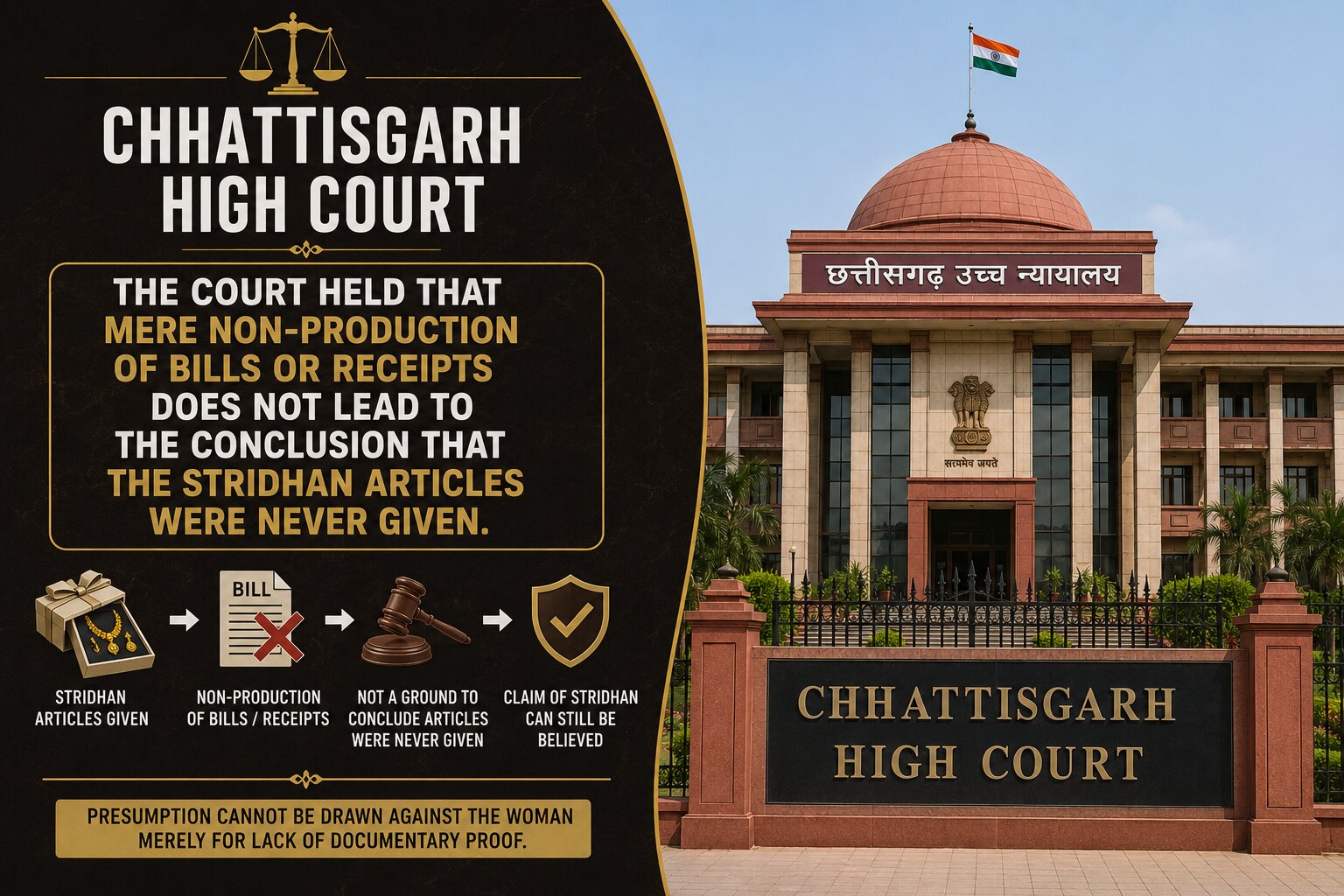
Failure of the wife to produce bills or receipts does not by itself disprove the existence or entrustment of Stridhan articles.
Judgement Details
Court
Chhattisgarh High Court
Date of Decision
16 July 2026
Judges
Justice Parth Prateem Sahu and Justice Sachin Singh Rajput
Citation
Acts / Provisions
Facts of the Case
-
The respondent-wife filed an application under Section 27 of the Hindu Marriage Act, 1955, seeking return of her Stridhan articles.
-
She alleged that after the birth of their daughter, she was subjected to cruelty and dowry-related harassment by her husband and his family.
-
According to the wife, her Stridhan articles remained in the possession of her husband and his family members.
-
The husband denied the allegations and disputed the existence and entrustment of the alleged Stridhan.
-
He contended that the wife had failed to produce any bills, receipts, or documentary evidence proving that the Stridhan articles were ever given at the time of marriage.
-
The wife specifically stated before the Family Court that the bills and receipts relating to the Stridhan articles were in the possession of her in-laws.
-
The Family Court accepted the wife's evidence regarding entrustment of the Stridhan and directed the husband to return the articles.
-
It further ordered that if the articles could not be returned, the husband should pay ₹2 lakh, instead of the ₹4 lakh claimed by the wife, after taking into account depreciation in the value of the articles other than gold ornaments.
-
Aggrieved by the order, the husband preferred an appeal before the Chhattisgarh High Court.
Issues
-
Whether the wife's failure to produce bills or receipts relating to her Stridhan articles is sufficient to reject her claim under Section 27 of the Hindu Marriage Act, 1955?
-
Whether the wife established that the Stridhan articles had been entrusted to the husband and his family at the time of marriage?
-
Whether the Family Court was justified in directing return of the Stridhan articles or payment of ₹2 lakh in lieu thereof?
Judgement
-
The High Court held that the burden of proving entrustment of the Stridhan initially rested upon the wife.
-
The Court found that the wife had specifically deposed that the Stridhan articles were given during the marriage and that the relevant bills and receipts remained in the possession of her in-laws.
-
The Court observed that, as a matter of ordinary human conduct, bills and receipts relating to matrimonial gifts are often retained by the wife's in-laws after marriage.
-
The Court held that mere non-production of bills or receipts does not lead to the conclusion that the Stridhan articles were never given.
-
The Court noted that the husband had not specifically denied the wife's pleadings regarding the Stridhan articles.
-
The Court accepted the Family Court's finding that, except for the gold ornaments, the remaining articles would naturally depreciate in value over time.
-
The Court held that the Family Court had reasonably assessed the value of the Stridhan at ₹2 lakh, instead of the ₹4 lakh claimed by the wife.
-
Finding no perversity or legal infirmity in the Family Court's appreciation of evidence, the High Court dismissed the appeal.
-
Consequently, the direction requiring the husband to return the Stridhan articles or pay ₹2 lakh in lieu thereof was affirmed.
Held
-
Where the wife explains that the receipts are in the possession of her in-laws and adduces evidence regarding entrustment, her claim cannot be rejected solely for want of documentary proof.
-
The Family Court rightly directed return of the Stridhan articles or payment of ₹2 lakh if the articles were not returned.
-
The husband's appeal was dismissed.
Analysis
-
The judgment adopts a practical and realistic approach to disputes concerning Stridhan by recognizing that documentary evidence may not always remain with the wife after marriage.
-
The Court emphasized that matrimonial disputes must be decided on the basis of the overall evidence, rather than insisting upon documentary proof in every case.
-
By acknowledging ordinary social practices regarding custody of bills and receipts after marriage, the Court prevented technical deficiencies from defeating substantive rights.
-
The decision reinforces that oral evidence, when found credible and supported by surrounding circumstances, can sufficiently establish entrustment of Stridhan.
-
The Court also approved the Family Court's balanced approach in assessing the monetary value of the articles by considering depreciation, thereby ensuring equitable compensation.
-
The ruling strengthens the protection available to women seeking recovery of their Stridhan and discourages denial of legitimate claims solely because documentary records are unavailable.
-
Overall, the judgment advances the beneficial object of matrimonial law by safeguarding a woman's proprietary rights over her Stridhan while applying realistic standards of proof.