
Taher Vajiyuddin Rangwala & Anr. v. The State of Gujarat, 2026
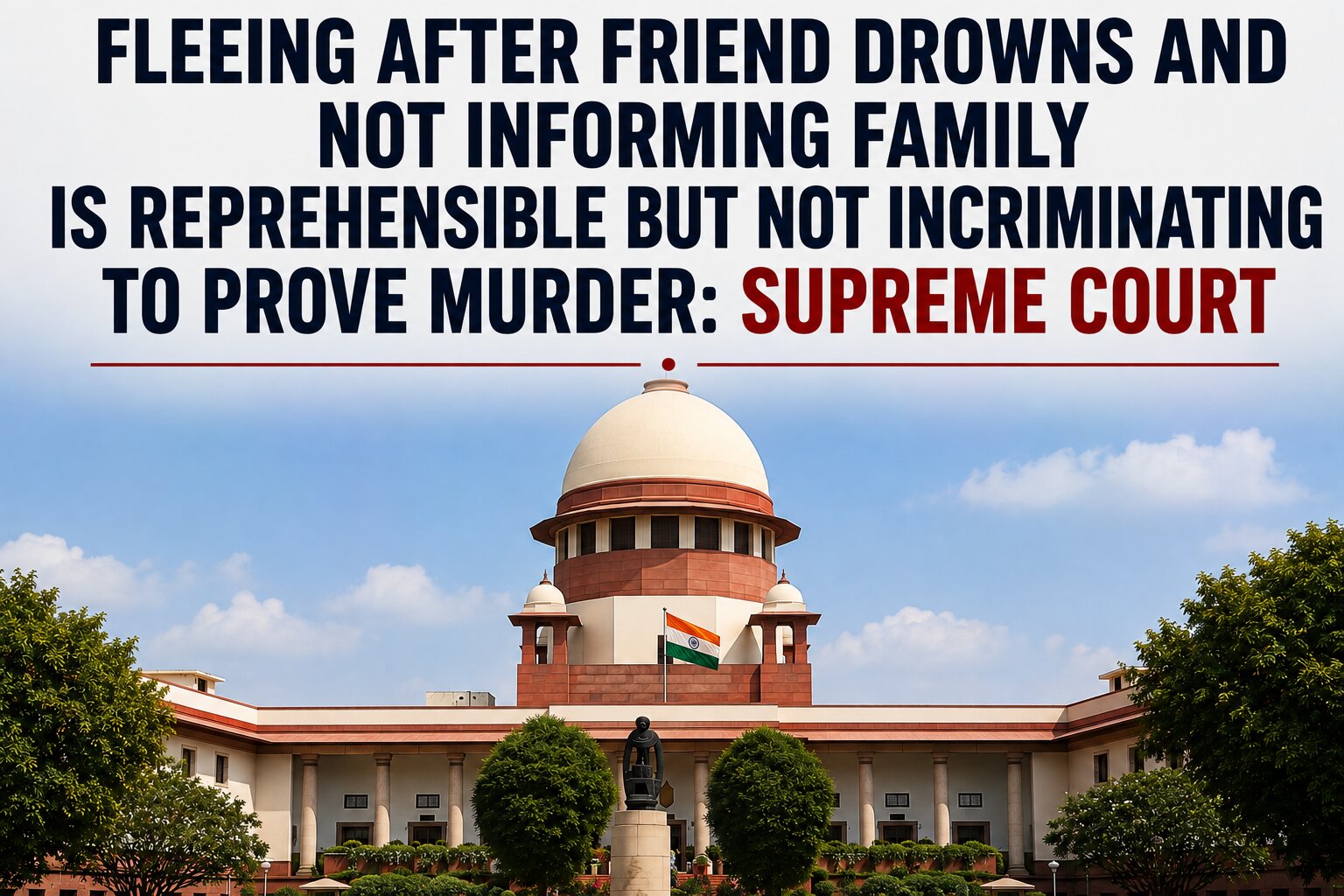
Fleeing from the scene after witnessing an accidental drowning, though reprehensible, is not by itself an incriminating circumstance sufficient to establish murder.
Judgement Details
Court
Supreme Court of India
Date of Decision
21 August 2026
Judges
Justice J.B. Pardiwala and Justice K. Vinod Chandran
Citation
Acts / Provisions
Facts of the Case
-
The deceased was taken from his home during the early hours of 17 July 2006.
-
The prosecution case was that he had gone with the appellants to Ankleshwar to play volleyball.
-
The deceased did not return home that evening.
-
His clothes and belongings were subsequently discovered near the bank of a river.
-
His body was recovered the following morning.
-
The post-mortem examination attributed the death to cardio-respiratory arrest caused by drowning.
-
The prosecution alleged that the appellants had murdered their friend and attempted to conceal the circumstances of his death.
-
There was no independent eyewitness to the alleged murder.
-
The prosecution relied substantially upon the circumstances surrounding the appellants' conduct after the incident.
-
The appellants allegedly left the spot after the deceased drowned.
-
They did not immediately inform the deceased's family about the incident.
-
They subsequently went to watch a movie.
-
The prosecution argued that such conduct was unnatural and constituted an incriminating circumstance indicating their involvement in the murder.
-
The Trial Court convicted the appellants under Sections 302, 34 and 201 read with Section 120-B IPC.
-
They were sentenced to life imprisonment for murder along with additional sentences for the other offences.
-
The High Court affirmed their convictions.
-
The appellants approached the Supreme Court challenging the findings of guilt.
-
The Supreme Court examined whether the prosecution had established a complete chain of circumstances proving murder beyond reasonable doubt.
Issues
-
Whether the appellants' conduct of fleeing from the spot after witnessing the deceased drown and failing to immediately inform his family can, by itself, constitute an incriminating circumstance proving murder?
-
Whether the medical evidence established that the deceased had suffered a homicidal death rather than an accidental death by drowning?
-
Whether the injuries found on the deceased's body were sufficient to establish that the appellants had assaulted him and deliberately caused his drowning?
-
Whether the alleged broken soda bottle constituted reliable evidence connecting the appellants with the death of the deceased?
-
Whether the circumstances relied upon by the prosecution formed a complete chain pointing only towards the guilt of the appellants?
-
Whether the prosecution had proved the appellants' guilt under Sections 302, 34, 201 and 120-B IPC beyond reasonable doubt?
Judgement
-
The Supreme Court allowed the appeals filed by the appellants.
-
The Court set aside their convictions and acquitted them.
-
The Court found that the prosecution had failed to establish that the deceased's death was homicidal.
-
The post-mortem report attributed the death to drowning and cardio-respiratory arrest.
-
The doctor had not provided evidence establishing that the deceased was deliberately assaulted and drowned.
-
The three injuries found on the deceased did not establish homicide.
-
According to the medical evidence, the injuries could have resulted from bathing in the river or from the body being dragged by the current and striking a hard object.
-
There was no reliable evidence that the deceased had been struck on the head, rendered unconscious and then deliberately drowned.
-
The Court rejected the prosecution's reliance on the alleged broken soda bottle.
-
No broken bottle or blood-stained fragments were recovered from the scene or subjected to forensic examination.
-
The Court held that the appellants' failure to immediately report the drowning could not automatically be treated as evidence of murder.
-
The Court considered their conduct reprehensible but held that it did not establish the commission of murder.
-
The Court found that the more probable explanation was that the deceased had accidentally drowned.
-
The prosecution failed to establish a complete chain of circumstances inconsistent with the innocence of the appellants.
-
The appellants were therefore acquitted.
-
The Court directed that they be released unless their custody was required in any other case.
Held
-
Failure to inform the deceased's family immediately cannot automatically be treated as proof of guilt.
-
Medical evidence showing drowning, without reliable evidence of homicidal intervention, cannot support a murder conviction merely on suspicion.
-
Injuries found on a body must be assessed in light of the surrounding medical and factual evidence.
-
Suspicion arising from post-incident conduct cannot substitute for proof beyond reasonable doubt.
-
An alleged weapon or object connecting the accused to the offence must be supported by reliable recovery or forensic evidence.
-
In a case based on circumstantial evidence, every circumstance must be firmly established and the circumstances must form a complete chain pointing exclusively towards guilt.
-
Where the circumstances equally or more reasonably support an accidental death, the accused is entitled to the benefit of doubt.
-
The prosecution failed to establish the alleged murder beyond reasonable doubt.
-
The appellants were therefore entitled to acquittal.
Analysis
-
Post-incident conduct: The Court made an important distinction between conduct that may appear morally reprehensible and conduct that has genuine evidentiary value. Leaving a drowning friend and going to a movie may be blameworthy, but it does not automatically establish that the person caused the death.
-
Suspicion versus proof: Criminal conviction requires proof beyond reasonable doubt. The Court refused to convert suspicious behaviour into proof of murder when the underlying cause of death itself was not established as homicidal.
-
Medical evidence: The post-mortem evidence was central. It supported drowning but did not establish that the drowning had been deliberately caused by the appellants.
-
Alternative explanation for injuries: The injuries did not necessarily point to assault. The doctor's evidence permitted an accidental explanation, including injuries caused while bathing or when the body was carried by the river current.
-
Broken soda bottle: The prosecution theory concerning the bottle lacked evidentiary foundation because no broken bottle or blood-stained fragments were recovered or sent for forensic examination.
-
Circumstantial evidence: Where there is no eyewitness, the prosecution must establish every link in the chain of circumstances. A missing link concerning the actual manner of death can be fatal to a murder prosecution.
-
Conduct after an accident: The Court recognized that human behaviour following an accident can be irrational, cowardly or irresponsible. Such conduct cannot automatically be assigned the meaning of consciousness of guilt.
-
Burden of proof: The burden remained entirely on the prosecution to establish homicide and the appellants' involvement. The accused were not required to prove the accidental-drowning theory beyond reasonable doubt.
-
Benefit of doubt: Once the accidental drowning hypothesis emerged as a reasonable and probable explanation, the prosecution could not secure a murder conviction merely because the appellants behaved badly afterwards.
-
Premeditated murder theory: The Court found no convincing evidence supporting the prosecution's theory that the deceased had been deliberately rendered unconscious and drowned.
-
Sections 201 and 120-B IPC: Once the foundational allegation of murder and deliberate concealment was not proved, the connected allegations of conspiracy and causing disappearance of evidence also could not sustain the convictions.
-
Importance for criminal trials: The judgment reinforces that courts must distinguish between suspicious circumstances, reprehensible conduct and legally incriminating evidence.
-
Broader significance: The ruling is a strong reminder that a criminal conviction cannot rest on an accused person's questionable behaviour alone when objective medical and forensic evidence does not establish the alleged offence.