
SXXXX v. State of Punjab and Others, 2026
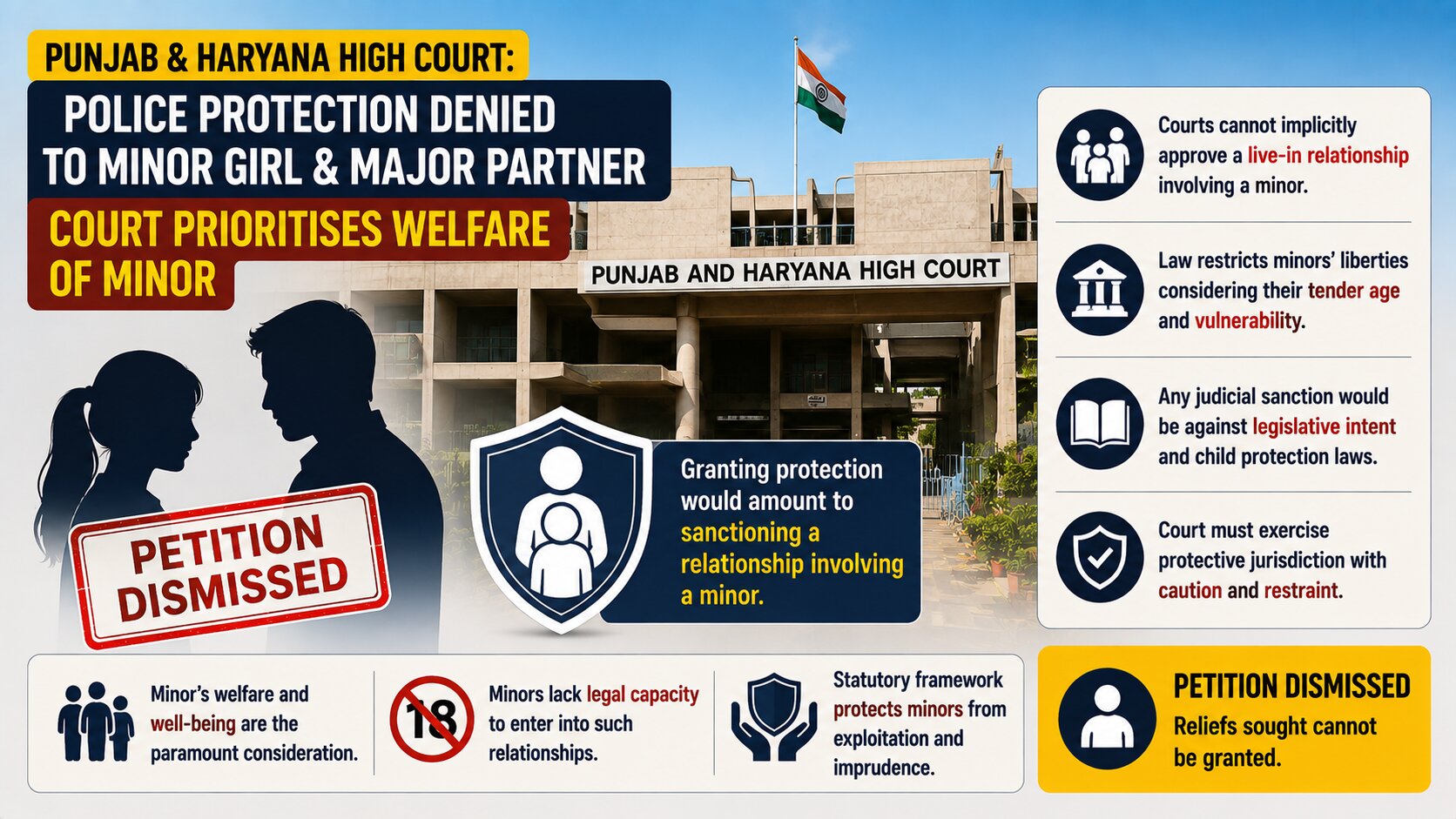
A minor cannot ordinarily obtain judicial protection in circumstances where doing so would effectively sanction a live-in relationship with an adult.
Judgement Details
Court
Punjab and Haryana High Court
Date of Decision
7 August 2026
Judges
Justice Sumeet Goel
Citation
Acts / Provisions
Facts of the Case
-
The petition was filed by a minor girl and a major male partner, who was working as a driver.
-
The petitioners sought police protection from the State authorities.
-
They also sought protection from alleged interference by the minor girl's family members.
-
The petitioners stated that they had known each other for a considerable period.
-
They intended to marry after the girl attained majority.
-
According to the petitioners, after their families became aware of their relationship, the minor's parents allegedly attempted to force her to marry another person.
-
The minor allegedly refused to comply with the proposed marriage.
-
It was alleged that she was subsequently beaten and threatened with death.
-
Due to the alleged apprehension to her safety, the minor left her parental home and joined the second petitioner.
-
The petitioners further alleged that one of the private respondents sent a voice message threatening to kill both of them.
-
They claimed that attempts were made through common relatives and respectable persons to resolve the dispute.
-
According to the petitioners, the private respondents nevertheless allegedly intended to harm them.
-
The petitioners therefore approached the High Court seeking police protection and protection of their personal liberty.
-
The Court noted that the girl was born on 11 August 2009.
-
At the time of filing the petition, she was approximately 16 years, 11 months and 19 days old.
-
The Court therefore found that her status as a minor was undisputed.
-
The Court considered the earlier Division Bench decision in Yash Pal and Another v. State of Haryana and Others.
-
That decision had held that a minor involved in a live-in relationship with an adult, or a relationship where both parties are minors, cannot ordinarily seek protection from the Court in a manner that would effectively validate the relationship.
-
The High Court emphasized that minors have restricted legal capacity and that statutory frameworks exist to protect them from exploitation and imprudent decisions.
-
The Court also considered its role as parens patriae, requiring it to prioritize the welfare and protection of the minor.
-
On that basis, the Court declined to grant the requested protection.
Issues
-
Whether a minor involved in a live-in relationship with a major partner can seek police protection from the High Court against interference by her family members?
-
Whether granting police protection to a minor living with an adult partner would indirectly amount to judicial approval of a relationship prohibited or restricted by the statutory framework protecting minors?
-
Whether the welfare and best interests of a minor must take precedence over the minor's asserted choice to live with an adult partner?
-
Whether a minor possesses sufficient legal capacity to independently seek judicial protection for a live-in arrangement with an adult?
-
Whether the High Court, while exercising protective jurisdiction, can refuse protection where granting such protection may undermine statutory safeguards intended to protect minors?
Judgement
-
The Punjab and Haryana High Court dismissed the petition seeking police protection.
-
The Court held that the girl was undisputedly a minor at the time the petition was instituted.
-
The Court emphasized that the welfare and well-being of the minor must remain the paramount consideration.
-
The Court held that granting protection in the circumstances would effectively amount to implicit approval of a live-in relationship involving a minor.
-
Such approval would be inconsistent with the statutory framework designed to protect minors from exploitation and undue influence.
-
The Court relied upon the earlier Division Bench decision in Yash Pal v. State of Haryana.
-
The Court emphasized that statutory provisions concerning minority and guardianship restrict the ability of minors to make certain legally consequential choices independently.
-
The Court noted the Court's role as parens patriae, requiring it to act in the best interests of the minor.
-
The Court held that protective jurisdiction must be exercised cautiously where the relief sought could indirectly validate conduct that the law seeks to prevent.
-
The requested protection was therefore not granted.
Held
-
The welfare and well-being of the minor remain paramount.
-
A minor's asserted choice to live with an adult partner does not override statutory safeguards designed to protect minors.
-
Courts exercising protective jurisdiction must ensure that their orders do not indirectly undermine the legislative framework protecting children.
-
The Court's parens patriae responsibility requires it to act in the best interests of the minor.
-
The petitioners were therefore not entitled to the requested police protection on the facts presented.
Analysis
-
Welfare of the minor: The central principle is that the Court must prioritize the minor's welfare rather than simply enforce the minor's immediate stated preference.
-
Protective jurisdiction: The judgment emphasizes that protective jurisdiction is not intended to provide judicial approval to an arrangement that may conflict with statutory protections available to children.
-
Minor's legal capacity: The Court relied on the principle that minors have legally restricted capacity to make certain decisions and that this restriction exists because of their age and vulnerability to influence.
-
Adult-minor relationship: The Court treated the involvement of an adult partner as particularly significant because granting protection could practically enable continuation of the arrangement.
-
Parens patriae jurisdiction: The judgment highlights the Court's responsibility to act as a guardian of the interests of persons who cannot fully protect their own interests, particularly children.
-
Statutory protection: The Court referred to the legal framework governing minority, guardianship and child protection to demonstrate that the law does not treat minors as having unrestricted autonomy in matters carrying significant legal and social consequences.
-
Protection versus approval: An important distinction emerges between protecting a minor from genuine threats and granting protection in a manner that could effectively validate the underlying relationship. The Court considered the latter impermissible in the circumstances.
-
Yash Pal precedent: The Court relied upon the earlier Division Bench ruling that a minor involved in such a relationship cannot seek protection in a manner that would amount to recognition or approval of the relationship.
-
Possible protective intervention: The supplied material notes that where an imminent threat to a minor's life exists, appropriate measures under the Juvenile Justice Act may be considered, including placement in a suitable child-care institution rather than simply facilitating the minor's continued stay with an adult partner.
-
Age as decisive factor: The Court placed considerable emphasis on the fact that the girl was approximately 16 years and 11 months old, making her undisputedly a minor despite being close to majority.
-
Overall significance: The judgment reinforces that a court's protective jurisdiction cannot be used to indirectly legitimize an adult-minor live-in arrangement. In cases involving minors, the protection of the child's welfare and statutory safeguards takes precedence.