
Sushila v. Rajiv Kumar Chaudhary, 2026
Long cohabitation as husband and wife is sufficient to maintain a claim for maintenance without strict proof of a valid marriage.
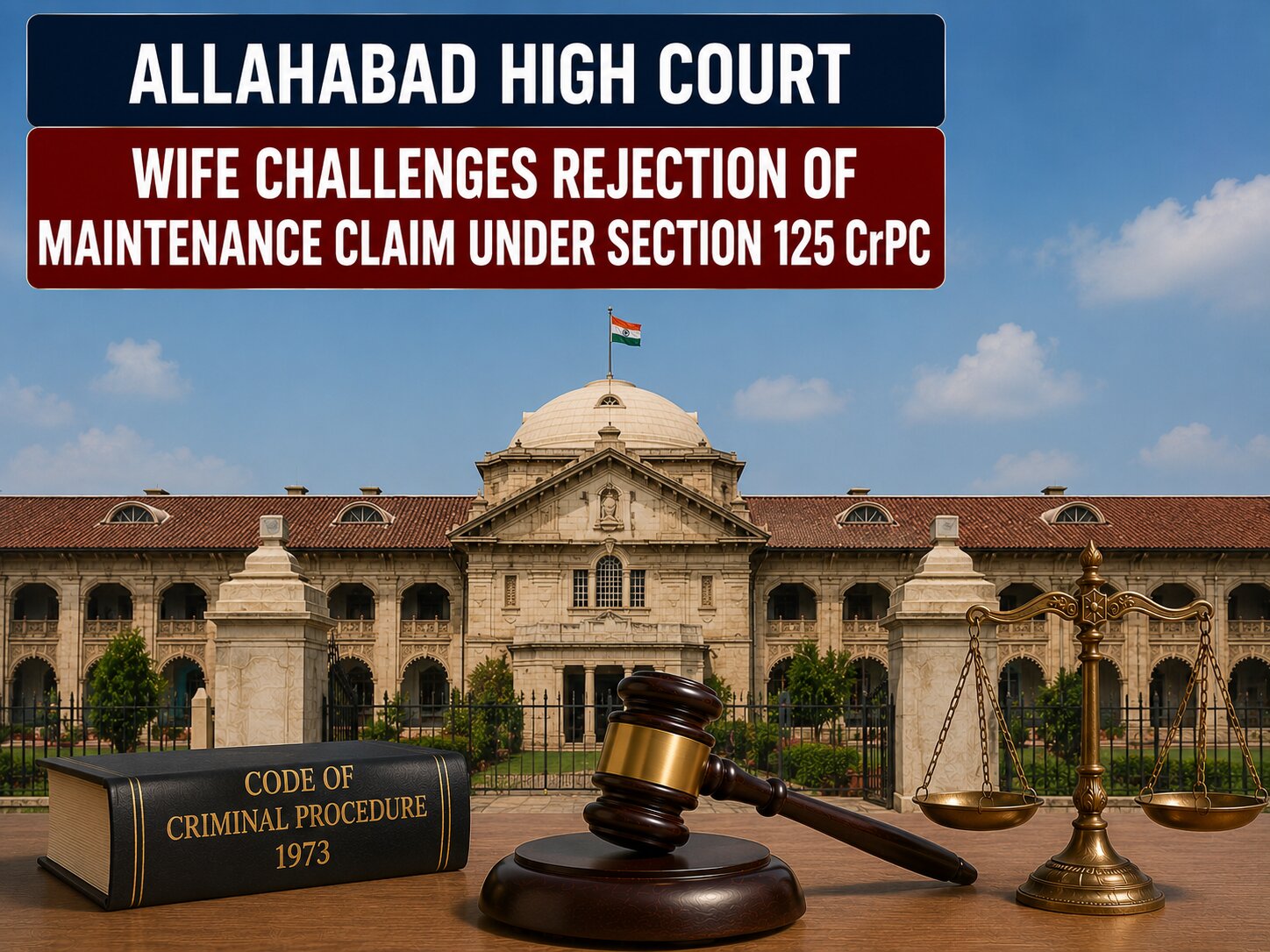
Judgement Details
Court
Allahabad High Court
Date of Decision
10 July 2026
Judges
Justice Achal Sachdev
Citation
Acts / Provisions
Facts of the Case
-
The revisionist-wife filed an application under Section 125 CrPC seeking maintenance for herself and her minor son.
-
She alleged that she and the opposite party had applied for a court marriage in September 2017.
-
According to her, after they started living together, she was subjected to dowry demands, harassment, and physical assault by the husband and his family.
-
She alleged that they demanded a four-wheeler as dowry and ultimately expelled her and the minor child from the matrimonial home.
-
She sought ₹25,000 per month as maintenance for herself and ₹15,000 per month for her son.
-
The opposite party admitted that both had applied for court marriage but contended that the marriage was never formally solemnized.
-
He, however, admitted that they had lived together in his government accommodation at Gorakhpur and that a son was born from their relationship.
-
The Family Court dismissed the wife's claim solely on the ground that she failed to produce documentary proof establishing a valid marriage.
-
The Family Court nevertheless awarded ₹5,000 per month as maintenance to the minor child while describing him as an illegitimate child.
-
Aggrieved by the rejection of her maintenance claim, the wife filed a criminal revision before the Allahabad High Court.
Issues
-
Whether strict proof of a legally valid marriage is mandatory for claiming maintenance under Section 125 CrPC when long cohabitation as husband and wife is otherwise established?
-
Whether the Family Court erred in rejecting the wife's maintenance claim solely for want of documentary proof of marriage despite admissions regarding cohabitation and the birth of a child?
-
Whether a purposive and socially beneficial interpretation of Section 125 CrPC should prevail over a technical approach in maintenance proceedings?
-
Whether a father is legally bound to maintain his child irrespective of whether the child is legitimate or illegitimate?
Judgement
-
The High Court partly allowed the criminal revision petition.
-
The Court set aside the Family Court's order insofar as it rejected the wife's maintenance claim.
-
The Court held that where continuous cohabitation as husband and wife is otherwise established, strict proof of a legally valid marriage should not be insisted upon for the purpose of Section 125 CrPC.
-
The Court observed that the Family Court completely ignored the husband's admissions regarding the parties' cohabitation and the birth of their child.
-
The Court held that maintenance proceedings require a purposive and socially contextual interpretation rather than a rigid technical approach.
-
The Court found that the Family Court's order reflected non-application of mind and mechanical consideration of the evidence.
-
The High Court upheld the direction granting ₹5,000 per month as maintenance to the minor child.
-
The Court reiterated that Section 125 CrPC obligates a father to maintain both legitimate and illegitimate children.
-
The matter was remanded to the Family Court for fresh consideration of the wife's maintenance claim.
-
Both parties were directed to file financial disclosure affidavits in accordance with the Rajnesh guidelines, and the Family Court was directed to decide the matter within three months.
Held
-
The revision petition was partly allowed.
-
Strict proof of a valid marriage is not indispensable where long cohabitation as husband and wife is otherwise established for the purpose of Section 125 CrPC.
-
Maintenance proceedings should receive a purposive and socially beneficial interpretation.
-
The Family Court erred in rejecting the wife's claim solely on technical grounds.
-
The maintenance awarded to the minor child was affirmed.
Analysis
-
The judgment reinforces the beneficial object of Section 125 CrPC, which is intended to prevent destitution and provide social justice rather than determine complicated questions of matrimonial status.
-
By relying upon Badshah v. Urmila Badshah Godse, the Court reaffirmed that maintenance provisions must be interpreted liberally to protect economically vulnerable women.
-
The Court rightly emphasized that long cohabitation and admissions by the respondent may constitute sufficient prima facie evidence of a marital relationship for maintenance proceedings.
-
The decision discourages excessive reliance on technical deficiencies in proof where the factual relationship between the parties is otherwise established.
-
The judgment also highlights the importance of judicial application of mind, criticizing mechanical disposal of maintenance cases.
-
By affirming maintenance for the child irrespective of legitimacy, the Court upheld the statutory protection afforded to children under Section 125 CrPC.
-
The direction to follow the Rajnesh guidelines promotes transparency in determining the financial capacity of the parties and facilitates fair assessment of maintenance.
-
The ruling advances the constitutional values of social justice, dignity, and protection of women and children within family law.