
Suresh Shah Sisodiya v. Jai Prakash Yadav, 2026
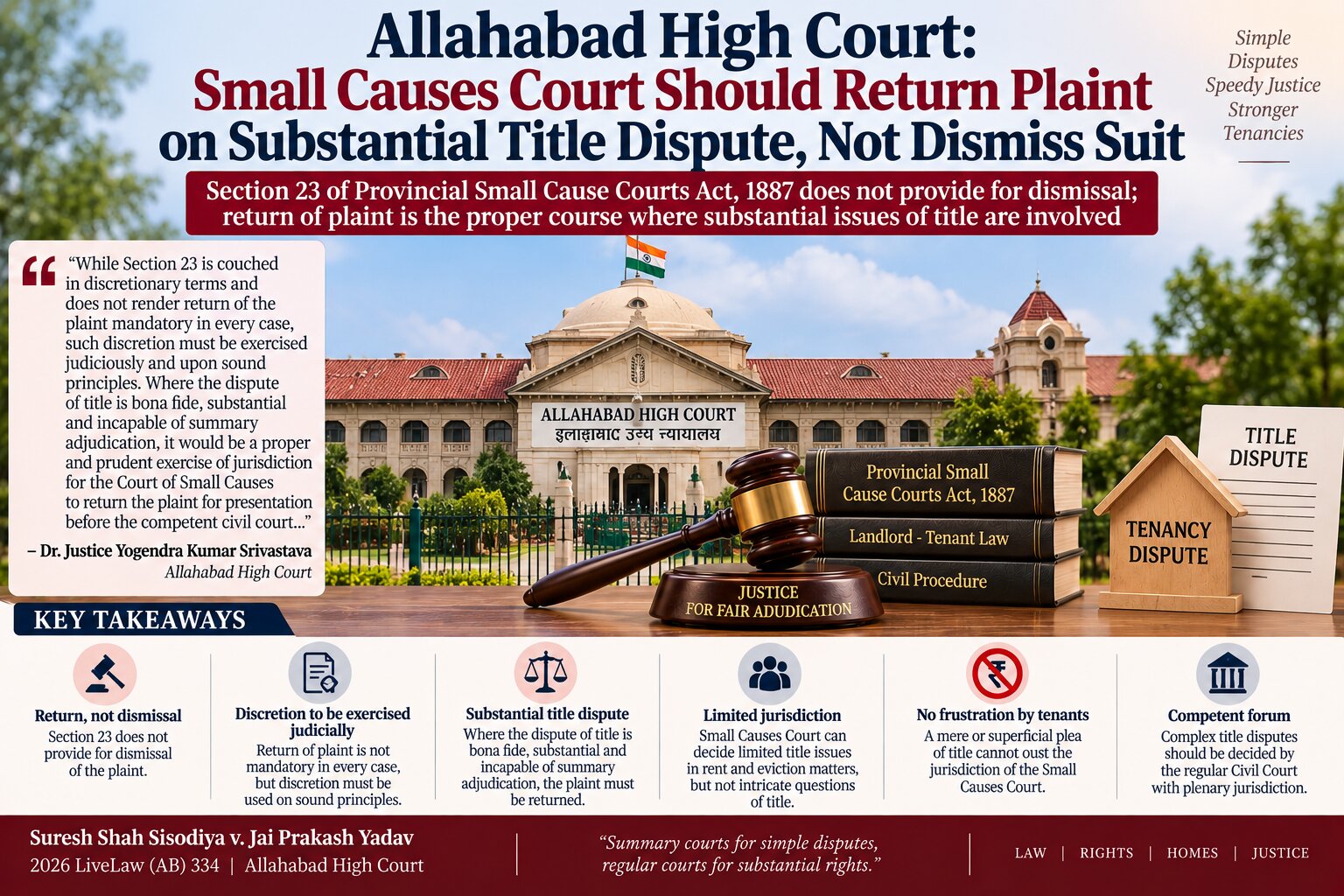
A mere plea of title does not automatically oust the jurisdiction of the Small Causes Court.
Judgement Details
Court
Allahabad High Court
Date of Decision
5 September 2026
Judges
Dr. Justice Yogendra Kumar Srivastava
Citation
Acts / Provisions
Facts of the Case
-
The plaintiff-revisionist had entered into a lease deed concerning the disputed property.
-
The property was already occupied by the opposite party as a tenant.
-
The tenant allegedly committed default in payment of rent.
-
The landlord consequently issued notices seeking eviction of the tenant.
-
As the tenant did not vacate the premises, the landlord instituted an eviction suit before the Court of Small Causes.
-
The tenant disputed the existence of the landlord-tenant relationship between the parties.
-
The dispute raised questions concerning the plaintiff's entitlement and title to the property.
-
The Small Causes Court concluded that the plaintiff had failed to establish the landlord-tenant relationship.
-
The Court also recorded that substantial questions concerning title were involved.
-
Despite recording the existence of substantial title issues, the Small Causes Court dismissed the suit instead of returning the plaint.
-
The plaintiff challenged the dismissal before the Allahabad High Court.
-
The High Court examined the scope and effect of Section 23 of the Provincial Small Cause Courts Act, 1887.
-
The Court considered whether a mere plea of title automatically ousts the jurisdiction of the Small Causes Court.
-
It also examined the proper course where the title dispute is bona fide, substantial and incapable of satisfactory determination within summary proceedings.
-
The High Court held that a superficial or unsubstantial plea of title does not by itself require return of the plaint.
-
However, once the Small Causes Court finds that a substantial and intricate question of title lies at the root of the dispute and cannot be appropriately determined within its summary jurisdiction, Section 23 requires the plaint to be returned for presentation before the competent Civil Court.
-
The High Court accordingly set aside the dismissal and directed the Small Causes Court to return the plaint to the plaintiff.
Issues
-
Whether a mere plea of title by a tenant automatically requires the Small Causes Court to return the plaint under Section 23 of the Provincial Small Cause Courts Act, 1887?
-
Whether the Small Causes Court can adjudicate a limited question of title while deciding an eviction or rent dispute within its summary jurisdiction?
-
Whether the Small Causes Court must return the plaint when a bona fide and substantial question of title is found to be incapable of satisfactory determination within its summary jurisdiction?
-
Whether Section 23 of the Provincial Small Cause Courts Act, 1887 permits dismissal of the plaint after the Small Causes Court concludes that a substantial question of title is involved?
-
Whether the Small Causes Court ought to return the plaint for presentation before the competent regular Civil Court where determination of the landlord's entitlement substantially depends upon adjudication of title?
Judgement
-
The Allahabad High Court allowed the revision and set aside the order of the Small Causes Court.
-
The Court held that Section 23 of the Provincial Small Cause Courts Act, 1887 operates as an important limitation on the summary jurisdiction of the Small Causes Court.
-
The Court clarified that the mere use of the word “may” in Section 23 does not confer an unguided or arbitrary discretion upon the Small Causes Court.
-
The discretion to return the plaint must be exercised judicially and on sound principles.
-
A mere plea of title raised by a defendant does not automatically oust the jurisdiction of the Small Causes Court.
-
The Small Causes Court can consider a limited question of title to the extent necessary for deciding a rent or eviction dispute.
-
However, where the title dispute is real, bona fide, substantial and supported by material, the Small Causes Court must determine whether the controversy can be resolved within its limited summary jurisdiction.
-
Where determination of the plaintiff's entitlement to relief necessarily depends upon adjudication of a substantial and intricate question of title, the appropriate course is to return the plaint.
-
The Court held that Section 23 does not contemplate dismissal of the plaint on the ground that a substantial title dispute exists.
-
Since the Small Causes Court itself had recorded that substantial questions of title were involved, it ought to have returned the plaint rather than dismissing the suit.
-
The High Court therefore directed the Small Causes Court to return the plaint to the plaintiff for presentation before the competent Civil Court.
Held
-
The Small Causes Court may consider title to a limited extent when necessary for deciding a rent or eviction dispute.
-
A tenant cannot defeat summary proceedings merely by raising a superficial or unsubstantial title dispute.
-
Where the title dispute is bona fide, substantial and goes to the root of the landlord-tenant relationship, the Small Causes Court must examine whether it can properly determine the controversy within its summary jurisdiction.
-
If determination of the plaintiff's right to relief necessarily requires adjudication of an intricate and substantial question of title, the plaint should be returned under Section 23.
-
The discretion under Section 23 is judicial discretion, not an unguided discretion.
-
Once the Small Causes Court concludes that substantial questions of title cannot be satisfactorily determined within its jurisdiction, it should return the plaint rather than dismiss it.
-
Section 23 does not provide for dismissal of the plaint on the ground that a substantial title dispute exists.
-
The regular Civil Court, having plenary jurisdiction, is the appropriate forum for determining intricate and substantial questions of title.
Analysis
-
The judgment draws a clear distinction between the summary jurisdiction of Small Causes Courts and the plenary jurisdiction of regular Civil Courts.
-
Small Causes Courts are intended to provide relatively expeditious adjudication of disputes such as rent and eviction matters. They are not ordinarily the forum for conducting an extensive trial concerning complicated questions of ownership and title.
-
At the same time, the Court rejected an overly broad proposition that every allegation of title requires the plaint to be returned. Such an approach could allow defendants to frustrate summary proceedings simply by introducing an unsubstantial title plea.
-
The Court therefore adopted a two-stage approach. First, the Small Causes Court may examine whether the title dispute is genuine and relevant. Second, if the dispute is substantial and cannot be satisfactorily resolved within summary jurisdiction, the plaint must be returned.
-
The judgment clarifies the meaning of the word “may” in Section 23. Although the provision is expressed in discretionary language, that discretion must be exercised according to judicial principles and the nature of the controversy.
-
The Court also recognised that some consideration of title is unavoidable in landlord-tenant litigation. For example, determining whether a person has the status necessary to maintain an eviction claim may require a limited examination of the underlying title.
-
However, such limited examination is fundamentally different from conducting a full-fledged adjudication of complex ownership rights.
-
The crucial consideration is therefore not simply whether title has been mentioned, but whether the plaintiff's right to the relief sought is substantially dependent upon resolution of a complicated title dispute.
-
The High Court's conclusion that dismissal was improper is particularly significant. Once the Small Causes Court had itself recorded that substantial title questions existed, the appropriate procedural consequence under Section 23 was return of the plaint, not dismissal on merits.
-
Returning the plaint preserves the plaintiff's ability to present the dispute before the court possessing the necessary jurisdiction to decide the title question.
-
The ruling also prevents the summary jurisdiction of the Small Causes Court from becoming a mechanism for conclusively deciding matters that require the broader evidentiary and jurisdictional powers of a regular Civil Court.
-
The decision therefore establishes a balance between preventing abuse of summary proceedings by artificial title pleas and protecting the jurisdiction of regular Civil Courts over substantial title disputes.
-
The judgment is particularly relevant to landlord-tenant litigation where the existence of the tenancy itself depends upon the determination of competing claims concerning ownership or title.