
Suniti @ Sunita Patnaik v. Sajjan Kumar Agrawal, 2026
A Section 138 NI Act complaint can be maintained against the trustee who signed the dishonoured cheque.
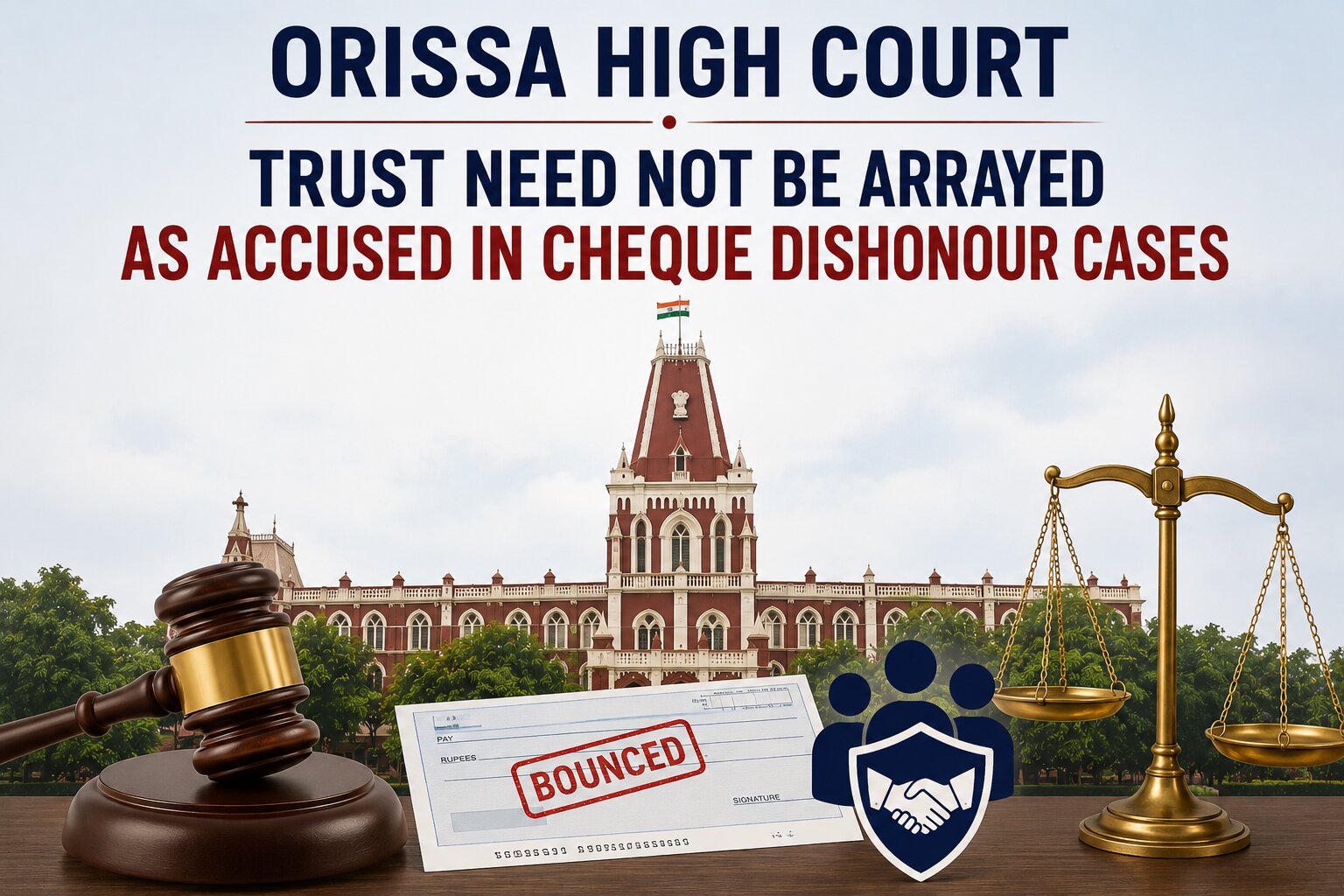
Judgement Details
Court
Orissa High Court
Date of Decision
1 August 2026
Judges
Justice Sibo Sankar Mishra
Citation
Acts / Provisions
Facts of the Case
-
The opposite party allegedly supplied hardware materials worth ₹22,42,145 on credit.
-
It was agreed that the outstanding amount would be paid within two months.
-
The petitioner issued a cheque towards payment of the outstanding dues.
-
The cheque was drawn from the bank account of a trust.
-
The cheque was subsequently dishonoured for insufficiency of funds.
-
The complainant issued a statutory demand notice, but the notice was returned undelivered.
-
Thereafter, the complainant instituted proceedings under Section 138 of the NI Act.
-
The SDJM, Dharamgarh found prima facie material and took cognizance against the petitioner and the co-accused.
-
The petitioner approached the High Court under Section 482 CrPC, seeking quashing of the cognizance order and criminal proceedings.
-
The principal argument was that the transaction was with the trust and the cheque had been issued from the trust's account.
-
It was contended that the trust itself had not been arraigned as an accused.
-
The petitioner therefore argued that the Section 138 complaint was not maintainable.
-
Reliance was placed on the earlier Orissa High Court decision in Bijaya Manjari Satpathy v. State of Orissa.
-
The High Court examined the subsequent Supreme Court ruling in Sankar Padam Thapa v. Vijaykumar Dineshchandra Agarwal.
Issues
-
Whether a complaint under Section 138 of the Negotiable Instruments Act is liable to be quashed merely because the trust from whose bank account the cheque was issued has not been arraigned as an accused?
-
Whether prosecution under Section 138 of the Negotiable Instruments Act is maintainable against a trustee who has signed and issued the dishonoured cheque on behalf of the trust without impleading the trust as an accused?
-
Whether the earlier legal position relied upon by the petitioner continues to apply after the Supreme Court's subsequent ruling concerning prosecution of trustees in cheque dishonour cases?
-
Whether the High Court should exercise its inherent jurisdiction under Section 482 CrPC to quash the criminal proceedings against the trustee on the ground of non-impleadment of the trust?
Judgement
-
The Orissa High Court dismissed the petition filed under Section 482 CrPC.
-
The Court held that the complaint under Section 138 NI Act was maintainable against the trustee who had signed the dishonoured cheque.
-
The Court relied heavily upon the Supreme Court's decision in Sankar Padam Thapa v. Vijaykumar Dineshchandra Agarwal.
-
The Supreme Court had held that where the cause of action arises from dishonour of a cheque, proceedings under the NI Act can be maintained against the trustee who signed the cheque without necessarily arraigning the trust as an accused.
-
The High Court held that the Supreme Court's ruling directly applied to the present dispute.
-
The Court rejected the argument that non-impleadment of the trust made the complaint fundamentally defective.
-
The Court held that the petitioner could not rely upon earlier decisions that proceeded on a contrary legal position.
-
The Court noted that the Supreme Court had expressly held that the contrary view in decisions including Bijaya Manjari Satpathy did not lay down the correct law and had been overruled.
-
The Court found no error in the order by which the Trial Court had taken cognizance.
-
Consequently, the criminal proceedings were not quashed.
Held
-
The trust itself need not necessarily be impleaded as an accused in the circumstances governed by the Supreme Court's ruling relied upon by the High Court.
-
Non-impleadment of the trust does not, by itself, make the complaint fundamentally defective.
-
The Supreme Court's subsequent interpretation prevails over earlier contrary decisions.
-
The High Court found no ground to exercise its inherent jurisdiction under Section 482 CrPC.
-
The petition seeking quashing of the proceedings was therefore dismissed.
Analysis
-
Supreme Court precedent: The decisive factor was the Supreme Court's ruling in Sankar Padam Thapa, which the High Court treated as directly governing the controversy.
-
Trustee's liability: The judgment recognizes that a trustee who issues and signs a cheque on behalf of a trust may be proceeded against for cheque dishonour without the trust necessarily being made an accused.
-
Effect of later precedent: The Court made it clear that an earlier High Court decision cannot be relied upon when the Supreme Court has subsequently clarified the applicable legal position.
-
Section 482 CrPC: The inherent jurisdiction of the High Court is not intended to be exercised merely because the accused disputes the maintainability of the complaint. Quashing is justified only where the proceedings suffer from a legally sustainable defect.
-
Cheque dishonour proceedings: The decision strengthens the ability of complainants to pursue Section 138 proceedings against the person who actually issued and signed the cheque on behalf of the trust.
-
Overruling of contrary view: The High Court specifically noted that the earlier contrary decisions, including Bijaya Manjari Satpathy, could no longer provide a basis for quashing after the Supreme Court's later authoritative ruling.
-
Impact on existing law: The judgment reinforces the Supreme Court's clarified position regarding the prosecution of trustees in cheque dishonour matters and limits reliance on the earlier contrary approach.
-
Practical significance: A trustee cannot automatically seek termination of Section 138 proceedings merely by arguing that the trust was not separately arraigned as an accused, where the applicable Supreme Court precedent permits prosecution against the trustee who signed the cheque.