
Sunil Dnyandev Kamble v. Ramesh Anandrao Bagwe, 2026
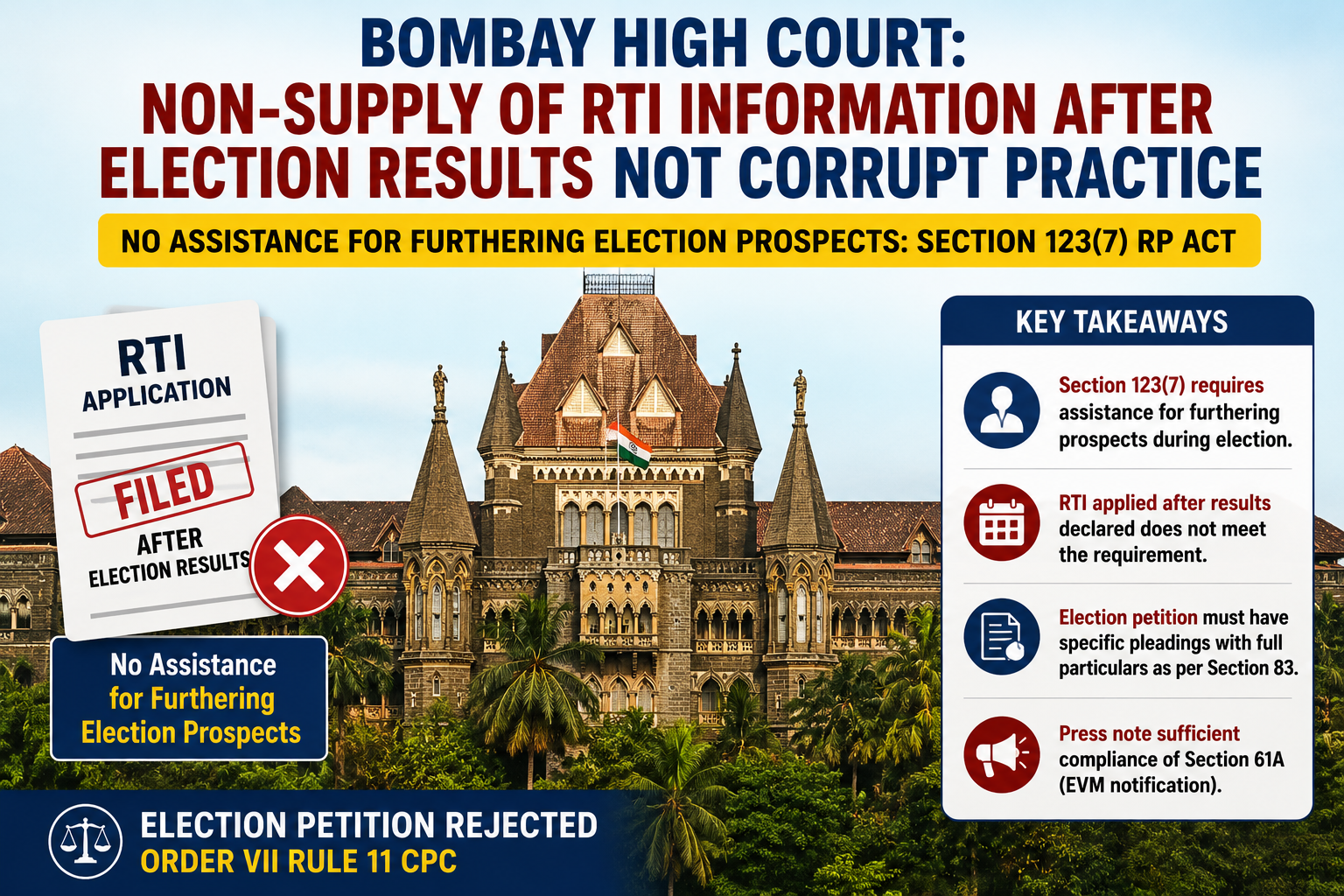
Non-supply of RTI information after declaration of election results is not assistance for furthering a candidate's election prospects.
Judgement Details
Court
Bombay High Court
Date of Decision
21 August 2026
Judges
Justice Sharmila U. Deshmukh
Citation
Acts / Provisions
Facts of the Case
-
The election petition challenged the election of a candidate from the 214 Pune Cantonment Legislative Assembly Constituency in the 2024 election.
-
The petitioner alleged, among other things, that a corrupt practice under Section 123(7) of the RP Act had been committed.
-
The allegation was based partly on the alleged non-supply of information sought through an RTI application.
-
The election results were declared on November 23, 2024.
-
The RTI application was submitted on November 27, 2024, i.e. after declaration of the election results.
-
The petitioner alleged that information relating to the election was not supplied.
-
The petitioner sought to connect this non-supply of information with the alleged corrupt practice.
-
Allegations concerning EVM tampering were also raised.
-
The returned candidate sought rejection of the election petition under Order VII Rule 11(a) CPC.
-
It was argued that the petition did not contain the material facts and particulars necessary to establish a cause of action under Section 83 of the RP Act.
-
The Court also examined whether the requirements of Section 61A concerning voting machines had been complied with.
Issues
-
Whether non-supply of information under the RTI Act after declaration of election results constitutes assistance for furthering the prospects of a candidate's election under Section 123(7) of the Representation of the People Act, 1951?
-
Whether an allegation of non-supply of RTI information after declaration of election results can constitute a corrupt practice under Section 123(7) of the Representation of the People Act, 1951?
-
Whether an election petition alleging corrupt practice must specifically plead the material facts, persons involved, date, place and nature of the alleged assistance as required under Section 83 of the RP Act?
-
Whether the allegation of EVM tampering, without specific factual particulars, is sufficient to constitute a cause of action for challenging an election?
-
Whether issuance of a press note regarding the use of voting machines satisfies the requirement under Section 61A of the Representation of the People Act, 1951?
-
Whether the election petition was liable to be rejected under Order VII Rule 11(a) CPC for failure to disclose a legally sustainable cause of action?
Judgement
-
The Bombay High Court allowed the application under Order VII Rule 11 CPC.
-
The Court rejected the election petition.
-
It held that the alleged non-supply of RTI information occurred after the election results had already been declared.
-
Therefore, such non-supply could not constitute assistance obtained for furthering the prospects of a candidate's election.
-
The Court emphasized that Section 123(7) concerns assistance connected with furthering the prospects of the candidate's election.
-
The RTI application was made on November 27, 2024, whereas the election results had already been declared on November 23, 2024.
-
Consequently, the alleged refusal to provide information could not logically have furthered the candidate's electoral prospects.
-
The Court also found that the election petition did not adequately explain how the alleged RTI refusal constituted assistance to the returned candidate.
-
Section 83 requires detailed and specific pleadings when corrupt practice is alleged.
-
The petition lacked the necessary particulars regarding the alleged corrupt practice.
-
The Court also rejected the challenge based on Section 61A, holding that a press note was sufficient compliance and that a separate notification was not mandatory.
-
The vague allegations concerning EVM tampering were also insufficient to establish a legally sustainable cause of action.
-
The election petition was consequently rejected.
Held
-
Such conduct therefore does not constitute corrupt practice under Section 123(7) on the facts alleged.
-
An election petition alleging corrupt practice must contain specific and complete particulars as required by Section 83.
-
Merely making a general allegation of corrupt practice is insufficient.
-
The petitioner must demonstrate the nature of the assistance, the persons involved and the circumstances in which the assistance allegedly furthered the candidate's electoral prospects.
-
Vague allegations of EVM tampering cannot independently establish a cause of action.
-
A press note can satisfy the requirement of Section 61A concerning notification of elections through voting machines.
-
Where an election petition fails to disclose material facts constituting a cause of action, it can be rejected under Order VII Rule 11(a) CPC.
Analysis
-
Temporal connection is essential: The Court's reasoning rests significantly on timing. Assistance under Section 123(7) must have a connection with furthering the candidate's electoral prospects. Information sought after results were declared could not ordinarily advance those prospects.
-
Corrupt practice requires strict pleading: Election disputes involving allegations of corrupt practice are treated seriously. Section 83 requires precise pleadings rather than broad or speculative allegations.
-
Post-election conduct: The judgment draws an important distinction between conduct occurring during the electoral process and conduct occurring after the election has concluded.
-
RTI refusal is not automatically electoral assistance: A refusal by a public authority to provide information may potentially give rise to remedies under the RTI framework, but that does not automatically transform the refusal into a corrupt practice under election law.
-
Causal connection: The petitioner was required to demonstrate a connection between the alleged assistance and the candidate's election prospects. The Court found this connection missing.
-
EVM allegations: Allegations concerning EVM tampering must be supported by concrete factual material. A general allegation without specific particulars is insufficient to sustain an election challenge.
-
Section 61A: The Court adopted a practical interpretation of the requirement concerning voting machines, holding that a press note could amount to sufficient compliance rather than insisting upon a separate formal notification.
-
Order VII Rule 11: The decision demonstrates that an election petition can be terminated at the threshold where the pleadings themselves fail to disclose a legally recognizable cause of action.
-
Importance for election litigation: The ruling reinforces that an election petition is not an ordinary civil proceeding where vague allegations can be expanded through evidence later. Material facts and particulars must be pleaded at the outset.
-
Overall significance: The judgment emphasizes specific pleading, causal connection and timing when allegations of corrupt practice are made under the Representation of the People Act.